“Nine Lives” by Ursula K. Le Guin

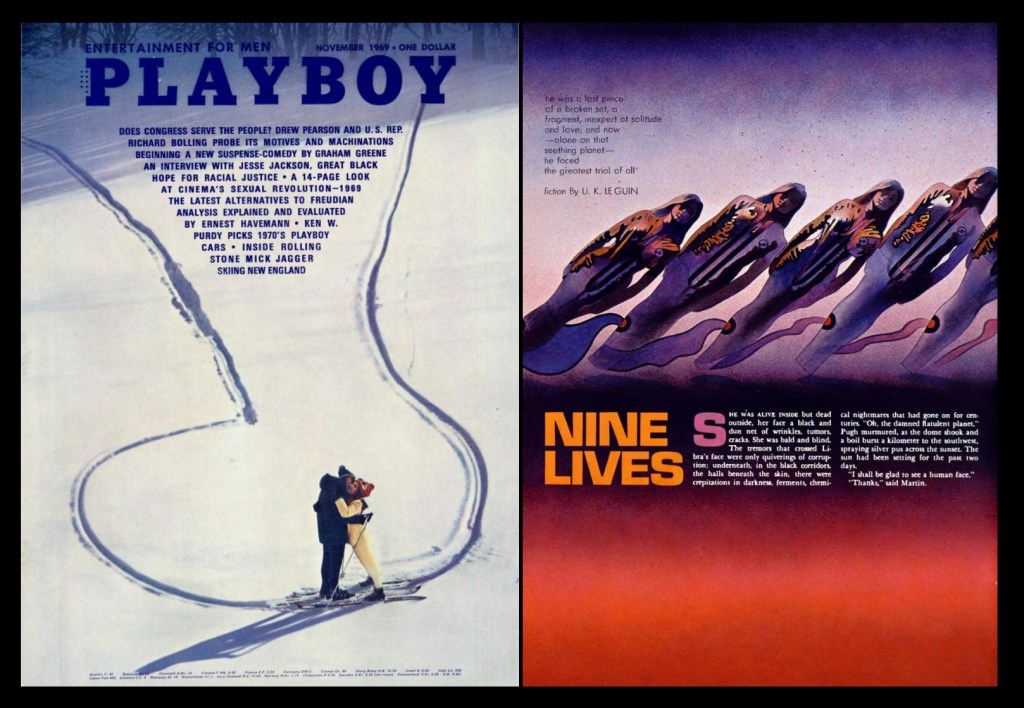
Nine Lives” by Ursula K. Le Guin is story #31 of 52 from The World Treasury of Science Fiction edited by David G. Hartwell (1989), an anthology my short story club is group reading. Stories are discussed on Tuesdays, Thursdays, and Saturdays. “Nine Lives” was first published in Playboy (November 1969). This story has been reprinted an amazing number of times, and translated into several languages. And it has 13 citations in the CSFquery database.

“Nine Lives” is about two experienced planetary explorers, Martin and Pugh stationed at the Libra Exploratory Mission Base who are about to be relieved. Before they can, they must help a new crew from the Passerine, and Exploit Team, settle in to start mining the planet. Martin and Pugh are surprised when the mining crew turns out to be a 10-person clone — five men and five women. The clones look very much alike, work and play together as a tight unit, and pretty much ignore the old-timers. Then there is an accident, and 9 of the 10 clones are killed. The story is about the singleton struggling to survive as an individual.

Strangely, Le Guin uses up most characterization development on Martin and Pugh. I was hoping to know more about being a clone, instead, it’s really Martin and Pugh’s story.

“Nine Lives” is well done but it didn’t have the impact for me that “The Ones Who Walk Away From Omelas” or even “The Day Before the Revolution” or “Vaster Than Empires and More Slow” did. I’m used to Le Guin making a big social, political, or philosophical statement, and I just didn’t get one from “Nine Lives.”

I guess we’re supposed to contemplate the idea of clones, and in particular, the idea of a clone group. Clones don’t interest me. A DNA replica won’t be a replica of a person. I suppose ten cloned brothers and sisters should be more interesting than the Dionne quintuplets but I didn’t find that so.

I tried to imagine living with nine copies of myself and that produced a very weird sensation. Maybe I need to think about that for a while to really get into the story. In “Nine Lives” the ten clones form a utopian relationship. I’m not sure I’d get along so well with people like me.

There’s another story that explores this idea in a variant way, The Man Who Folded Himself by David Gerrold. It’s about a time traveler who gets together with different versions of himself. In both stories, all the selves get along, but I don’t know if that would be true. I might bring out the worst in myself. I’m pretty sure my wife wouldn’t want ten of me.

However, as a kid, I always wished I had been a twin. I wonder if “Nine Lines” would have had a greater emotional impact on me if there had only been two clones. It’s logical to have ten for a group of workers, but it would have been easier to relate to if the story was only about a pair. And in the story, the clones tended to pair off and work together.

David Hartwell liked “Nine Lives” so much that he included it in another one of his giant retrospective anthologies of science fiction, The Ascent of Wonder.

I think this story is for people who wish they had more friends like themselves.

James Wallace Harris, 7/16/23

A Time Before Science Fiction

I believe young people can’t imagine what life was like before the Internet, smartphones, or personal computers. I can’t imagine what my parents’ lives were like living before television, or my grandmother’s life before airplanes, cars, radios, movies, and all the inventions that my parents grew up with. My mother’s mother was born in 1881.

Lately, I’ve been trying to imagine what life was like before science fiction. There have always been stories that had science-fictional elements. Isn’t Noah’s Ark really a post-apocalyptic tale? I’m talking about science fiction as a defined category, a genre.

Life Magazine had to explain science fiction to its readers in its May 21, 1951 issue. It covered books, magazines, movies, and even fandom. Science fiction as a term had been used for the genre for about twenty years before that, but mainly in pulp magazines, and with a very small group of Americans. It’s like how the internet and network computers were used by a small subset of the population for a couple decades before the public was introduced to the World Wide Web with Mosaic in 1993. (See my essay: “When Mainstream America Discovered Science Fiction.”)

I’m theorizing it was the paperback book that got America to discover science fiction. The technology of the mass-market paperback was like when the technology of the Netscape browser got America to discover the World Wide Web.

I consider the science fiction pulp magazines of 1926-1950 to be like the internet before the World Wide Web when few people used it and all the tools were text-based. In the late 1940s and early 1950s science fiction fans created small-press publishing houses to reprint pulp magazine science fiction stories in hardback. Print runs were typically 1,500-3000, and the books were sold mainly to fans, and some libraries. I consider this era to be like the short-lived Gopher technology on the internet. (See my essay: “Remember Fantasy Press, Arkham House, Primes Press, Gnome Press, Shasta Publishers, and Others.”)

My guess is the American public noticed science fiction when science fiction movies came out in the early 1950s and when Ballantine Books, Ace Books, Pocket Books, and others brought out lines of paperback books devoted to science fiction in 1953. Movies were everywhere, and twirling paperback racks were everywhere. By the way, there was a time before mass-market paperbacks. Paperbacks as we know them began appearing in the late 1930s, were widely distributed to soldiers during WWII, and exploded on the scene in the early 1950s. Read Two-Bit Culture: The Paperbacking of America by Kenneth Davis for an excellent history of the paperback.

My guess is if you asked the average American what science fiction was before 1950 most would not know, and some might say when you mentioned space travel, “You mean that Buck Rogers stuff?” My parents grew up before science fiction. I was born in 1951, and I didn’t understand the term until 1963 when I was eleven. I had encountered plenty of science fiction on television, but I didn’t think of it as a specialized subject, genre, or art form. I didn’t go to a new bookstore until 1967 when I was 16. My first bookstores were all used bookstores, and I didn’t discover them until 1965.

Even though I was born in 1951, after the time I said was the beginning of the time when the American public started to think of science fiction as a thing, I didn’t learn it myself until 1963, and even then I had to figure it out on my own. It wasn’t until 1964 that I discovered science fiction sections in libraries. Because I had trouble comprehending science fiction as a genre in 1963 at age 11, I imagine many people in the 1950s and 1960s still didn’t comprehend it fully either.

I don’t think it was until the 1970s, when shopping malls became common, and chain bookstores were popping up everywhere, that the public began to see science fiction book sections. The used and new bookstores I shopped at in the 1960s had science fiction sections, but the bookstores were tiny, and the science fiction sections were really just two or three shelves of books. Before March 1967 I had no friends who read science fiction. That’s when I met my lifelong friend Jim Connell. Before that, the only science fiction fan I met was on a Greyhound Bus, when I struck up a conversation with a soldier.

I have to wonder what the average American thought when they saw Destination Moon in 1950 or The Day the Earth Stood Still in 1951? Was it mind-blowing? Or just silly kid stuff? I remember talking to my grandmother in 1968 about the space program and the planned Moon landing. She said it wouldn’t happen, that God would stop it.

It’s hard for me to imagine life before I was born in 1951. I think it’s harder for anyone growing up in the 21st century. We get our conception of life before 1950 in old movies, mainly ones in black and white. And think about it — have you ever seen any character in any of those old movies ever mention science fiction, or even talk about a science-fictional subject?

It was a different world back then. A much different world. A world most of us can’t comprehend. But try to imagine people of different ages visiting a drugstore back in 1953 and finding these books on a twirling rack. Especially, people who lived in small towns and suburbs. Imagine young kids, working-class men, and young housewives. What would they think if they picked up one of these books? And what would it do if they bought one, took it home, and read it?

When I read Red Planet by Robert A. Heinlein in 1964 when I was twelve, that was when I knew science fiction was my genre. I was a convert. Even by 1964, the percentage of science fiction converts in the American population was very small. And the conceptual umwelt I experienced from reading that 1949 book in 1964 must have been far different from the mind-expanding experiences of twelve-year-olds reading it in 1949, or even what Heinlein felt writing it. When did you discover science fiction as a genre, and what was the book that converted you?

I picked 1953 as the year America discovered science fiction because that’s when Ballantine Books and Ace Books began publishing science fiction, and near the beginning of the general paperback boom. Science fiction paperbacks existed before 1953, but they were much fewer. 1953 was also a boom year for science fiction magazines. (See my essay: The 1953 SF&F Magazine Boom.)

I wrote this essay because I’m learning that the umwelt of every person is different. Not only for how we perceive reality but how our biological sensory inputs lead to comprehending different abstract concepts. We have a tendency to assume everyone sees and knows what we know, and that’s so wrong. What’s amusing me to contemplate is thinking about how we perceive things at different ages and in different generations. Science fiction is just one example. What’s weird to grasp is authors work to code their umwelt into a story but the umwelt the reader decodes isn’t the same. I wish I could have gotten my parents and grandparents to read one of my favorite science fiction books when I was a kid and then ask each of them how they interpreted it.

James Wallace Harris, 7/15/23

“Zero Hour” by Ray Bradbury

Zero Hour” by Ray Bradbury is story #30 of 52 from The World Treasury of Science Fiction edited by David G. Hartwell (1989), an anthology my short story club is group reading. Stories are discussed on Tuesdays, Thursdays, and Saturdays. “Zero Hour” was first published in Planet Stories (Fall 1947). The most famous place to read it is in Bradbury’s classic, The Illustrated Man.

I thought as I was reading “Zero Hour” this morning, “Hey, here’s a Bradbury story I haven’t read before!” Yesterday, I bought Bradbury Stories: 100 of His Most Celebrated Tales for $1.99 for the Kindle edition so I’d have his stories on my phone. That worked out well since I decided to read “Zero Hour” at 5:30am this morning while I was still in my sleeping chair. I love having a library that’s always with me.

But when I checked ISFDB.org I realized I’ve read it at least two times before. I read The Illustrated Man in 1969 when the movie version came out. I might have read it again when I bought The Illustrated Man on audio. And I read it when I read The Great SF Stories 9 (1947). Two definite times, maybe a third.

So, why didn’t I remember reading it this morning? It’s a wonderful story. “Zero Hour” has a very similar ending to “The Veldt” which is also in The Illustrated Man, and that’s a story I always remember. Maybe “The Veldt” just hogged those neurons allocated to Bradbury.

“Zero Hour” is about a little girl, Mink, under 10, who her mother thinks has an imaginary friend — a Martian. The story is told from the point of view of the mother, Mrs. Morris, watching Mink and her friends play outside. Mrs. Morris interviews Mink about the game when Mink comes in for lunch. It’s called “Invasion.” Mrs. Morris learns from Mink that only kids under 10 can play because older kids are too critical. Bradbury has often written about the enchanting time of childhood when believing was real.

I don’t want to say any more, because I don’t want to spoil your enjoyment of reading this wonderful little story.

I’ve always admired Ray Bradbury, especially when I was young. However, I never considered him a regular science fiction writer. He was always a horse of a different color. Bradbury’s sense of science is on the magic side of the spectrum. Ray Bradbury is closer to L. Frank Baum than Robert A. Heinlein. Bradbury seemed old even when he was young.

Ray Bradbury was born nostalgic. Mentally, he seemed to live in the 1930s or earlier. Even though he became famous for writing about rockets and space travel, it was from a nostalgic perspective, and not from being futuristic.

“Zero Hour” is a beautiful story about childhood and motherhood. It may have Martians invading Earth, it may have children who kill their parents, and it may have futuristic gadgets, but it’s really a view of Norman Rockwell’s America in the 1930s. Buck Rogers shaped his future, not Heinlein. Sure, “Zero Hour” has the twisted humorous horror of Charles Adams and Gahan Wilson, but essentially it’s a story about being a child of wonder.

My guess is I didn’t remember “Zero Hour” because Bradbury was prolific and many of his stories were similar in theme, so they blur together. However, after reading “Zero Hour” I wanted to read the other 99 Bradbury stories in that collection.

James Wallace Harris, 7/13/23

Which Writers Would Be Included In A Group Biography/History of 1950s Science Fiction?

The World Beyond the Hill by Alexei and Cory Panshin and Astounding Alec Nevala-Lee were two huge histories of science fiction in the 1940s. Both books focused on the magazine Astounding Science-Fiction, where John W. Cambell was a genre-shaping editor. The Panshins concentrated on three writers: Heinlein, Asimov, and van Vogt, while Nevala-Lee dwelt on Heinlein, Asimov, and L. Ron Hubbard. The Panshins volumes were more about the stories, with some biographical details. Nevala-Lee spent more words on the biographies of the four men, with less prose about their stories. Combined, the two volumes make a great overview of Astounding Science-Fiction in the 1940s.

What if a similar group biography/history was written about science fiction in the 1950s? I already own a bookcase full of books about science fiction but they aren’t the kind I want. The book I ache to read is a biography/history on the impact of science fiction in the 1950s that’s as impressive as biographies/histories written by Walter Isaacson, Robert A. Caro, or Doris Kerns Goodwin. I want to read a biography/history that would make the subject interesting to the general reader. I just finished Tune In by Mark Lewisohn, a giant history of The Beatles that only covered their career until 1962. That’s the kind of high-quality biography/history of 1950s science fiction I want to read.

Alec Nevela-Lee’s biographies approach that league. He could write the book I want, but I don’t think he would because he probably knows the market for such a volume isn’t very big. And I wonder if science fiction fans would want a history of science fiction in the 1950s by him. His books Astounding and Inventor of the Future were hard on his subjects. I thought them honest appraisals, but he may have done in John W. Campbell’s reputation, and he didn’t help Heinlein’s or Asimov’s. I ended up feeling Buckminister Fuller was brilliant but not very successful, and a bit of a nut or crank after reading Inventor of the Future. However, any honest biography of the influential science fiction writers of the 1950s is going to unearth some worms.

The whole phenomenon of science fiction in the 1950s could be fascinating to the general reader if it was written in the right way. Look how pervasive science fiction has become. Science fiction as a subculture actually had a far more lasting cultural impact than The Beats in the 1950s and The Hippies in the 1960s, yet those movements are more studied and written about. Organized science fiction fandom has since inspired many other forms of organized fandoms. There are connections between science fiction and the space program and computers, both of which also started in the 1950s. And as a pop culture art, science fiction might be bigger than rock. Rock music is fading, while science fiction is still big business.

So, who were the movers, shakers, and creators of 1950s science fiction? I don’t think the major players are as obvious as they were in the 1940s.

As a science fiction fan back in the 1960s I was commonly told that Heinlein, Asimov, and Clarke were the Big Three Authors of science fiction. Looking at our CSFquery database, which uses various forms of citations to remember short stories and novels, I’m not sure it backs up that common knowledge. Look at the results. I’ve set the citation level at 3 or more citations. (Short stories are within double quotes, and novels are italicized. Clicking on the number of citations will show you the individual citations.)

The three writers with the most citations were Heinlein with eleven, and Bradbury and Asimov with eight each. However, some of those cited stories first appeared in the 1940s. After that, three authors have six titles on the list: Alfred Bester, C. M. Kornbluth, and Fritz Leiber.

Before looking at this data, I would have said Philip K. Dick, Alfred Bester, John Wyndham, and Walter M. Miller, Jr. were the breakout science fiction authors of the 1950s. Another indication of their popularity is how many photographs I can find of these men, especially ones taken in the 1950s. I’m guessing since photographs are hard to find, then details about their lives will be just as hard to find. That suggests any history of science fiction that focuses on anyone other than Heinlein, Bradbury, and Asimov will be covering events in the shadows of history.

If we alter the search to allow any work with two or more citations we see other authors standing out, but I’m not sure if it would change the overall apparent rankings. Thirteen women writers are on this list, but none have very many stories listed. I’m afraid the 1950s was still a male-dominated decade for science fiction.

And what about editors? Many histories of science fiction claim that John W. Campbell wasn’t as influential in the 1950s. But who was then? H. L. Gold at Galaxy is often mentioned. Anthony Boucher, and maybe J. Francis McComas at The Magazine of Fantasy and Science Fiction. There were dozens of science fiction magazines published during the 1950s, and I’m not sure if any other editor stood out. But then I haven’t researched it. However, I would say the 1950s were still a magazine-driven era for science fiction.

The Panshins and Nevala-Lee had Astounding Science-Fiction to anchor their history/biographies of the 1940s. The Magazine of Fantasy and Science Fiction, Galaxy, and Astounding Science Fiction dominated the 1950s, but there were many other magazines that published significant science fiction and influenced the genre. I don’t know if a history of science fiction of the 1950s could be as focused as The World Beyond the Hill and Astounding. The genre just exploded in too many different directions.

The small press or fan press science fiction publishers of the 1950s are legendary, especially to collectors, but I don’t know if any of their editors had that much influence. I would think the editors at Doubleday and the Science Fiction Book Club could be a consideration if I knew who they were. Another consideration is Donald A. Wollheim. His work at Ace Books was both influential and widespread.

If a single volume could be written about science fiction in the 1950s it might need to be divided into twelve chapters, one for each year, or into 120 chapters, based on the months. A linear progression through the decade might be the best way to capture the history of science fiction in the 1950s. And the book would have to be big, maybe a thousand pages.

There is one significant book about science fiction history in the 1950s that I know about, Transformations: The Story of the Science Fiction Magazines – From 1950 to 1970 by Mike Ashley. I have quite a few other books that cover that era in science fiction, but none are of the scope I’m talking about. I wish Ashley’s books were available in cheap Kindle editions so more people would read them.

And should we also add the impact of the movies and television? Should we consider George Pal and Rod Serling as movers and shakers of 1950s science fiction, for this book I want to read? An Astounding-like biography/history of science fiction in the 1960s would include Gene Roddenberry and one for the 1970s would have to include George Lucas and Steven Spielberg.

I wish I had the skill and stamina to write a history of science fiction in the 1950s. I’m in awe of the work done by the Panshins and Nevala-Lee. I would love to read a book about 1950s science fiction like I’ve described, so if you’re a writer looking for a topic, here’s one. I don’t know how many copies it would sell. Sadly, the audience for such a history is getting old and dying. I wrote this essay to gauge interest in such a book, but I’m not finding much so far. However, a good biographer can make any person or topic into a page-turner.

James Wallace Harris, 7/11/23

“The Hurkle is a Happy Beast” by Theodore Sturgeon

The Hurkle is a Happy Beast” by Theodore Sturgeon is story #29 of 52 from The World Treasury of Science Fiction edited by David G. Hartwell (1989), an anthology my short story club is group reading. Stories are discussed on Tuesdays, Thursdays, and Saturdays. “The Hurkle is a Happy Beast” appeared in the very first issue of The Magazine of Fantasy and Science Fiction (Fall 1949) when it had the title The Magazine of Fantasy.

“The Hurkle is a Happy Beast” is a cute story about a creature from another dimension thrown onto Earth. The Hurkle is blue, has six legs, and is kitten-like. It follows a theme of things discovered by humans in the present that come from other times and dimensions, however, it’s not up to the classics of this theme like “Mimsy Were the Borogoves,” “The Twonky,” or “The Little Black Bag.”

Even though “The Hurkle is a Happy Beast” is a slight effort by Sturgeon, it has been often reprinted. However, our discussion group wondered why Hartwell selected a second story by Sturgeon for The World Treasury of Science Fiction. It definitely wasn’t one of Sturgeon’s better efforts.

This listing from CSFQuery shows Sturgeon’s most recognized short stories. If Sturgeon deserved two stories in this monumental anthology, I would have picked “Thunder and Roses” or “A Saucer of Loneliness” because their lengths were close to “The Hurkle is a Happy Beast.” But why give Sturgeon two stories. Wasn’t there a better option from 1949?

Well, not exactly. However, my guess is Hartwell wanted to lighten things up by using Hurkle. To me, the obvious substitute for a cute science fiction story with an animal would be “Bears Discover Fire” by Terry Bisson, unfortunately, it came out the year after Hartwell’s anthology. Another possibility is “The Ugly Chickens” by Howard Waldrop, it came out in 1980, so it was available. Or maybe “The Star Mouse” by Fredric Brown?

“The Hurkle is a Happy Beast” is not a bad story. It’s cute enough, but it’s lightweight. This got me thinking about being a science fiction writer in 1949 and having to crank out short stories to make a living. Imagine sitting at a typewriter and knowing your survival depends on your writing a story that will impress editors and readers. I doubt Theodore Sturgeon was thinking he needed to hit one out of the park for future editors of retrospective anthologies. He just needed to sell a story to earn a penny or two a word. There were damn few science fiction writers who lived solely off selling fiction. Sturgeon may have been one since he was so prolific.

In 1949 Sturgeon sold ten short stories according to ISFDB:

  • “Farewell to Eden” – Invasion From Mars edited by Orson Welles (anthology)
  • “Messenger” – Thrilling Wonder Stories (February 1949)
  • “The Martian and the Moron” – Weird Tales (March 1949)
  • “Prodigy” – Astounding Science Fiction (April 1949)
  • “Die, Maestro, Die!” – Dime Detective (May 1949)
  • “Scars” – Zane Grey’s Western Magazine (May 1949)
  • “Minority Report” – Astounding Science Fiction (June 1949)
  • “One Foot and the Grave” – Weird Tales (September 1949)
  • “The Hurkle is a Happy Beast” – The Magazine of Fantasy (Fall 1949)
  • “What Dead Men Tell” – Astounding Science Fiction (November 1949)

Is it really fair to judge “The Hurkle is a Happy Beast” at all? We think because a story is in Hartwell’s anthology it must be one of the best SF short stories from around the world from the 20th century. But should we think that?

After our reading group has plowed through many of these gigantic SF anthologies I’m starting to wonder about their value and their goals. The Big Book of Science Fiction turns out to be a very accurate title, and by that consideration, an honest one. My problem, and for my fellow group members, I believe, is the phrase “World Treasury” gives us great expectations.

“The Hurkle is a Happy Beast” is a pleasant enough story. I would have been fine reading it in any magazine in 1949. Even though Bleiler & Dikty and later Asimov & Greenberg picked it for their annual best-of-the-year anthologies, which I’ve both read, I don’t think Sturgeon’s story was even at that level. If I had read it in a theme anthology about cute alien creatures it might have been acceptable. It was in two of those, The Science Fiction Bestiary edited by Robert Silverberg, and Zoo 2000 edited by Jane Yolen.

If you follow the links to those two anthologies you’ll find lists of not-so-famous stories. Evidently, this theme isn’t a gold mine for classic SF stories. My favorite alien pet is Willis from Heinlein’s Red Planet. Heinlein and Norton often added cute aliens to their young adult books.

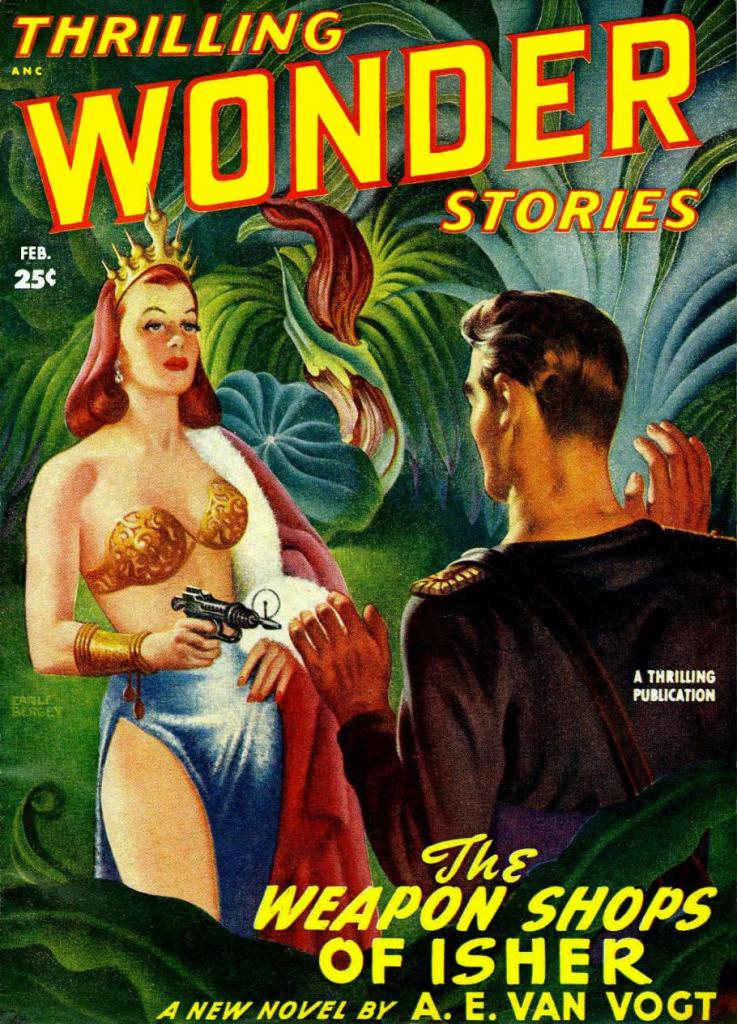
Just for grins, here are some of the covers for Sturgeon’s 1949 publications.

James Wallace Harris, 7/11/23

“All the World’s Tears” by Brian W. Aldiss

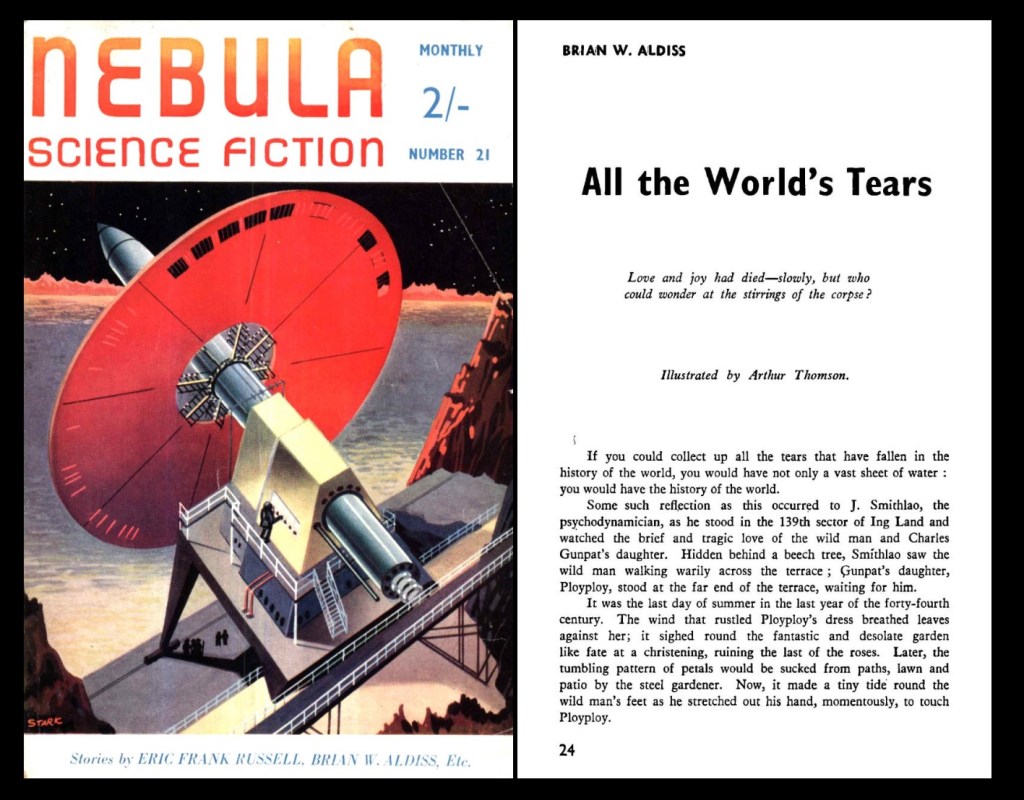
All the World’s Tears” by Brian W. Aldiss was first published in Nebula Science Fiction 21 in 1957. It has been rarely anthologized, but frequently reprinted in collections of stories by Aldiss. Older American science fiction fans might remember reading it in Galaxies Like Grains of Sand (1960). However, that collection has been republished many times with varying numbers of stories. I don’t recommend the current Kindle edition because it leaves off the story titles, uses the theme titles instead, and runs the intros into the beginnings of the stories. It’s readable but annoying.

You can read “All the World’s Tears” in Nebula Science Fiction 21. You can read a review of Galaxies Like Grains of Sand at Science Fiction and Other Suspect Ruminations.

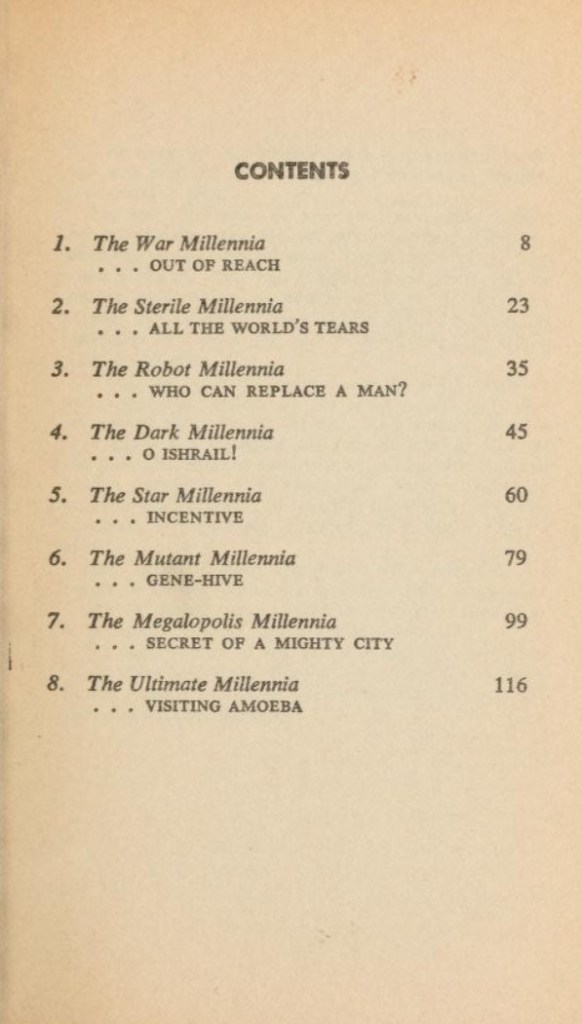
Galaxies Like Grains of Sand is a fixup novel with a mosaic story composed of eight or nine unrelated short stories glued together by imaginative introductions. Sort of like Simak’s City. It feels like a cross between Last and First Men and The Dying Earth.

“All the World’s Tears,” is the second story, under the theme “The Sterile Millennia.” For being such a short short story is dense with ideas, atmosphere, and imagery. The opening sequence, tells us the ending but we won’t know that until we get to the last page and read it. Aldiss has painted a future Earth of stark contrasts. The setting is the far future, the last day of summer of the 44th century. Earth no longer supports billions of humans, just hundreds remain, living in a high-tech society under the control of robots. No one is poor, but civilization is in decay.

Robots control every intent of peapods, bees, birds, and ants. The agricultural land is impoverished, yet wild mother nature is encroaching everywhere. I have to wonder if this is the mid-way point between the mid-20th century and the future of the Hothouse stories Aldiss would soon write.

Strangely, the robots do everything, yet are rather dumb. They monitor all activity, yet talk between each other in clumsy English and can be easily fooled. At one point, a man evades security robots by holding tree branches and telling the robots he’s a rose bush.

Aldiss’ prose suggests vivid scenes for paintings and films. Aldiss is quite imaginative. Both Hothouse and Galaxies Like Grains of Sand could be the basis for wonderful animated films for adults.

“All the World’s Tears” feature four human characters and several robots. The main character of focus of Ployploy. She is a young woman who is considered mentally deficient for being kind and barred from having children. However, Ployplay is well-loved by her father Charles Gunpat. She is judged a hereditary throwback because she is white and can’t express herself with hate and aggression. I can’t but wonder if Aldiss isn’t being racist here by suggesting non-white people are the genetic aggressors. Although he could also be suggesting that whiteness disappeared as the world’s population homogenized, and aggression was another trait that emerged after thousands of years of endless wars.

Observing Ployploy is a visitor, J. Smithloa, who is hired to visit Gunpat’s estate. He is a professional insulter, hired to fire up people’s aggression so they will mate and work to keep civilization going. The fourth character is a wild man sneaking onto Gunpat’s estate. He lives outside the control of the cyber-controlled state and wants Ployploy to run off with him.

Aldiss envisions the future as being extremely regulated, and high-tech, yet, falling into decay, near the end of mankind’s reign on Earth. Wild nature will soon overrun what is left of our civilization. Not only is Aldiss’ picture of our future bleak, but the couple we want to escape this horrible society die tragically.

Why did Aldiss write this story? Why is he so pessimistic? Over the past couple of years, I’ve become a fan of Brian W. Aldiss. Sometimes his works seem more adult, more mature than American science fiction. I assume in the 1950s, Aldiss extrapolated human aggression constantly evolving through natural selection into what he projects in “All the World’s Tears.” I have not read all the stories in Galaxies Like Grains of Sand, but the ones I have contain the same Darwinian cynicism about the future. In these stories, it’s a red tooth and claw existence.

I read this story years ago, and then yesterday, and again today. Each time I found more little nuggets of speculation. The story is both slight and deep. Aldiss included in his collection Man in His Times: The Best Science Fiction of Brian W. Aldiss, a collection I’m group reading on Facebook.

James Wallace Harris, 7/9/23

“The Lens” by Annemarie van Ewyck

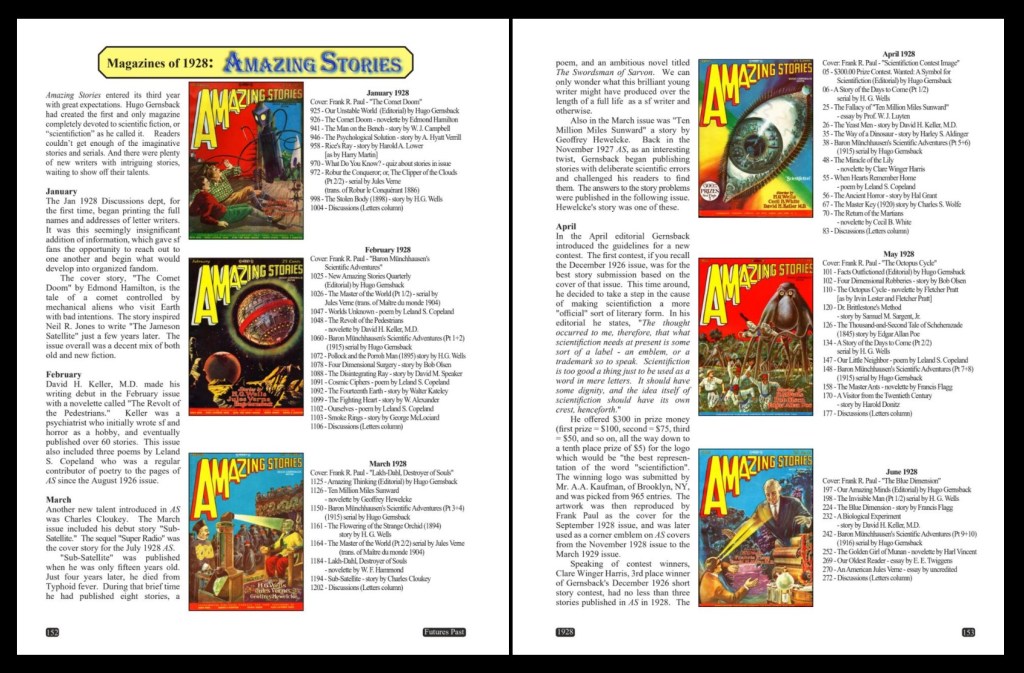
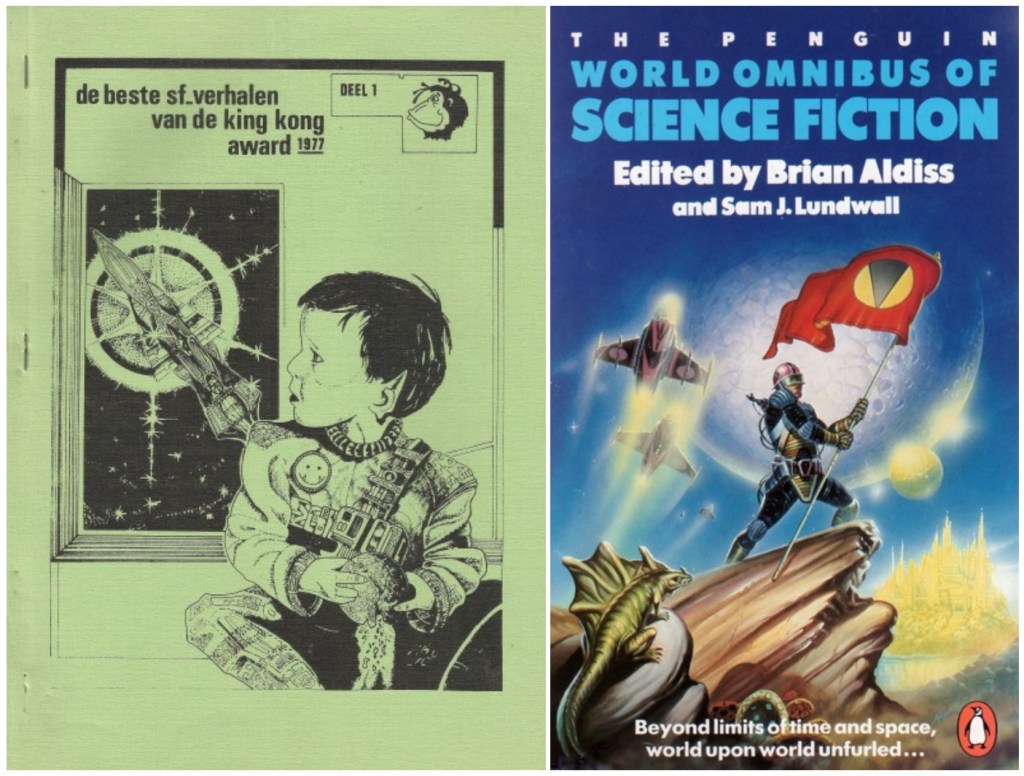
The Lens” by Annemarie van Ewyck is story #28 of 52 from The World Treasury of Science Fiction edited by David G. Hartwell (1989), an anthology my short story club is group reading. Stories are discussed on Tuesdays, Thursdays, and Saturdays. “The Lens” first appeared in Dutch in De beste sf-verhalen van de King Kong award 1977, deel 1 (Dec. 1977/Jan. 1978). In 1986 it was reprinted in English in The Penguin World Omnibus of Science Fiction edited by Brian W. Aldiss and Sam J. Lundwall.

Annemarie van Ewyck was Annemarie Pauline van Ewijck (1943-2017). She only has three short stories listed in ISFDB and was mainly an editor and columnist. The periodical above where the story first appeared looks like a fanzine to me.

Once again, I find it interesting that my take on a story is different from Hartwell’s. More and more, I’m realizing that The World Treasury of Science Fiction (1989) seems like a precursor to The Big Book of Science Fiction (2016) and that I’m out of touch with both editors. I might just be out of touch with the genre in general. However, with “The Lens” I believe it’s a perfect story for this anthology, and it’s my kind of science fiction.

Here’s Hartwell’s intro:

I thought “The Lens” was quite a nice story, especially effective for being so short, but I didn’t think “The Lens” reflected the mood, tone, or concerns of 1950s science fiction. I don’t know if that era can be generalized, and I wonder if there really is a general style to post-Anglo-American post-New Wave works. “The Lens” doesn’t feel like Bradbury, Zelazny, or Sturgeon to me at all but it does remind me of James Tiptree, Jr., but also Ursula K. Le Guin.

In other words, “The Lens” reminds me of 1970s science fiction written by women, which it is, but can we generalize on that? Is there a common denominator? I don’t think so, other than a female character in an alien society feeling the shock of otherness after undergoing an alien rite. But isn’t that theme also explored by Jack Vance in “The Moon Moth” or Downward To the Earth by Robert Silverberg?

As the years go by, I’m less inclined to believe there was much of a New Wave in science fiction, despite the efforts of Michael Moorcock, Judith Merril, and J. G. Ballard. Yes, there were some experimental efforts, like the kind we saw in New Worlds, England Swings, and Dangerous Visions, but that kind of experimentation had been going on in the literary world for a long time. I believe by the 1960s and 1970s the genre was just getting more diverse writers, and better writers in general, writers who were willing to try different ways to tell a story. By then writing programs were flourishing everywhere.

I also know people get tired of me bellyaching about some stories in these anthologies not being science fiction. That’s not because of how they were written, or by who. I believe science fiction represents a state of mind, and “The Lens” is definitely science fiction, and fits within that state of mind.

The first-person narrator, Dame Ditja, a diplomat, is returning from Earth to Mertcha after visiting their dying mother. We know things are very different when we learn her mother died at age 286. I liked how Dame Ditja described her relationship with their mother and their interaction with the other passengers on the ship. She is returning to the city of Tiel where she is the Head of Cultural Liason.

On Mertcha, the aliens have three arms and three legs, and their architecture and philosophy reflect that difference. Dame Ditja has decided to request a permanent assignment to Mertcha, which she now thinks of as home. She expected to be met at the spaceport by Mik, a local who is her driver and friend, however, a substitute driver meets her instead. That driver thinks she is an ordinary tourist and takes her to a holy place that is a main tourist attraction for people from Earth.

At the Holy Place of Tiel, Dame Ditja has a transcendental experience, one of ecstasy, one that is usually experienced by certain believers in this alien culture. While having this experience, Dame Ditja realizes that radical monks of this faith have trapped some tourists from Earth to hold hostage, and Dame Ditja comes out of her trance and carefully, but forcefully, frees them in a diplomatic coup.

This achievement gets her offered more prestige assignments, and Dame Ditja changes her mind and plans to leave, even though all through the story she wanted to stay.

The ending is strange. Because of the incident at the Holy Place of Thiel, Dame Ditja no longer feels like Mertcha is her home, and thus feels compelled to leave. It appears Dame Ditja wants to die, and she feels she can only die in a place she considers home. I’m not sure why she wants to die or is ready to die, but I wonder if it’s because people live too long in this fictional future?

After reading this story twice I feel it’s closest in style and tone to some stories I’ve read by Brian W. Aldiss. On the first reading, I would have rated this story ***+ but on my second reading, I feel it’s a **** story.

James Wallace Harris, 6/8/23
Futures Past: 1928

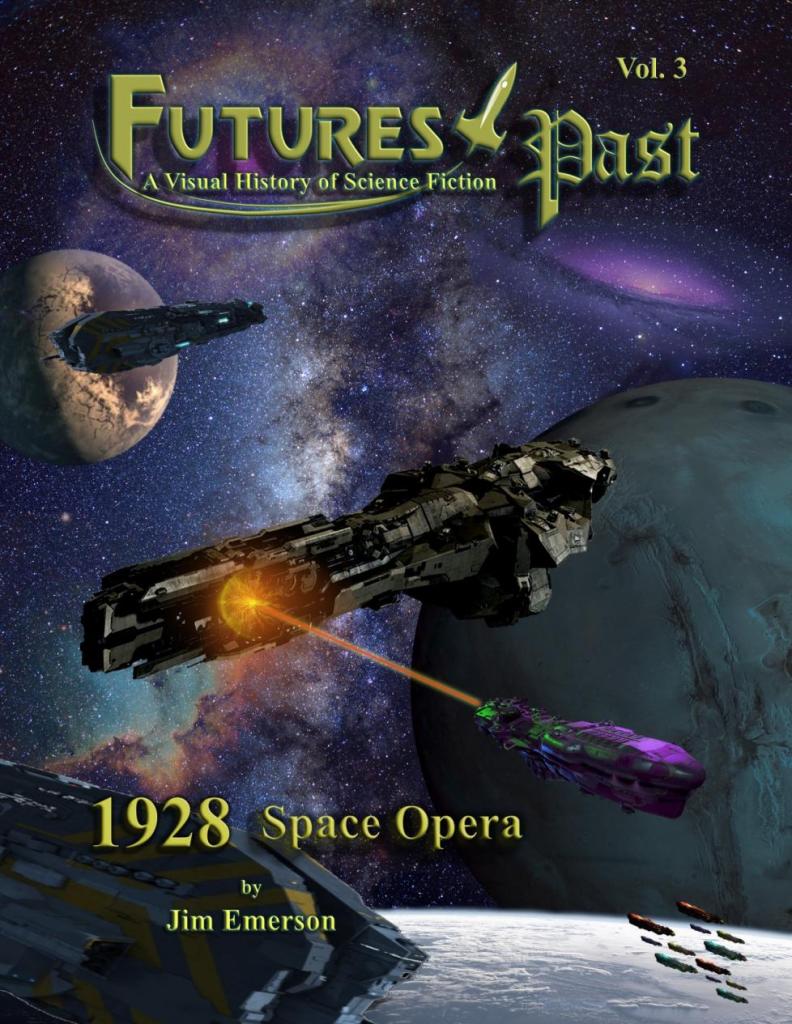
Futures Past – Link to website for ordering softbound, hardbound, and digital copies. Jim Emerson writes and publishes Futures Past. Read Emerson’s About page to find out more about him and his future plans. Jim hopes to eventually publish volumes for the years 1926-1975. Even if Jim cranks out two volumes a year, I don’t know if I can live that long, but I hope I can live long enough to read those for the 1940s and 1950s. A .pdf file of the 1926 volume is available as a free download.

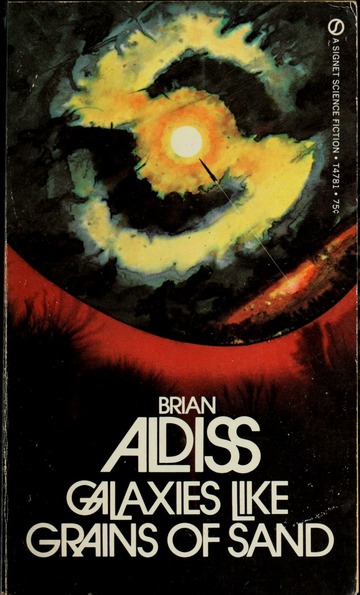
Jim has just published the third volume in his history of science fiction, Futures Past: A Visual History of Science Fiction. This 194 book is a visual delight, full of color photographs of book and magazine covers, as well as old black and white photographs of the people who created them. There’s an extensive history of space opera, including long profiles of the pioneers of the subgenre, E. E. “Doc” Smith, Jack Williamson, and Edmond Hamilton. I’ve been reading about the history of science fiction all my life, but I still found plenty of new information to discover in Futures Past. See my review of the earlier 1926 and 1927 volumes. Here’s the full table of contents to 1928.

1928 will be ancient history to most young science fiction fans, so they will find that year to be full of obscure details. However, the main articles in this volume, cover more than just the year 1928. The piece on space opera mentions books from 1802 to 1998, and the profiles of Smith, Hamilton, and Williamson cover their entire careers. That means pages 15-151 cover a good portion of the history of science fiction, especially the 20th century.

Content that’s exclusively on the year 1928 is on pages 8-14, 152-188. My favorite section in Futures Past is the section devoted to the books of the year. Most of the novels Emerson describes are long out of print and forgotten, yet some of them sound intriguing and make me want to track them down. Futures Past was first a fanzine in the early 1990s, and one mention in the 1926 volume, told about Phoenix by Lady Dorothy Mills. That one paragraph got me on a decades-long search for the novel. In fact, that mention made me become a collector of books by Lady Mills and inspired by to create a website devoted to her.

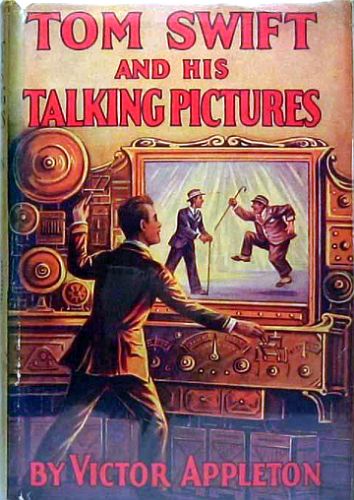
I’m intrigued by Tom Swift and His Talking Pictures, where Tom invents a large screen color TV and the movie moguls try to put him out of business because they fear TV will ruin their industry. Elsewhere in Futures Past 1928, Emerson mentions that May 10, 1928, was the first broadcast of a regularly scheduled TV program from W2XB, a General Electrics station in Schenectady, New York. I had no idea that television began so early. That makes me want to read more about it. I wish Emerson could have published their TV schedule. I did find out that W2XB broadcast the first drama, The Queen’s Messenger on September 11, 1928. This is leading me down a rabbit hole of researching early TV.

I expect readers of Futures Past will do the same thing, find an intriguing bit of history, and go follow it. I always thought The Skylark of Space was the first science fiction novel that features interstellar travel. That’s not true. Emerson says Les Posthumes by Nicolas Restif de la Bretonne, a French novelist, is considered the first space opera and was published in 1802. But I’m intrigued by his mention of The Struggle for Empire: A Story of the Year 2236 by Robert William Cole published in the year 1900.

I’m curious how many people will buy Futures Past. It means they are interested in the history of science fiction. And more than likely, readers of old science fiction. I expect Baby Boomers who discovered science fiction in the 1950s and 1960s will be the most ardent fans of this publication, mainly for nostalgic reasons.

One fact that Emerson notes is Amazing Stories started publishing the full names and addresses of readers who wrote letters to the letter column. This allowed early science fiction fans to contact one another and led to the creation of fandom and fanzines. I expect his yearly volumes to start chronicling the rise of fandom in the 1930s.

As each year progresses, I believe there will be more and more content specific to that year. I’m looking forward to that. It will be a tremendous amount of work to gather such information. Maybe Emerson could use some help or ideas.

What I would like to see is a month-by-month chronicle of the best content published in magazines and fanzines. Most of the magazines and many of the fanzines from the 1930s are online. Knowing what’s worthy of reading is the key to using those libraries. Emerson has a start of that for Amazing Stories and Weird Tales. However, I’d want more details. Sort of like A Requiem for Astounding by Alva Rogers, which mentions the best stories and illustrations from each issue.

I’m less concerned with the table of contents from each issue shown on the right than what Emerson comments on the left. ISFDB lists the contents of magazines, but I never know what’s worth reading. What would be worth knowing is the outstanding stories from each prozine and the commentary about them from the fanzines.

What I use Futures Past for is finding old forgotten science fiction that I think might be worth tracking down and reading. The trouble is the amount of content coming out each year grows larger and larger, making Emerson’s job harder and harder. By 1953-1954, a 200-page book could be published on what went on each month in science fiction. That was when a science fiction boom happened when almost 40 SF magazines were coming out.

James Wallace Harris, 7/7/23
“The Dead Past” by Isaac Asimov

The Dead Past” by Isaac Asimov is story #27 of 52 from The World Treasury of Science Fiction edited by David G. Hartwell (1989), an anthology my short story club is group reading. Stories are discussed on Tuesdays, Thursdays, and Saturdays. “The Dead Past” first appeared in Astounding Science Fiction (April 1956). I can find no ebook or audiobook edition of this story.

Normally, I don’t link to the Internet Archive because I worry it’s going to be taken down. But for “The Dead Past” you can read it here in a scan of the April 1956 Astounding.

Let’s imagine that “The Dead Past” is a robot Isaac Asimov built. This robot has a specific function, to trigger certain ideas and emotions in readers. I believe we can understand this story in terms of the motors and gears Asimov used to design his robot.

  1. The first motor is Arnold Potterley, Ph.D., a Professor of Ancient History. Arnold is obsessed with ancient Carthage. He desperately wants to use a time viewer to prove that specific history about Pre-Roman Carthage is untrue, and were lies created by their enemies the Greeks and Romans.
  2. The second motor is academic control, as viewed through The Department of Chronoscopy, which has the power to view the past using the science of neutrinics, an area of physics created by a man named Sterbinski.
  3. The third motor is Jonas Foster, a new instructor in the physics department.
  4. The first gear system is a dystopian society that rigidly controls all academic research. Asimov used this feature to satirize the real-life academic bureaucracy that he had to deal with. Arnold fights against this bureaucracy to get access to the time viewer to do his research. Jonas becomes intrigued with why the bureaucracy suppresses the time viewer. The two men’s motives mess to work together secretly to build their own time viewer.
  5. The fourth motor is Caroline Potterley, Arnold’s wife. She is obsessed with the death of their child, Laurel, who died twenty years earlier at age 3. She wants the time viewer to see Laurel again.
  6. The second gear system is the mystery of Laurel’s death. Arnold is afraid that if Caroline could see the event he might be blamed. I believe Asimov added this system to his machine because he wanted an emotional component.
  7. The fifth motor is Ralph Nimmo, a popular science writer.
  8. The third gear system links Ralph and Jonas and allows Asimov to express views on science writers, as well as enable the building of a home time viewer.
  9. The sixth motor is Thaddeus Araman, Department Head of the Division of Chronoscopy. He is in charge of suppressing the technology of time viewing for a very specific reason.
  10. The last gear is between Arnold, Caroline, Jonas, and Thaddeus. The first three want to view the past, and the last wants to stop them. The why is the revelation of the story.

“The Dead Past” is one of Asimov’s better stories, even a favorite to some. I liked it quite a lot but found it clunky. The driving force behind Arnold is to prove ancient Carthage didn’t practice child sacrifice, and the driving force behind Caroline is to see her dead child again. Jonas is so intrigued by a possible conspiracy theory that he throws over his budding career in physics. I thought all three of these fictional motives were melodramatic. They do work, adding complexity and emotion to a rather dry final idea, but it’s a shame that Asimov didn’t come up with a more sophisticated emotional linkage.

I think Asimov would have shown more finesse if he had foreshadowed the ending. There is a cross-link between Arnold’s and Caroline’s desire to see the past, but neither predicts the real reason why Thaddeus wants to suppress the time viewer. This might be simplistic on my part, but if Arnold, Caroline, and Jonas each had a reason to use the time viewer, and one of their reasons should have foreshadowed the real reason why Thaddeus thought the time viewer was so dangerous. I believe the story would have been tighter if Jonas has wanted to use the time viewer to uncover the conspiracy, and Caroline wanted to use it to spy on Arnold and Jonas.

I don’t think Asimov was a very mature person. From what I’ve read about him, and from reading his stories, he comes across as a rather clever child prodigy who as an adult had trouble comprehending human relationships. This is often reflected in his stories. His fiction focuses on ideas, and his characters are constructed to present those ideas. In “The Dead Past,” Asimov tries harder than usual to present adult emotions, but they come across as contrived. Still, “The Dead Past” is a good example of Asimov trying to overcome his weakness. I give him credit for that.

Two or three years ago I read or reread all of Asimov’s robot stories. They were all hampered by this problem. I could always see how Asimov added human emotion to his stories. When I was young, that effort worked unseen, but as I got older, the stories succeeded in their ideas but felt clunky in their efforts to deal with genuine humans and relationships. In fact, I was sometimes horrified by some of Asimov’s emotional conclusions – but that’s for another essay.

“The Dead Past” is a nicely worked-out science fiction story. Asimov adds psychological depth to a neatly complex plot. Unfortunately, he uses B-movie creativity for creating the psychological drivers of this story.

Finally, regarding “The Dead Past,” I want to make a protest, or maybe a lament. This is my third reading of the story, and this time I wanted to read “The Dead Past” with my eyes, and then listen to it again from an audiobook. But I could find no audiobook edition. Nor could I find an ebook edition. This annoyed and depressed me. “The Dead Past” is one of Asimov’s best works of short fiction. You can find it in print in The Complete Stories, Volume 1. There are US and UK versions on Amazon, but they don’t have the same number of pages, so I don’t know which to recommend. However, used copies of the US edition are quite common and much cheaper.

I now prefer consuming fiction via ebooks and audiobooks. I hate that Asimov’s short fiction, as well as other science fiction writers’ short fiction, is either not available or is no longer available in these formats. A friend eventually found an epub version for me to read, and that visually easier-to-read format made reading the story far more enjoyable.

I recently noticed that all English language versions of Brian W. Aldiss audiobooks have been pulled from Audible. Classic old science fiction is slowly disappearing. There’s still plenty to buy and read, but it’s disappearing at the edges. I hate that.

James Wallace Harris, 7/6/23

.

“The Spiral” by Italo Calvino

“The Spiral” by Italo Calvino is story #26 of 52 from The World Treasury of Science Fiction edited by David G. Hartwell (1989), an anthology my short story club is group reading. Stories are discussed on Tuesdays, Thursdays, and Saturdays. “The Spiral” first appeared in Le Cosmicomiche, a collection of the author’s stories first published in Italy in 1965. It was later translated and published in English in 1968 as Cosmicomics.

Calvino is growing on me. In fact, after reading “The Spiral” I decided to buy Cosmicomics. I went to Amazon and Audible and listened to the introduction to The Complete Cosmicomics. I was so intrigued that I bought the ebook for $2.99 and the audiobook for an additional $7.49. That volume contains Cosmicomics (12 stories), Time and the Hunter (11 stories), 4 stories from Numbers in the Dark and Other Stories, and 7 newly translated stories, 34 in all.

“The Spiral” continues with the character from “A Sign in Space,” Qfwfq, who reminds me of YHWH. I don’t know if Calvino intended that or not, but these stories feel like another Bible that describes the evolution of matter and life through a coevolving self-awareness. I recently read An Immense World by Ed Yong, a book about umwelt in humans and animals, including mollusks. These two books have great synergy.

Cosmicomics stories are about science. I think it’s especially important to read Martin McLaughlin’s introduction to The Complete Cosmicomics. It’s too long to quote in its entirety, but I believe this should get you interested to maybe spring for the $2.99 Kindle edition.

With “The Spiral” I feel Calvino is trying to write a scientific description of reality using a philosophical conceit. Like McLaughlin said, Calvino thinks realistic fiction was exhausted, so he came up with this new approach.

Qfwfq is like God or Gaia, or one of an infinity of pantheistic gods who is describing the evolution of the universe and life. Although Calvino’s goal is to describe science, it also feels spiritual.

When I was young I couldn’t conceive of God or a beginning. I concluded that reality has always existed. It’s infinite in all directions and dimensions. Nothing can’t exist. Reality is the unfolding of all possible forms of non-existence.

You can listen to “The Spiral” here:

James Wallace Harris, 7/4/23