“2066: Election Day” by Michael Shaara

“2066: Election Day” was first published in Astounding Science Fiction, December 1956. You can read it on Archive.org. It is story #18 of 22 for The Best SF Stories of 1956 group read. “2066: Election Day” was a selection for Dikty’s SF anthology covering 1956-57 published in 1958 and for Asimov/Greenberg 1988 anthology devoted to the best SF of 1956. It’s also been reprinted in several interesting theme anthologies.

I read Michael Shaara’s famous novel about the civil war, The Killer Angels back in the 1970s, so I’m surprised to see his name here. However, I have discovered other famous writers who got their start writing science fiction. Shaara published several SF stories before moving on.

“2066: Election Day” is about a future America where we elect the president by selecting the most qualified person using a network supercomputer called UNCLE SAM. Anyone can take the test to see if they qualify. The story is about the 2066 election when SAM considers no one qualified.

I’ve always wondered why we don’t have more requirements for the job of United States President other than being a natural born citizen that is at least 35 years old. When I was in my early twenties, I took and passed a civil service test to get a temporary job at the IRS as a data entry clerk. I genuinely doubt Donald Trump could have passed that test, or any civil service exam.

I’ve always thought we should have more qualifications for the job of president. I would suggest either a law degree, or a doctorate in political science or history, and having served at least one term as a state governor, or two terms as a U.S. senator, or a minimum of ten years as a major of a U.S. city with a population over one million.

In “2066: Election Day,” Shaara has the requirement of taking a test that covers knowledge in many subjects, including economics, taxes, military, political science, etc. I’m not sure book learning should be the sole qualification, but meeting minimum scores on such tests could be part of the requirements too.

“2066: Election Day” doesn’t have much of a plot, being mainly an essay about an idea, but Shaara does show Harry Larkin going through a few different emotional states. That’s a big plus for this story.

I was surprised by Shaara repeatedly stating the process was aimed at finding the best “man” for the job. No mention of women. That would have shown more foresight. (There is a hint that women could be president, because there’s a little old lady is taking the tests at the beginning of the story.)

My friend Mike told me he didn’t think this story had anything worth discussing. And it is the kind of science fiction story where the author contorts the short story form to express ideas they want to promote. But to paraphrase that adage, “If you have a message, use Western Union.” I would say, “If all you’ve got is an idea, write an essay.” Shaara added a minimal story as a wrapper for his ideas.

For “2066: Election Day” to be a genuine short story, we’d have to experience Harry Larkin going through a struggle, developing as a person while overcoming obstacles. A good short story should produce a cathartic emotional reaction in the reader, even an epiphany. I thought Shaara tried but didn’t make it. Everything came to Harry Larkin, he never worked for anything in the story.

James Wallace Harris, 1/6/24


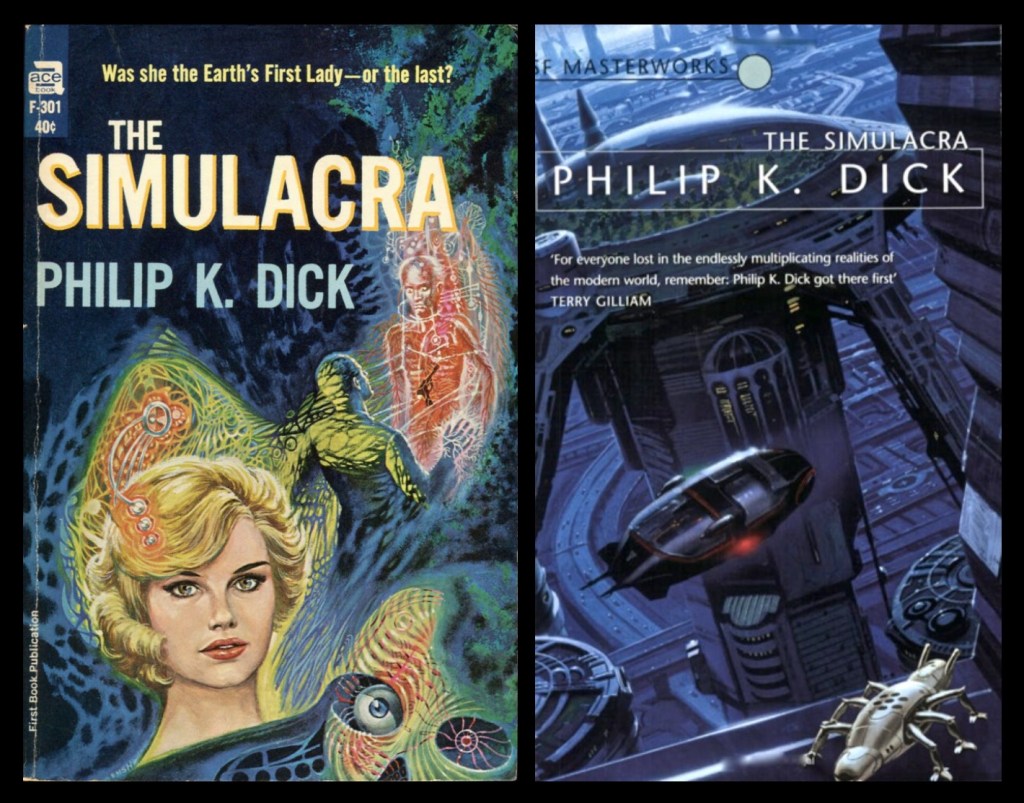
The Simulacra by Philip K. Dick

How do literary scholars of Philip K. Dick’s fiction determine which of his novels are masterpieces and which are his hackwork? They all seem equally bizarre, and even confusing. Library of America selected four novels for their first volume in 2007 devoted to PKD. The years given are when they were (written, published).

  • The Man in the High Castle (1961,1962)
  • The Three Stigmata of Palmer Eldritch (1964,1965)
  • Do Androids Dream of Electric Sheep? (1966, 1968)
  • Ubik (1966, 1969)

The second volume came out in 2008 recognized:

  • The Martian Time-Slip (1962, 1964)
  • Dr. Bloodmoney (1963, 1965)
  • Now Wait for Last Year (1963, 1966)
  • Flow My Tears, the Policeman Said (1970, 1974)
  • A Scanner Darkly (1973, 1977)

The third volume in 2009 highlighted:

  • A Maze of Death (1968, 1970)
  • VALIS (1978, 1981)
  • The Divine Invasion (1980, 1981)
  • The Transmigration of Timothy Archer (1981, 1982)

Are we to assume these are Dick’s best novels? My personal favorite, Confessions of a Crap Artist wasn’t included. Neither was The Simulacra which I just read and found fascinating and fun. I think some of the Library of America selections are better than The Simulacra, such as The Man in the High Castle, The Martian Time-Slip, and VALIS, but I’d also claim The Simulacra is not a lesser novel to the others. However, using our citation database system, it gets only one citation. Twelve of the twenty-seven PKD novels in our database only got one citation. The novels in the first LOA volume received 9 to 32 citations, which supports the LOA editors.

The only reason The Simulacra received one citation is because it was part of the SF Masterworks series. All the science fiction magazine reviewers ignored it when it came out. As far as I can tell, none of the reprint editions got reviewed either. The Simulacra just isn’t well-known. It’s often disliked when I see it mentioned.

I liked it. And I want to make a case that it’s worth reading. However, it will be hard to even describe. I’m afraid most readers will be turned off by The Simulacra because it has multiple plot lines with over a dozen main characters. And I can imagine many readers calling it stupid too — but that could be true for a lot of readers coming to PKD work. However, if two of the five novels Dick wrote in 1963 made it into the Library of America, why shouldn’t the other three? What divides them? What makes one novel “good” and another “bad?”

The Simulacra‘s complexity might keep readers from liking it, but that complexity might hide many novelistic virtues. Just because I admired this novel, doesn’t mean others will. I’m writing this essay hoping people will read The Simulacra and give me their opinion. I’m curious if I’m a total outlier. I got a big kick out of the story.

According to Samuel Johnson, “No man but a blockhead ever wrote, except for money.” Dick complained in several 1963 letters found in The Selected Letters of Philip K. Dick: Volume One: 1938-1971, that his wife Anne constantly hounded him to make more money. On the other hand, Dick wrote eleven literary (non-genre) novels from 1952-1960 hoping to become a recognized mainstream writer. All were rejected. He then wrote The Man in the High Castle in 1961 which bridges the literary and science fiction world and won a Hugo award for best novel. Dick then wrote twenty-one science fiction novels from 1962 to 1969, five of them in 1963 alone. He obviously needed money and had to crank out the manuscripts.

After 1970, Dick only published six more novels before he died in 1982. Five of which are included in the Library of America editions. That suggests that the novels he took more time writing fared better with the critics. So, the five novels written in 1963 were among the fastest he wrote, suggesting they shouldn’t be as good. Yet, two were selected for the Library of America.

As much as I like The Simulacra, I do see that it’s flawed. It doesn’t have a main character which most readers prefer. Nor does it jump back and forth between two main characters, which can be quite successful with some readers. And it’s not even one of those experimental stories where we follow several unrelated characters that all come together in the end. Readers find that structure confusing but forgive it if the ending brings everyone together in a satisfying way. I’m not sure The Simulacra wraps up nicely.

We might call the plotting of The Simulacra an example of characters doing parallel play. Dick might have aimed for creating a collage of future American scenes. My guess is Dick banged away on his typewriter, vomiting up The Simulacra onto typing paper. The results are fascinating because the novel is one big pile of imagery from PKD unconscious mind — and what a mind! It begs to be psychoanalyzed. And I’m sure, it parallels his personal life, especially regarding insanity, psychoanalysis, and troubling wives and women.

The Simulacra is not satire even though it often feels like the film Dr. Strangelove, nor is it a fantasy even though everything is unbelievable. And I wouldn’t call it surreal or dreamlike, or avant-garde even though it was written in 1963 when trendy artists were creating pop art and post-modern fiction. It’s straight science fiction, meant to be taken as realistic, even though it’s bonkers. The Simulacra has the existential absurd horror of The Tin Drum or The Painted Bird. I don’t even think Dick was making fun of science fiction with its comic book level wild ideas. Dick had crazy ideas, and he saw the world being just as crazy.

The Simulacra pictures future America where psychic abilities are accepted as real, that time travel has been perfected, where people and animals can be artificially created and the results indistinguishable from real people and animals, that colonies exist on Mars and the Moon, and alien lifeforms can be commercialized. In other words, all the crap ideas that science fiction fans and fans of the occult believed in the 1950s. Everything they thought possible, became possible.

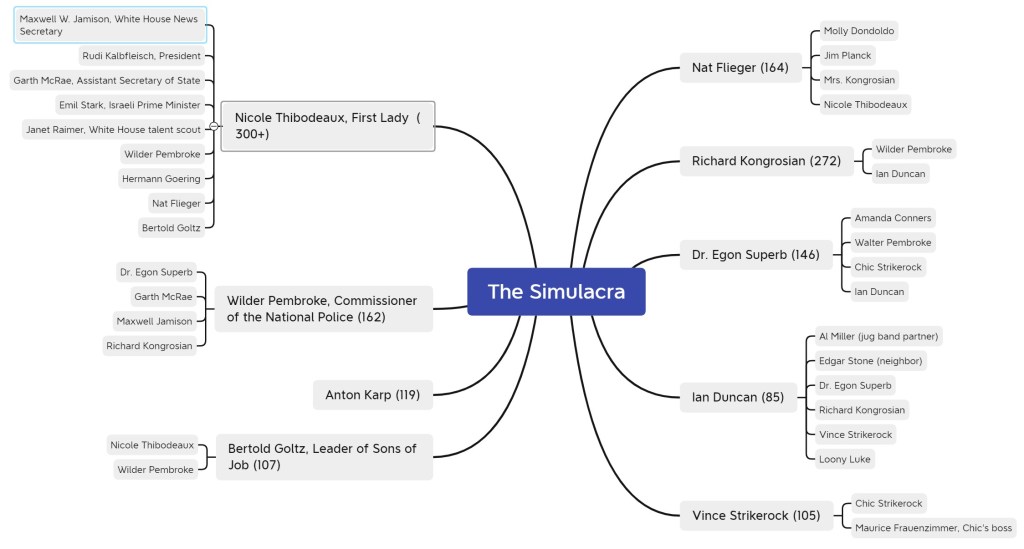
The hardest part of this essay is describing what happens in The Simulacra. I wrote about that trouble already for my Auxiliary Memory blog, where I explained I had to read the book and listen to the audiobook to get the most out of The Simulacra. In fact, I’m still picking up the book, or putting on the audiobook, and enjoying random parts of the novel. I can’t seem to leave this story. I’m still finding new insights into whatever scene I stumble upon. I’ve decided the best way to describe the story is by mind mapping the characters. The number given is the number of times the character is mentioned in the story.

I’m trying not to give away too much of the plot. Each of the first level characters involves a subplot. For example, Dr. Egon Superb is the last legally practicing psychiatrist after the pharmaceutical industry pushed through the McPhearson Act that made drug therapy the only legal form of treatment for mental illness. One of his patients is Richard Kongrosian, a psychic pianist who uses telekinesis to play the piano instead of using his hands. Nat Flieger is a sound engineer who wants to record Kongrosian, but he and his crew of Molly Dondoldo and Jim Planck can never track down the man. Ian Duncan and his old friend Al Miller want to perform classical music as a jug band at the White House for Nicole Thibodeaux. Nicole Thibodeaux, the First Lady, but maybe the true ruler of The United States of Europe and America (USEA) wants to negotiate with Hermann Goering via a time machine to get the Nazis to not kill the Jews. Vince and Chic get involve with making the next president, an android, which will replace Nicole’s current husband. Wilder Pembroke, Anton Karp, and Bertold Goltz all vie for power behind the scenes.

If the novel has a main character, it could be Nicole Thibodeaux. Dick’s original draft was called The First Lady of Earth. Since this book was written in the summer of 1963, I assume Dick was inspired by Jackie Kennedy because Nicole spends most of her time charming people, decorating the White House and gardens, and putting on nightly cultural events. Everyone loves Nicole. Yet, out of the public eye, Nicole is also ruthless enough to have people summarily executed. Evidently, she wields unlimited power because of her access to time travel.

The novel is set in a post-apocalyptic future, decades after China attacked the U.S. with missiles with atomic warheads. This gave rise to a population of mutants, similar in appearance to Neanderthals. People ride in self-driving cars. Ads are living creatures that can invade your home and car and must be killed. Richard Kongrosian believes he has a terrible body odor because a deodorant ad infected him with a jingle. The Sons of Job are a neo-fascist political party. People live in giant communal apartment complexes and are required to take civics tests to stay in them. Many people want to escape this totalitarian society by immigrating to Mars. People buy android nuclear families just to have normal friends.

I could go on. There are several layers of political and corporate intrigue in The Simulacra. Dick evidently thought there were conspiracies everywhere. Later in life, Dick would get into Gnostic religion, which is a very paranoid belief system. This novel has many traits of Gnosticism. The Simulacra was written after The Man in the High Castle, We Can Build You, Dr. Bloodmoney, and The Martian Time-Slip, and before The Three Stigmata of Palmer Eldritch and Do Androids Dream of Electric Sheep? There are many similar themes and obsessive ideas that run through all of them. I wish I had the time and energy to study all those novels and plot all the connections. Why did PKD fixate on certain ideas repeatedly? Was it a lack of imagination to explore unfamiliar territory, or were they ideas PKD just could let go of?

James Wallace Harris, 1/5/24

“The Last Question” by Isaac Asimov – 2nd Review

“The Last Question” was first published in Science Fiction Quarterly, November 1956. You can read it on Archive.org. It is story #17 of 22 for The Best SF Stories of 1956 group read. “The Last Question” was a selection for Asimov/Greenberg anthology devoted to the best SF of1956 — but I’ve got to wonder, if it was at Asimov’s request? He’s often said “The Last Question” is his favorite among his own stories. I’ve reviewed the story before, for when the group read The Big Book of Science Fiction.

We’ve had two Isaac Asimov stories from 1956 – “The Last Question” and “The Dead Past.” I thought “The Dead Past” was flawed but I was impressed with Asimov’s ambition to write an emotional story. I know other people who consider it Asimov’s best short story. Neither are my favorites.

On one hand, “The Last Question” is a famous, often loved, science fiction story. On the other hand, it’s a gimmick story without traditional story elements. It’s more of an essay disguised as a short story. I’ve gotten tired of reading gimmick stories, and I’ve gotten tired of reading “The Last Question.” Once you know it, it’s not much fun to reread. I like stories where I get behind a character who is struggling to overcome an emotional problem. And I like stories that get better on rereading. “The Last Question” isn’t that kind of story. I’m thinking that Asimov wasn’t big on writing that kind of story either. However, I need to reread “The Ugly Little Boy.” If I remember right, it does have character development and an emotional punch to the gut.

This morning, I got a text from my friend Mike about the story, he wasn’t too kind:

I think that “The Last Question” is a gimmick story with cardboard characters. But this story is beloved, so I guess that leaves me out in the cold. I don’t really want to dump on Asimov, but I don’t think much of his favorite story.

It has the repetitive plot and thin characters of “Compounded Interest.” I’ve never been a fan of gimmick stories. I need characters that I care about.

I have to say I completely agree with Mike. “The Last Question” is a gem of a story for a gimmick story, but a letdown for when you’re wanting a vicarious emotional experience. I had the same problem with “Compounded Interest” by Mack Reynolds. However, as I mentioned in my review, I found another Mack Reynolds story from 1956 that had all the elements I love in a good dramatic short story. Read: “After Some Tomorrow.”

The genre has room for all kinds of stories, but I’m getting old and sappy, and want to be moved by what I read. I must wonder if the twenty-two stories we’ve selected to read from 1956 are mostly remembered because of their ideas and gimmicks. I wonder if there are loads of emotional stories that weren’t well remembered because they had ordinary science fictional ideas, but ones I would like better for their emotional and dramatic qualities — that is, if I could find them, like I did with “After Some Tomorrow.”

James Wallace Harris, 1/4/24

“The Doorstop” by Reginald Bretnor

“The Doorstop” was first published in Astounding Science Fiction, November 1956. You can read it on Archive.org. It is story #16 of 22 for The Best SF Stories of 1956 group read. “The Doorstop” was a selection in both the Merril and Asimov/Greenberg anthologies devoted to the best SF of1956, but the story hasn’t been widely anthologized otherwise.

I believe Reginald Bretnor is most famous for his Ferdinand Feghoot pun stories. He wrote three books about science fiction, and besides writing a fair number of science fiction short stories, also liked to write about weapons and war. See his ISFDB entry.

“The Doorstop” is a pleasant mood piece about a country doctor discovering an alien artifact, one his wife bought to use as a doorstop. The story doesn’t have much of a plot, mainly a discussion by scientists and military men, a cliche for science fiction stories and movies, especially in the 1950s. However, what stands out in this story is the doctor’s state of mind. Dr. Cavaness stands between the old world where stars were romantic lights in the sky, with life having a certain order, and a new paradigm, something much different, even threatening and horrifying. (I’m reminded of the Fredric Brown title, The Lights in the Sky Are Stars. I might need to read it.)

Writing “The Doorstop” in 1956, I can imagine Bretnor worrying about all those ordinary people who were about to experience the sense of wonder that science fiction readers and writers cherished. He recognized the mental state of the world was changing, and imagined for many, it might not be wanted.

My friend Mike emailed me his notes for the story, and he was quite taken with it — as was I.

On the surface, the plot of "The Doorstop" is very simple. 

Ellie, the wife of Dr. Cavaness, buys a doorstop: "Oh, that. I got it today from Mrs. Hobbs. It's...well, it's a doorstop."
Cavaness soon realizes that the doorstop "...was no simple artifact. Alien to him and strange, it was a mechanism, a machine."
Cavaness takes the doorstop to Ted Froberg, "...an electronics engineer working behind the ramparts of Security." Froberg reveals the doorstop "...wasn't made in any country here; it wasn't even made on Mars or Jupiter. It's from the stars."
But there is another story to be considered, an existential drama that unfolds in the mind of Dr. Cavaness. He desperately longs for an ordered existence, a carefully circumscribed life. His mind is comforted by the "...pages of the past, pages of friends and fishing trips, or midnight calls to childbirth, hypochondria, surgery--pages of precious trials and triumphs and routines. That was his life, the busy hours, the days succeeding days, the months, the seasons, the gently moving years, all encompassed by his family, his patients, and his town."
He clings fiercely to his English garden world and calls "...on God to drive the mystery out, extinguish it..." Cavaness poignantly prays:
"Voicelessly, in a despairing language without words, he prayed to a parochial God to make this all untrue, to wipe it out, to let his world remain as it had been. Oh God, preserve these small peripheries against all things incomprehensible; I am my world; its limits limit me; allow the stretches of eternity, the darknesses, to stay unreal; oh, God, deny this living proof that life unthinkable teems in those depths and distance, that they exist--"
Finally, when it's made clear to Cavaness that the doorstop is alien, "...he stared straight ahead--facing the majesty of God, facing a new maturity for man, facing the open door."
What Bretnor doesn't reveal is what comes next for Cavaness. Does he accept the new reality, or does turn away and retreat into his walled city?

I like that “The Doorstop” is about a coming change in our group mind and questions the genre I grew up with and love. It’s not a particularly well-written story, yet I like it quite a lot. But that fondness is for the story’s central insight. I wonder how many people now would like to go back to a pre-SF world where we didn’t think about aliens, an infinite multiverse, and all the other insights science fiction has given us, to when the universe was only as big as The Old Testament?

James Wallace Harris, 1/3/24

“Compounded Interest” by Mack Reynolds

“Compounded Interest” was first published in The Magazine of Fantasy & Science Fiction, August 1956. You can read it on Archive.org. It is story #15 of 22 for The Best SF Stories of 1956 group read. “Compounded Interest” was a selection in both the Merril and Asimov/Greenberg anthologies devoted to the best SF of1956, but the story hasn’t been widely anthologized otherwise. I considered “Compounded Interest” an entertaining enough story for a magazine issue but considered it disappointing to read it in a best-of-the-year anthology. It’s a time travel story, yet it’s never been anthologized in any time travel themed anthology, and there have been many. That might tell us something.

The story is rather simple, a time traveler arrives back in the early days of Venice and deposits ten gold coins in a bank with special instructions. He returns every century with new instructions. If you wish to know what happens, read the story. The whole story is merely a fun little idea, with a somewhat punchy ending, so I won’t spoil it. However, the story does have a big “which came first, the chicken or the egg” problem.

“Compounded Interest” is so slight I almost didn’t write about it. Mack Reynolds was a rather prolific science fiction writer. Sadly, I’ve never read much of his work. I have a vague memory of reading a couple of his stories, and reading about Reynolds in Wikipedia, which I just did again. He sounds like an interesting guy, and I’d like to read more of his science fiction. It’s just that his work isn’t remembered. Like I said, I have a rather vague memory of reading one of his stories and sort of liking it, but just can’t remember what it was.

I’d want to think there were dozens of science fiction stories better than “Compounded Interest” published in 1956 yet to be discovered. I just don’t have the time to go read over a hundred issues of SF magazines to find them. And so far, no one else in our reading group has found any forgotten gems either. I’m tempted to go read the five other SF stories Reynolds published in 1956 just to test the waters:

  • “After Some Tomorrow” – If (June)
  • “The Triangulated Izaak Walton” – Fantastic (June)
  • “Case Rests” – Science Fiction Quarterly (August)
  • “Fair Exchange” – Fantastic (August)
  • “Dog Star” – Science Fiction Quarterly (November)

Maybe Reynolds didn’t hit his stride until the 1960s. I remember seeing him a lot in Campbell’s Analog during that decade. Even when I was subscriber back then, I passed over his stories. Reynolds never hooked me, but like I said, reading about him in Wikipedia shows he had a fascinating life and should have written at least a few interesting stories.

“Compounded Interest” is the kind of story that’s just okay. Evident Judith Merril and Asimov and Greenberg, but not T. E. Dikty found it just interesting enough to reprint in their best of 1956 anthologies. But is it padding? My guess, few years produce enough stories to fill an anthology with exceptional stories.

By the way, Mr. Mike wasn’t too kind to this story either, but he was less verbose than I in saying it:

Compounded Interest is a tissue paper thin story with a repetitive plot and uninteresting characters. 

As soon as Professor Alan Shirey is introduced toward the end of the story we realize that he must be the mysterious Mister Smith.
It's a nonsensical and tedious story.

James Wallace Harris, 12/31/23 – Happy New Year

UPDATE:

I just read “After Some Tomorrow” in the June If. Now, this is the Mack Reynolds story that Merril, Asimov/Greenberg, and Dikty should have collected as one of the best of 1956. Follow the link to read it online. It’s about gender role reversals after the apocalypse. And the plot has some nice twists. Plus, it’s quite gritty for a magazine aimed at young readers. Rating: ****+

“A Work of Art” by James Blish

“A Work of Art” was first published in Science Fiction Stories, July 1956 as “Art – Work.” You can read it on Archive.org. It is story #14 of 22 for The Best SF Stories of 1956 group read. Asimov and Greenberg picked “A Work of Art” for The Great SF Stories #18 (1956). It was widely reprinted. Its quality is inferred by the fact that I own “A Work of Art” in seven anthologies:

  • Science Fiction Showcase (1959) edited by Mary Kornbluth
  • The Worlds of Science Fiction (1963) edited by Robert P. Mills
  • The Best of James Blish (1979)
  • Science Fiction of the Fifties (1980) edited by Martin H. Greenberg and Joseph Olander
  • The Great SF Stories #18 (1956) (1988)
  • The Science Fiction Century (1997) edited by David G. Hartwell
  • Masterpieces: The Best Science Fiction of the Century (2001) edited by Orson Scott Card

“A Work of Art” is James Blish’s third most cited story in our database after “Surface Tension” and “Common Time.” James Blish isn’t very well known today, but he had a fair reputation when I was growing up in the 1960s. Among writers who knew Blish, he was remembered for being a scholarly intellectual writer. Older science fiction fans know him for the novel A Case of Conscience and the series Cities in Flight.

I first encountered Blish with his paperback series that converted the original Star Trek episodes into short stories. That was fun reading when I was a teen watching the show back in the 1960s, but it gave me the wrong impression that Blish was a hack writer. It took me decades to throw off that prejudice. “A Work of Art” offers me new hope for Blish.

It’s funny how we start off in our adolescence following a few writers as our favorites, and then years or even decades later, we learn that we should have read more of their contemporaries. Heinlein, Asimov, and Clarke dominated my formative years of science fiction reading. Now in my fading years, I’m discovering the 1950s and 1960s had other interesting science fiction writers — ones I should have been reading.

“A Work of Art” is the first story by Blish that backs the reputation I’ve gotten from reading about Blish. I’ve read A Case of Conscience twice, but I never considered it great, just particularly good. And I never liked the Cities in Flight stories. I keep hoping to discover more by Blish that matches the reputation he has with other readers. I’ve bought Black Easter and The Day After Judgment but haven’t read them yet. I’ve read “A Work of Art” twice and feel it’s closer to Aldiss and Ballard, which makes me want to try harder at finding the better Blish stories.

My friend Mike has been emailing me his thoughts on the Best SF Short Stories of 1956 and I’ll quote his comments to describe “A Work of Art” because I think he’s done a better job than I would have of summing up the story.

In James Blish's "A Work of Art," the mind sculptor Dr. Barkun Kris has "...superimposed memories..." of Richard Strauss onto Jerom Bosch, who "...had no talent for music at all..." 

At first, "A Work of Art" seems little more than Blish's satirical take on modern music. For Strauss (Bosch), "Music was, he quickly began to suspect, a dying art, which would soon have a status not much above that held by flower arranging back in what he thought of as his own century." Composers "...openly used a slide-rule-like device called a Hit Machine..."

Strauss composes a new opera with the intention to "...strike out afresh..." and not depend on his "...old tricks..."

During the opera's premiere, Blish introduces an epiphany for Strauss, who realizes during the performance that there "...was nothing new about the music. It was the old Strauss all over again--but weaker, more diluted than ever."

Strauss's anguish is palpable: "Being brought to life again meant bringing to life as well all those deeply graven reflexes of his style."

"His eyes filled; his body was young, but he was an old man, an old man. Another thirty-five years of this? Never."

The audience is ecstatic about the result of the mind sculpture. But Jerom Bosch has a depth of understanding that Dr. Kris never suspects. Bosch knows that the Strauss that Kris created "...was as empty of genius as a hollow gourd. The joke would always be on the sculptor, who was incapable of hearing the hollowness of the music..."

Bosch's moment of epiphany adds depth and dimension to the story by creating a nuanced character who will soon be returned to his regular life even though he feels that "I am Richard Strauss until I die, and will never be Jerom Bosch, who was unable to carry even the simplest tune." We feel his grief when Kris "...turned to him to say the word that would plunge him back into oblivion..."

One reason I like “A Work of Art” is it deals with an alternative to mind downloading that I think might be vaguely possible. Mind downloading/uploading has been a popular theme in SF for several decades, but I’ve never thought it possible. However, I’ve wondered if we could create an AI personality based on all the works of a famous person. In “A Work of Art” Dr. Kris sculpts minds in living people. I guess it’s a kind of temporary brainwashing. I don’t think that’s possible, but it’s a good enough idea for the story.

“A Work of Art” gives Blish the opportunity to show off his knowledge of classical music, something I know next to nothing about, but always wished I did. And Blish gets to speculate about the nature of personality, both real, and copied. Richard Strauss’ artificial personality struggles to create a new opera but is faced with two problems. The first is he’s old and has done everything already, so he tends to repeat himself. But the second, and the revelation of the story, is because he’s a copy his creativity is limited by what’s known about him. It begs the question: Can creative work be used to be creative? That’s pertinent today regarding LLM AIs.

Now Mike focuses on something I missed, or something Mike has added to the story. He sees Bosch as being a participant in this mind sculpting artwork. I didn’t. I assumed Bosch had temporarily left the building, so to speak, while the Strauss personality occupies it. Mike evidently saw mind art as a blend of the two. Mike assumes Bosch had the final epiphany, while I think the Strauss personality had it before it was erased.

Even though I disagree with Mike’s take, I like the idea of Bosch being there all along too, being part of the art. I’ll need to read “A Work of Art” for a third time to see if I see clues for that. That’s the fun thing about exceptional stories, that they can be interpreted in diverse ways.

James Wallace Harris, 12/28/23

“Horrer Howce” by Margaret St. Clair

“Horrer Howce” was first published in Galaxy Science Fiction, July 1956. You can read it on Archive.org. It is story #13 of 22 for The Best SF Stories of 1956 group read. Asimov and Greenberg picked “Horrer Howce” for The Great SF Stories #18 (1956) and it was also included in Galaxy: Thirty Years of Innovative Science Fiction, which was our Group Read #9. You can read our original discussion thread here.

I know nothing about Margaret St. Clair. Except for reading “Horrer Howce” before in the Galaxy anthology, I can’t recall reading any of her other stories. Wikipedia reports she wrote over 130 fantasy and science fiction stories, and ISFDB,org lists quite a few. She only has two books and five stories cited in CSF, with none getting more than two citations. I once owned a copy of this Ace Double, but I got it for the Philip K. Dick story. St. Clair has been reprinted in a several anthologies devoted to rediscovering women science fiction writers, such as The Future is Female! edited Lisa Yaszek, which I own, but haven’t read.

Unfortunately, I didn’t think much of “Horrer Howce.” The story is about a man named Freeman who tries to sell exhibits to amusement parks featuring haunted houses. He’s having trouble selling his exhibits because they drive his potential clients mad with fear, or even kills them. At first, I thought this might be an oddball fantasy like those Shirley Jackson wrote, but “Horrer Howce” appears to have a science fictional basis. Although, at one point, Freeman consults books like a conjurer. Even after two readings, I was never sure if Freeman was opening gateways to other dimensions or using magic to open fantasy portals. In either sense, I didn’t think such gateway/portals were suitable for amusement parks. The early ones were just scary dark holes, but Freeman expected visitors to enter the world of the Vooms, and it was much too big to be a fake thrill ride.

I can see where “Horrer Howce” has a certain appeal but just not to me. I thought it reasonably good enough for a magazine story, but I find it disappointing for a best of the year or retrospective anthology. My friend Mike summed it up nicely in an email:

Margaret St. Clair's "Horrer Howce" is an effective horror story. It invokes feelings of fear, dread, and dismay. 

We shouldn't ask "Horrer Howce" to be anything more. Examining the characters and plot seems like a fool's errand. We enjoy the creepiness of the Vooms and are left wishing that we could see Freeman's future tableau: A Horrer Howce for the Voom.

I didn’t feel fear, dread, or dismay. I could see how St. Clair worked to create those responses, but her efforts seemed too basic or simple to me. Because of the horror angle, it was out of place in Galaxy — at least for me. I thought it would have been more suited for F&SF, Fantastic, or Fantastic Universe.

I should give Margaret St. Clair another chance. Does anyone know of a better story of hers to recommend?

James Wallace Harris, 12/26/23

Leave the World Behind

I love post-apocalyptic science fiction, especially those stories that follow the collapse of civilization as it happens. My favorite SF novel of this type is Earth Abides by George R. Stewart from 1949 and the television show Survivors from the BBC in 1975. I’ve written about some of my favorite post-apocalyptic short stories here. I’ve also written about the theme many times because it’s one of my favorite science fictional themes in case you want to check out my fanatical interest.

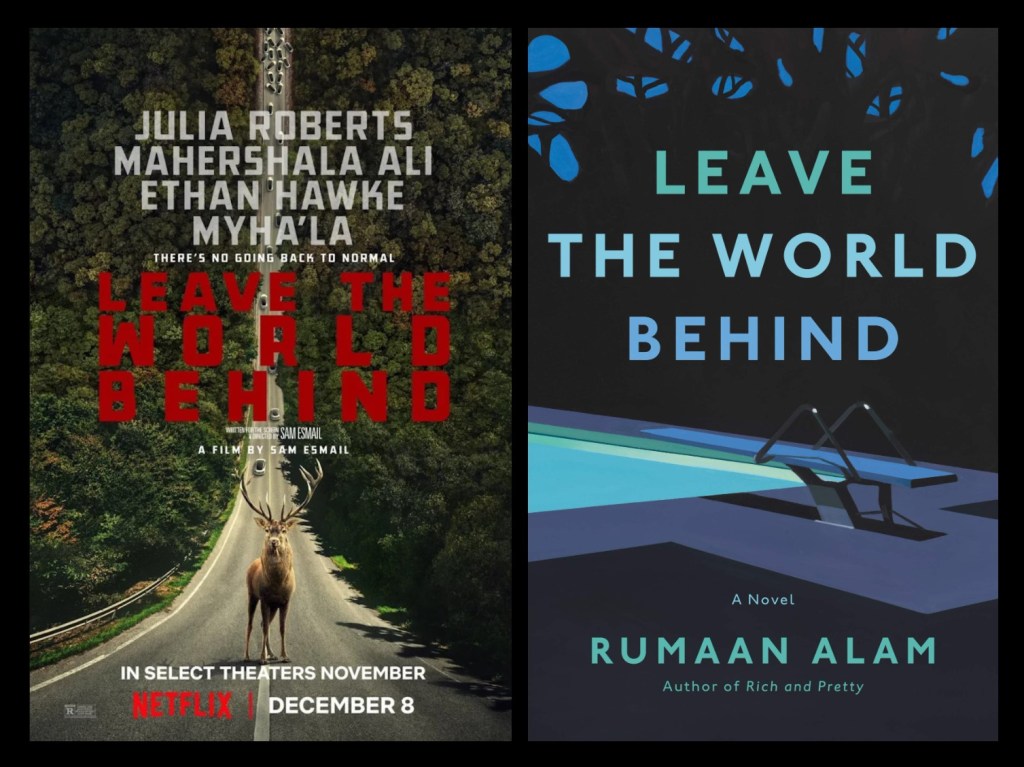
So, when I watched Leave the World Behind on Netflix last night, I got overly excited because it’s a new and interesting take on this old theme. Every generation has their own philosophical thoughts about the possible collapse of civilization. What made Leave the World Behind even more relevant was I had just watched this YouTube video (watch below). I highly recommend you take the time to watch it too — it will add to your paranoid theories about what’s happening in Leave the World Behind.

Joe Scott explains how there’s a philosophical movement that believes we should hurry the collapse of civilization so we can get busy rebuilding everything. I think that’s insane. The philosophy is called accelerationism, and I don’t know if the producers of Leave the World Behind were using accelerationism as a cause or not, but it’s worth thinking about.

Amanda Sandford (Julia Roberts) wakes up and decides her New York City family should rent a house out on the island for the weekend. She doesn’t even ask her husband Clay (Ethan Hawke) but just wakes him up while she’s packing. They get their two kids (Rose and Archie) and drive to the rental house on Long Island. After they settle in, they head to the beach where they experience their first weird event. An oil tanker runs aground right in front of their beach umbrella. It’s quite an impressive special effect. The Sandford family just think it’s an odd, but startling accident.

That night, G. H. Scott (Mahershala Ali) and his daughter Ruth (Myhal’la) knocked on their door claiming to be the owners of the house. They ask if they can stay there that night too because the power has gone off in New York City. The house still has power, but it’s lost cable and the internet, so things are starting to feel weird.

The rest of the movie is about how these six people get along not knowing what’s happening. As the weekend progresses increasingly weird and strange things happen, but because they have no real news, the two families can only speculate. Clay tries to drive into a local town to find out what’s going on but gets lost without a GPS. Amanda, a businesswoman freely admits she hates people, has all kinds of paranoid theories. G. H. knows some extraordinarily rich people connected to the military and offers other theories. Poor Rose only wants to see the last episode of Friends after binge-watching ten years of the series and having just one episode to go. The Scotts are African Americans, and Ruth doesn’t trust the white Sandfords, especially the mother, Amanda.

There are some spectacular special effects scenes with deer and Tesla cars that made me think of other theories about what’s happening. The gathering of deer reminds me of Hitchcock’s The Birds.

One of the obvious points the movie makes is how terribly dependent we are on our smart phones. But if you pay closer attention, it’s interesting to know how different Leave the World Behind is from earlier stories like it. There is little survivalism in this film. Of course, this is just the first weekend of the apocalypse. I’d love to see a sequel about what the six experiences over the next coming months. Amanda assumes that everything will get back to normal soon, but we know that’s insane. Rose Sandford has the most positive approach. She decides she isn’t going to wait for things to get normal again, but goes off on her own to find a copy of Friends to watch.

There are a lot of preppers and survivalists in our society, but the six presented here don’t think that way. I assume the storytellers are saying most of us are going to be damn helpless. None of the six even say, “At least we have plenty of deer to eat.”

I really got into Leave the World Behind, but Susan, my wife, thought it was a big waste of two hours on Christmas Eve. I thought it justified the price of Netflix this month. The film is based on a book by Rumaan Alam. I haven’t read it, but now I’m tempted.

James Wallace Harris, 12/25/23

“The Man Who Came Early” by Poul Anderson

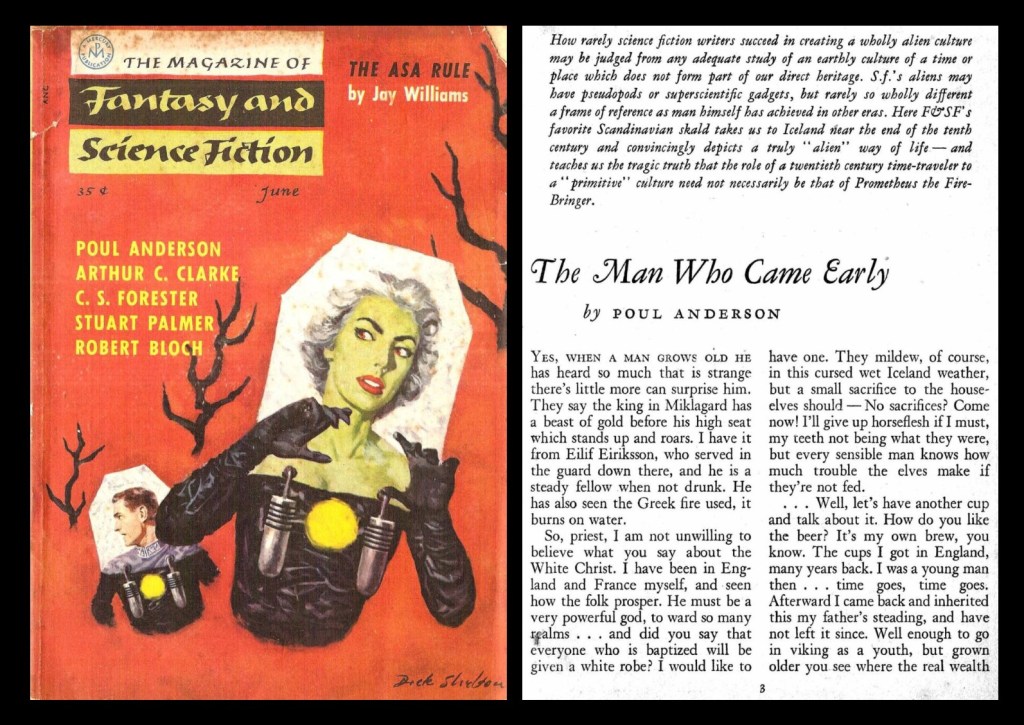
“The Man Who Came Early” was first published in The Magazine of Fantasy & Science Fiction, June 1956. You can read it on Archive.org. It is story #12 of 22 for The Best SF Stories of 1956 group read. Asimov and Greenberg picked “The Man Who Came Early” for The Great SF Stories #18 (1956) and in Richard Lupoff’s What If? Volume 1, his anthology that reevaluated the Hugo awards, thought “The Man Who Came Early” was the “single finest story” of 1956. “The Man Who Came Early” has been well anthologized.

Science fiction writers often reply to earlier science fiction writers in their fiction, and “The Man Who Came Early” is Poul Anderson’s reply to Mark Train’s A Connecticut Yankee in King Arthur’s Court and to L. Sprague de Camp’s Lest Darkness Fall. Both classic time travel novels are about men who are thrown into the past and use their scientific knowledge to gain power and success in less scientifically aware times. Anderson attacks the assumption that modern knowledge would give any time traveler an edge in the past.

Twain’s character, Hank Morgan, goes from the 19th century to the time of King Arthur via a knock on the head. De Camp’s Martin Padway travels to 535 A.D. Rome by being struck by lightning. Anderson’s Sergeant Gerald Roberts returns to about 1000 A.D. Iceland also via lightning strike.

Poul Anderson admired medieval societies, and often used them in his fiction. I’ve read where Anderson claimed such societies are about as complex as what he thinks humans could handle. What impressed me most about “The Man Who Came Early” was the historical details of ancient Iceland. I’m sure Anderson delighted in writing that part of the story.

The plot involving the hapless Gerald Roberts was less appealing to me, but I thought it made a good case for Anderson’s supposition that time travelers from the future will not have an advantage because they know more. If you’ve seen James Burke’s documentary television series Connections, you’ll know he’s right. Knowledge and skills are tied to time and culture.

I believe Anderson’s description of Gerald Roberts fate is spot on. And I was impressed with Anderson’s point of view character, Ospak. I do not know anything about Iceland, either current or past, but Ospak’s voice in the story felt very realistic. He was both wise and insightful. Ospak was also compassionate towards his daughter Thorgunna even though Ospak knew she fell in love with the useless man from the future. Ospak even believed Roberts was from the future, and vaguely perceived why he couldn’t adjust to living in the past. Anderson did a great job describing an alien culture to us.

I was impressed with “The Man Who Came Early” the first time I read it. I’ve never been a big Poul Anderson fan, but reading it made me want to read more of Anderson’s work. I was still impressed, maybe even more so, with this second reading. I find it hard to like most time travel stories because they are so hard to believe. Even if time travel was possible, I find it harder to believe people could overcome the language barrier. Anderson claims that Icelandic is one of the few languages that hasn’t changed much in a thouand years. That might be true, but I’m still skeptical. Kids just two or three generations younger than me already use so many words and phrases that I can’t decipher without checking my iPhone.

In some ways I wonder if “The Man Who Came Early” would have been a better story if told from Gerald Roberts point of view. Wouldn’t we identify more with the frustrations of surviving in the past if we followed the time traveler? I’m sure Anderson was enamored with creating Ospak’s character, but from a storytelling point of view, wouldn’t seeing the experience from Robert’s eyes have been more intense? I’m reminded of Thomas Jerome Newton, the Martian who came to our planet in The Man Who Fell to Earth by Walter Tevis. Newton’s experience of being a stranger in a strange land was emotionally gutwrenching.

I was surprised that my friend Mike didn’t like “The Man Who Came Early” when he emailed yesterday:

My problem with time travel stories is that the plots feel manufactured and synthetic. Character development is sacrificed on the altar of clever machinations.

I realize that "The Man Who Came Early" is a widely praised story, but it felt emotionally flat to me. Everything feels like a plot device, complete with a far-fetched love interest and a convenient adversary (red shirt).
I agree with Joachim Boaz: "There isn’t much redeemable about this stilted caper. Well, Poul Anderson’s pessimistic theme that the modern man is unable to function in the past despite his superior technology is somewhat interesting despite the story’s poor delivery."

I completely disagree with Boaz’s assessment that the story was poorly delivered. I thought Ospak’s tale exceedingly well done. It let us see an ancient Icelandic perspective that felt genuinely possible to me. I do believe if we followed Roberts’ perspective, we would have felt a greater sense of frustration and tragedy being a time traveler, much like what Karl Glogauer experienced in Behold the Man by Michael Moorcock.

I experienced several levels and kinds of emotions in the story, so my experience is much different from Mike’s. I’m curious how other people felt. If you’ve read the story, please say below in a comment.

The discussion on Facebook has been positive so far.

James Wallace Harris, 12/23/23

“The Dead Past” by Isaac Asimov

“The Dead Past” was first published in Astounding Science Fiction, April 1956. You can read it on Archive.org. It is story #11 of 22 for The Best SF Stories of 1956 group read. Even though this is one of Isaac Asimov’s better stories, it was not up for the Hugo award, nor was it selected for a best-of-the-year anthology. Of course, it was competing with “The Last Question” which many, including Asimov, considered one of his absolute best stories.

This is the fourth time I’ve read “The Dead Past,” the second time the group has discussed this story in 2023, and I previously reviewed it here. I like what I said in my previous review, so I’ll let it stand. For this essay, I want to talk about multiple readings of a story and reading reactions from different people. If you read a story only once, you’ll have only one perception of it. Reading a story again often produces a different perception. And reading what other people think of a story often produces perspectives different from our own experiences.

For example, my friend Mike is reading these stories along with the group, and here’s his reaction:

In "The Dead Past," Asimov presents the idea of chronoscopy or "time viewing." It's a method of viewing past events. In most stories, chronoscopy is simply a deus ex machina that allows the story's plot to unwind, but Asimov confounds our expectations by making chronoscopy the main "character" in the story. 

Arnold Potterly wants to use chronoscopy to view ancient Carthage.
Potterly's wife, Caroline, wants to use it to view her deceased daughter, pleading that "I want my child."
For Jonas Foster, the development of the chronoscope becomes "...a matter of important principle."
Thaddeus Araman is distraught because if the chronoscope becomes widely available then "There will be no such thing as privacy."
Asimov whipsaws us through conflicting emotions about the chronoscope. Would it be good to allow Potterly to peer into the everyday events of Carthage? Would allowing Caroline to view her long dead daughter bring her happiness or detach her from reality and result in madness? What about government control of chronoscopy? Araman laments the death of privacy, ignoring the fact that the government already uses chronoscopy to spy. Isn't privacy already dead?
Chronoscopy takes center stage and Asimov skillfully allows us to view its many facets. We are left to decipher our own feelings about how it should be used.
Araman's final words are stark and signal the impending dystopian future: "You have created a new world among the three of you, I congratulate you. Happy goldfish bowl to you, to me, to everyone, may each of you fry in hell forever. Arrest rescinded."

Even after reading the story four times myself, I feel Mike saw “The Dead Past” in ways I didn’t. Mike sums up the story nicely, somewhat like I did in my previous review, but leaving me feeling he liked the story more than I did and saw it with a different spin. But what’s interesting when I started rereading the story this time, was how I noticed things that weren’t in my last review, or memory, or in Mike’s comments, or in the comments on the Facebook group.

Even short stories are full of hundreds of details, details smaller than the plot. We might think of them as brushstrokes that paint the story. With each sentence Asimov gave us, we get something to think about, and each impression could take our vision of what’s going on in the story in a different direction. Just look at the first paragraph:

Arnold Potterley, Ph.D. was a Professor of Ancient History. That in itself, was not dangerous. What changed the world beyond all dreams was the fact that he looked like a Professor of Ancient History.

Knowing the rest of the story makes me wonder why did Asimov started the story this way? The word “looked” is italicized for emphasis. Even though I’ve read this story three times before I cannot recall anything in the plot that significantly deals with Potterley’s appearance. And the next paragraph is even more enigmatic.

Thaddeus Araman, Department Head of the Division of Chronoscopy, might have taken proper action if Dr. Potterley had been owner of a large, square chin, flashing eyes, aquiline nose and broad shoulders.

WTF! Did I miss something entirely in my first three readings? What is Asimov doing here? Is he just throwing out Araman’s prejudices to color the story’s opening? Did Asimov feel he personally wasn’t taken seriously because of his own looks, and just added this in as a story insight?

The story drops appearance and switches to the topic of chronoscopy and Carthage. In my previous readings I wondered about Carthage, and why Asimov was using it in this story. Asimov wrote many books on history, so I wondered if it was a pet topic of his. During previous reading I meant to research Carthage to see if what Asimov said about Carthage was true. Did it need defending and promoting?

The story then goes into Potterley’s academic frustration of being ignored and his desperation to use the time viewer. Now and in previous readings I wondered if in 1956 if Asimov had had similar academic tiffs with his superiors? Why is so much of the plot dealing with academic rejection? I especially ask this because I know the ending of the story takes us in a completely different direction to where the story had been taking us all along. In the end, we learn that the chronoscope (time viewer) can’t go back further than a century, so there was never a chance of seeing Carthage. And we learn there’s a reason the government keeps people from using the time viewer, and it abruptly changes the tone of the story.

I’ve often heard that there are two types of writers: pantsers and plotters. Pantsers are writers who sit down and start writing whatever comes to them through inspiration. They have no idea where the story is going but feel that their muse will guide them. Plotters are writers who carefully outline their stories ahead of time and know where they are going when they sit down to write each day. They believe everything must be consciously decided, structured, and interrelated.

I get the feeling Asimov was a pantser when writing “The Dead Past,” and with my every rereading of the story only confirms that impression.

If you only read a story once, you consume it like a pantser reader. But if you read it multiple times, you consume it like a plotter reader.

I assume Asimov’s original inspiration was an idea about a professor wanting to see the past with a time viewer. Asimov quickly decided Potterley wouldn’t get to see Carthage because he would have to turn the story into historical fiction and evidently Asimov didn’t want to go in that direction. He shifted the focus to frustration over not getting the funding to do research. Had that been happening to Asimov? I think Asimov saw this focus wouldn’t get him far, so he created the subplot of getting of the accomplice to add intrigue to the story. But even then, the story didn’t have much, so Asimov added the subplot with the wife. At some point he realized the story needed an ending and an insight and decided that examining the past was a bad idea after all. He then abruptly tied up the plots and subplots.

Even though Rich Horton picked this story as one of his all-time favorites, and “The Dead Past” got voted in on a Locus Poll of all-time favorite short stories, I’m not sure if “The Dead Past” is a good story. It was only in Volume Two of Asimov’s The Complete Stories, and not in any of Asimov’s other best of collections. I assume even Asimov later recognized it was clunky.

Multiple readings have revealed more problems with writing this short story. If Asimov knew when he started writing that time viewing was limited to the past one hundred years, would he have ever written about a professor wanting to view Carthage? My guess is Asimov added the subplot of the wife’s desire to see how her child died when he realized that the final insight showed time viewing dangerous to society because of privacy. I don’t know if he knew this on day one of writing, or several days later. Asimov was known to be a furiously fast writer. He was also famous for publishing hundreds of books. I doubt he spent a lot of time rewriting. I believe Asimov just doctored the story with the wife’s subplot.

If the time viewer had limitations and the government didn’t want to use it because it would cause privacy nightmares, there’s no reason this wouldn’t be made public knowledge. I can understand the government keeping a time viewer secret. But if the public knew time viewers existed, I don’t think there would be any need to keep its limits secret, or the fact that its invasion of privacy could shatter society.

Rereading the story reveals that Asimov liked to throw in interesting tidbits along the way. I won’t chronicle any more examples other than those I’ve given, but if you read the story again, look out for them. I’m fairly sure Asimov was a pantser, and things would come to him, and he’d throw little impressions and insights into his stories as he wrote them even if they don’t work consistently with the whole story. “The Dead Past” is like a snowball rolling downhill gathering more snow and other objects, and then it splatters apart when it hits a boulder. With one reading, following along with Asimov’s inspiration kind of works. But multiple readings make me see that “The Dead Past” was thrown together.

JWH