“The Country of the Kind” by Damon Knight

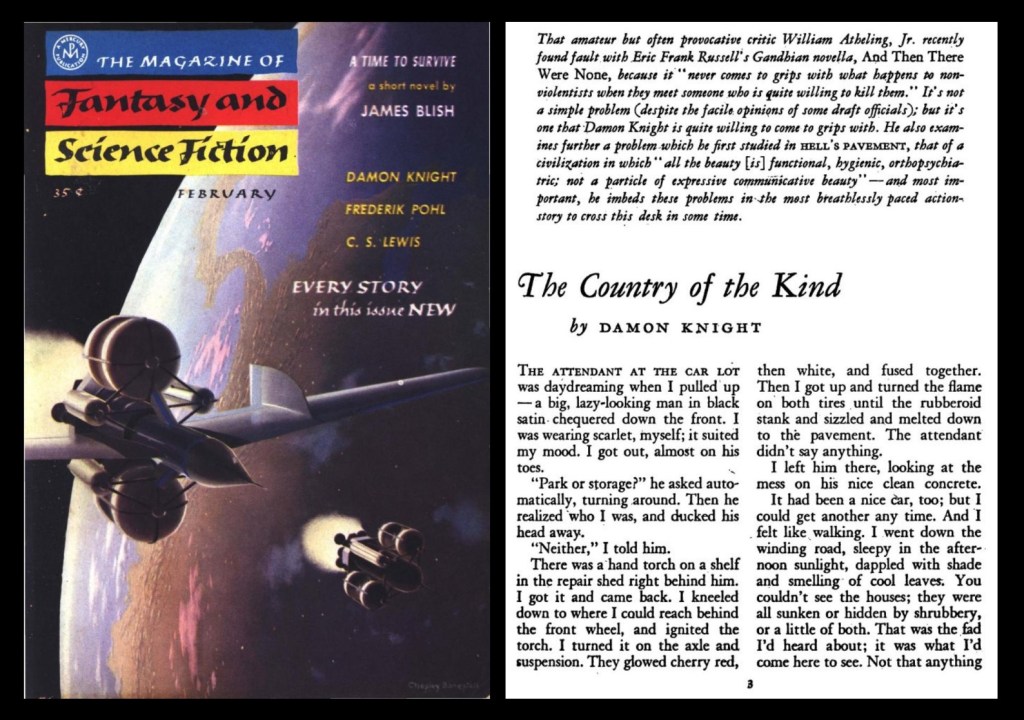
“The Country of the Kind” was first published in The Magazine of Fantasy & Science Fiction, February 1956. You can read it on Archive.org. It is story #5 of 22 for The Best SF Stories of 1956 group read. “The Country of the Kind” is one of the highest rated stories on The Classics of Science Fiction Short Stories v. 2 list, with eleven citations. It is by far the most remembered science fiction short story from 1956. Here are the eleven citations we used:

“The Country of the Kind” is set in an unnamed utopia and is told by an unnamed narrator. When the narrator was fifteen, he killed a girl who spurned him. In this utopian society they couldn’t punish him directly because it doesn’t allow violence. They fixed the narrator so whenever he tried to hurt someone else, he’d have an epileptic fit. And to warn others of his presence, his body odor and breath were made to smell repulsive. He was then left free to do whatever he wanted. For thirty years he has wandered about the Earth trying to retaliate by sabotaging other people’s activities or destroying their property. People ignored him, so he suffered endless loneliness. The narrator creates small works of art which he leaves everywhere with a message inviting other people to join him and be free.

My friend Mike sends me emails with comments about these 1956 science fiction stories since he doesn’t want to use Facebook. Here’s what he had to say:

A good science fiction tale draws you in completely, overriding your skepticism about the implausibility (or impossibility) of events.

Damon Knight asks us to accept the notion that a murderous psychopath is allowed by society to indulge himself in an endless destructive rampage. Although he is prevented from physically harming others by induced epileptic seizures, the community allows him to wreak havoc without restraint.

Perhaps Knight is exposing the passivity and weakness of that society, but it beggars the imagination that any group would allow such extreme behavior to go unchecked, no matter how kind and understanding they profess to be.

After the "king of the world" murdered his girlfriend named Elen when he was fifteen, he tells us "...if I could do it to Elen, I thought, surely they could do it to me. But they couldn't. They set me free: they had to."

Why did "they" have to? Are we to believe that a seemingly well run country is so "kind" that even a psychopath is allowed free rein? That's a bridge too far for me.

Remember, I talked about how believability was very important to me regarding science fiction when reviewing “Brightside Crossing.” I could understand why Mike didn’t think the world of “The Country of the Kind” was believable, but I said to him in a phone call, didn’t we both believe the world of “Brightside Crossing” was impossible? Yet, we still found the story believable. I asked him what crossed the line for him in “The Country of the Kind.” Mike said he just didn’t believe people would allow a person like the narrator in any society, that was too much for him to believe that people wouldn’t stop the narrator from damaging their property.

I said, wasn’t “The Country of the Kind” unbelievable in the same way “The Ones Who Walk Away from Omelas” is unbelievable, and didn’t you love that story? Mike replied that story was metaphorical.” I countered, doesn’t “The Country of the Kind” seem just as metaphorical in the same way? Both are about utopias that that are held together by the suffering of one person. After I said that, I even wondered if Ursula K. Le Guin wasn’t in some way inspired by “The Country of the Kind” when she wrote “The Ones Who Walk Away from Omelas.” Mike said he would reconsider “The Country of the Kind” as a metaphor. Maybe he will post a reply.

Are the fictional worlds of Brave New World, Nineteen Eighty-Four, or The Handmaid’s Tale believable? Aren’t they metaphorical too, because their authors have something to say about our reality? Dune, The Foundation trilogy, The Left Hand of Darkness and even The Man in the High Castle create worlds that we are asked to believe are realistic. Obviously, Alan E. Nourse wanted us to believe “Brightside Crossing” was realistic. But we aren’t expected to believe the fictional universes of The Hitch-Hiker’s Guide to the Galaxy or Sheckley’s Mindswap were realistic.

In other words, fantasy, humor, satire, and metaphorical fiction don’t ask us to believe their settings are realistic. But most literary works, especially of the mimetic type, and some kinds of science fiction do ask us to believe that they are reality based.

Of course, if “The Country of the Kind” is metaphorical, then what is the metaphor? That even kindness can cause great suffering. To be free in a utopia you need to be able to commit evil deeds. 1956 was a time of conformity in America, and many people were freaked out by juvenile delinquents, motorcycle gangs, and other nonconformists. Remember, a year later in 1957, On the Road by Jack Kerouac came out. Kerouac called his kind of nonconformists Beats, and society renamed them beatniks. A few years later, society turned against hippies too. I say On the Road wasn’t metaphorical. But I would say One Flew Over the Cuckoo’s Nest or Catch-22 are.

In the 1950s there was a lot of talk about crime being caused by society, and that criminals were a product of bad biology or a bad environment. Damon Knight’s unnamed narrator is an awful person, but he gets our sympathy. Unlike the tortured child in “The Ones Who Walk Away from Omelas,” the unnamed narrator isn’t the engine of utopia. Or is he? Wouldn’t a perfect utopia be dull and boring? What if evil is needed as the engine of goodness? I’m reminded of a phrase, “What if our world is their heaven?”

What if all fiction is metaphorical? What if “Brightside Crossing” was a metaphor for extreme adventurers?

Fiction is based on a suspension of disbelief. If Mike can’t suspend his disbelief that’s perfectly okay. If he doesn’t like “The Country of the Kind” does it matter that I do?

I’m fascinated by the nature of memory. I’m particularly fascinated by fiction that our culture remembers, like works by Jane Austen or Charles Dickens. But I’m also fascinated by the stories I find personally memorable. “The Country of the Kind” and “The Ones Who Walk Away from Omelas” are such stories. A year for now, I might forget “Brightside Crossing.” As I read and reread these old science fiction stories, I’m amazed by which ones I remember and which ones I don’t.

“The Country of the Kind” was voted into The Science Fiction Hall of Fame Volume One because it was so remembered by the first members of the Science Fiction Writers of America. I wish SFWA would poll their membership every ten years on their favorite stories. I’d love to see what every generation of science fiction writers remember.

With this December 2023 reading; it’s probably the fourth or fifth time I’ve read this story, I am somewhat sympathetic to the unnamed narrator of “The Country of the Kind.” I wasn’t before. I totally loathed the narrator. However, this time I still think his actions are still horrific, but I feel the utopian society has imposed a cruel and unusual punishment upon him.

And I’m still unsure of Knight’s intentions in writing this story. Whatever meaning it has could be entirely accidental. Knight might have thought of the situation without considering its implications.

The epileptic pain the narrator experiences is brought on by his own actions. But the loneliness is caused by the utopian society imposing the punishment. And this society is supposedly incapable of causing harm. Such a society would know that social contact is a necessity.

Writers often make their stories ambiguous but this one might be too unclear. I wonder if Knight has ever written an explanation of “The Country of the Kind.”

James Wallace Harris, 12/6/23

“Silent Brother” by Algis Budrys

“Silent Brother” was first published in Astounding Science Fiction, February 1956. It was by Algis Budrys writing as Paul Janvier. You can read it on Archive.org. It is story #4 of 22 for The Best SF Stories of 1956 group read.

Harvey Cable has a fascinating mystery to solve in “Silent Brother.” The spaceship Endeavor has returned from the first interstellar mission. Harvey might have been on that mission but was badly injured in a test flight of an earlier spaceship. He lives alone. Harvey must use a wheelchair or braces on his legs and a cane in both hands to get around the house. After watching the crew of the Endeavor return home on TV, he goes to bed hoping his old astronaut companions will come to see him soon. The next day he wakes up to find that someone has stolen the picture tube from his television.

After carefully searching his house, Harvey finds the picture tube on his basement worktable. He can prove that no one broke into the house. He even tests the picture tube for fingerprints and only finds his own. But Harvey is incapable of carrying a large TV picture tube downstairs because with leg braces, he must firmly hold onto the handrails. If no one broke into his house, who took the picture tube downstairs while he slept?

Harvey goes to bed the next night after rigging his house so he can’t sleepwalk out of his bedroom. Yet, once again he wakes up refreshed and discovers more work has been done on the picture tube in the basement. None of his traps to keep him in his bedroom have been disturbed.

“Silent Partner” is a fun story that sets up a good lock-room mystery. It has a satisfying solution, but I don’t want to tell you about it just yet. I encourage you to go to the link above and read the story. It won’t take long. “Silent Brother” was reprinted in both Merril’s and Asimov & Greenberg’s best of the year anthologies, but it’s not been reprinted in any major anthology since. My friend Mike who is reading these stories along with me emailed me quite a positive review. I’ll post it below after I get into the spoilers. I also liked the story, but does two guys liking a story sixty years later mean it was one of the best of 1956, or a forgotten classic science fiction story?

I’ve been thinking about the levels of good stories. There are good stories, and then there are good stories. A great story is a good story that launches into orbit for the reader. Not everyone who reads a group of stories will love every story, and different readers will pick different stories they think are the good ones. Here’s a hierarchy:

  • One of the good stories in a magazine
  • One of the good stories in a best-of-the-year anthology
  • One of the good stories that are finalists for an award
  • One of the good stories in a general anthology
  • One of the good stories that are in theme anthology
  • One of the good stories that are in a retrospective anthology
  • One of the good stories in a list of the all-time best stories.

“Silent Brother” was in the same 1956 issue of Astounding Science Fiction with the first part of Double Star, one of Heinlein’s best novels, and it won the Hugo award. The issue also contained “Clerical Error” by Mark Clifton which I reviewed last time. Our short story club generally didn’t like “Clerical Error” but Astounding readers back in 1956 picked it as their second favorite after the Heinlein serial in The Analytical Laboratory poll. “Silent Brother” came in third. I like both “Clerical Error” and “Silent Brother,” but I wouldn’t reprint either if I was an anthologist. I thought “Clerical Error” was more ambitious but poorly written, and I thought “Silent Brother” nicely written, and very enjoyable, but far from great. I can easily say it’s a good story, but what does that mean?

If you look at the table of contents for Merril’s best-of-1956 anthology, none of the stories stand out to me except “Stranger Station” by Damon Knight. That story has shown up three times already in our short story reading group because it’s often reprinted. I haven’t read most of Merril’s selection, and “Silent Brother” might be among the good ones. But “Silent Brother” is not in the same league as “Stranger Station.”

Looking at the table of contents from Asimov and Greenberg’s best-of-1956 anthology, we see five stories that stand out: “The Country of the Kind” by Damon Knight, “Exploration Team” by Murray Leinster, “The Man Who Came Early” by Poul Anderson, “The Last Question’ by Isaac Asimov, and “Stranger Station” by Damon Knight. These are all stories our group has encountered several times in the many anthologies we’ve already read. I have read The Great SF Stories 18 (1956), and “Silent Brother” falls toward the back of the pack. (It is interesting that Asimov and Greenberg with thirty-two years of hindsight were able to create such a solid lineup of 1956 SF stories.)

“Silent Brother” wasn’t a finalist for the Hugo award, and it’s never been anthologized for a major theme or retrospective anthology. Nor is it on any fan poll for being an all-time great SF story. Now, do you sense the relative nature of good? What I want to find are the most memorable, most powerful of the SF stories from 1956 that most people consider good. I liked “Silent Brother” a fair amount, but I wouldn’t anthologize it if I was creating an anthology of the best SF short stories of 1956. I might include it in a theme anthology if it worked well with the other stories.

Still, it was a pretty good story. And I think it would be interesting to analyze why? For me, the mystery about who was rebuilding the television made the story a page turner. However, it was the conclusion that elevated the story with a particular kind of happy ending. The crew of the Endeavor brought back invisible aliens who they had developed a highly beneficial symbiotic relationship. The silent brother was a new alien being that lived inside of you. Now, if you had just read Heinlein’s The Puppet Masters you might not think this was so wonderful, but Algis Budrys pulled it off. Why?

I think the idea of having a silent brother that heals and helps you if awful lot like what religion promises, like believing that Jesus will save us, or becoming one with God who will watch over all his followers. “Silent Brother” represents a story of transcendence. It reminds me of the ending to Childhood’s End. Harvey Cable was lonely and suffering from a damaged body. He, and the Endeavor crew welcomed the alien into their bodies and passed them on. But isn’t this the same story as The Invasion of the Body Snatchers? But that story was a metaphor for communism. Budrys presents the alien as a brother. Is it little brother to big brother? Harvey’s personality isn’t changed or possessed; he just has a very helpful invisible friend living inside of him.

Algis Budrys was a savvy guy. I’m guessing he consciously knew about the religion connection in his story, and he knows that most people would love to have a personal god to help them. Instead of inventing a theological being, Budrys creates an alien that serves the same function.

Here’s what Mike had to say:

I think "Silent Brother" is an excellent story.

The genius of the story is what Budrys leaves out. He gives us bits and pieces, and our imagination fills in the blanks.

For example, Harvey Cable has obviously been seriously injured in the past. We don't know for sure what happened to him, but we imagine some kind of space flight misfortune left him damaged. Was it radiation? Was it an equipment failure, or a spaceship catastrophe? Budrys gives us room to speculate.

Budrys relates that Cable's struggle is both physical and mental. He "...trembled on the brink of admitting to himself that his real trouble was the feeling that he'd lost all contact with the world." He is in trouble and "The idea was to hang on to reality."

It's slowly revealed that Cable is disassembling his TV set and reworking it into something else. Budrys writes beautifully descriptive sentences: "How did one shot-up bag of rag-doll bones and twitchless nerves named Harvey Cable accomplish all this in his sleep?" and "What in the name of holy horned hell am I building?"

Once the TV rebuild is complete, Budrys never reveals its exact purpose, but it's obviously of great importance because afterwards "...he felt his silent brother smile within him." Again, we get to fill in the blanks on our own.

A parasitic alien has entered Cable, and healed him. "Who wants symbiosis until he's felt it?"

Budrys explains "...we were born in a solar system with one habitable planet, and we developed the star drive. And on Alpha's planet, a race hung on, waiting for someone to come along and give it hands and bodies

Cable's final act is to send part of his silent brother to each of the three men who have come to interview him. The parasitic alien is passed on.

No long info dumps. No discursions. A concise, heartfelt, beautifully written story.

I think Mike admired the story far more than I did. I thought the rebuilt TV with its flashing lights helped Harvey connect with his new brother and helped him to retrain him to reprogram his damaged body. It’s like when Dr. Cal Meacham builds an “interocitor” in the film “This Island Earth” — the gadget allowed him to connect with aliens.

Mike and I have talked about “Silent Brother,” discussing how stories affect readers differently. Critics often write about fiction as if there were objective standards, but that’s not possible. Fiction is like a day, for some people the day might be wonderful, and for others horrible, and for many just another day.

I’m looking forward to seeing how many members in the Facebook group like or dislike “Silent Brother.”

James Wallace Harris, 12/4/23

“Clerical Error” by Mark Clifton

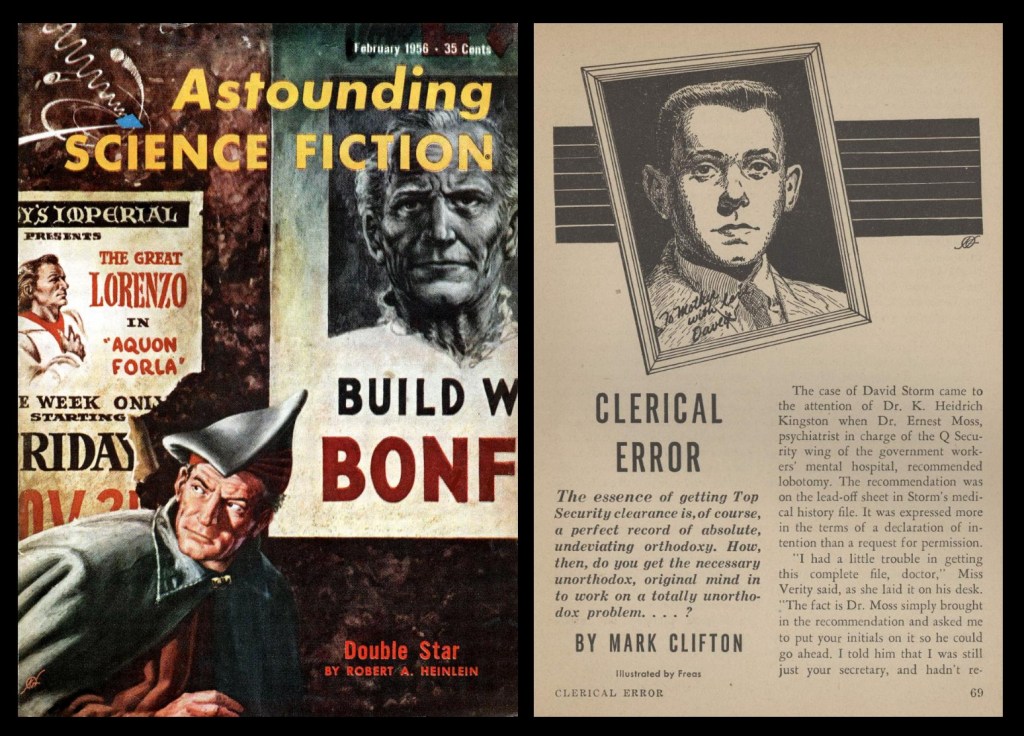
“Clerical Error” was first published in Astounding Science Fiction, February 1956. You can read it on Archive.org. It is story #3 of 22 for The Best SF Stories of 1956 group read. I selected “Clerical Error” for our best SF stories of 1956 group read because Asimov and Greenberg, and T. E. Dikty selected this story for their best-of-1956 anthologies, and Judith Merril listed it in her anthology for 1956 as an honorable mention.

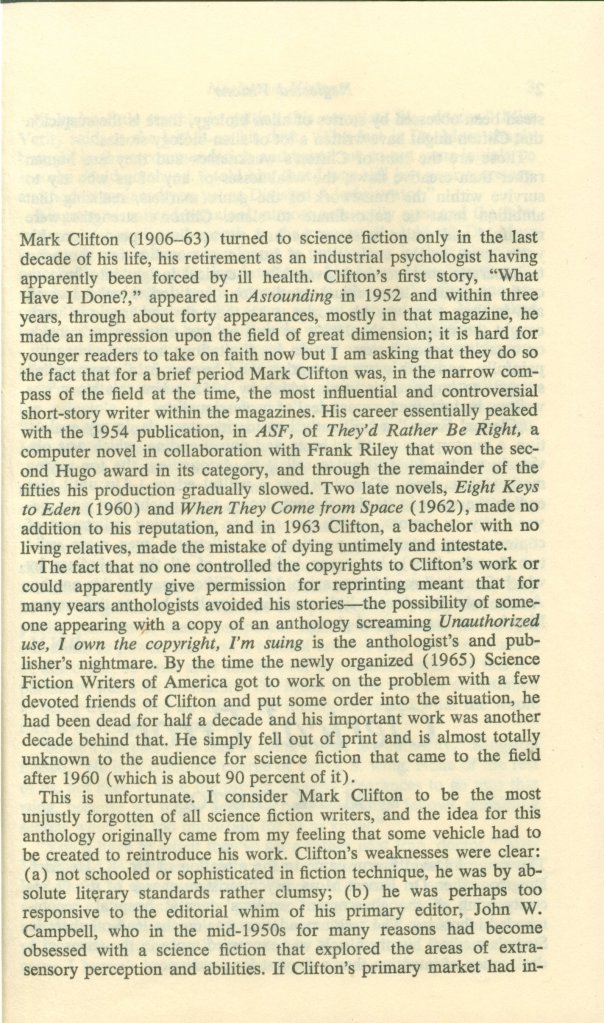
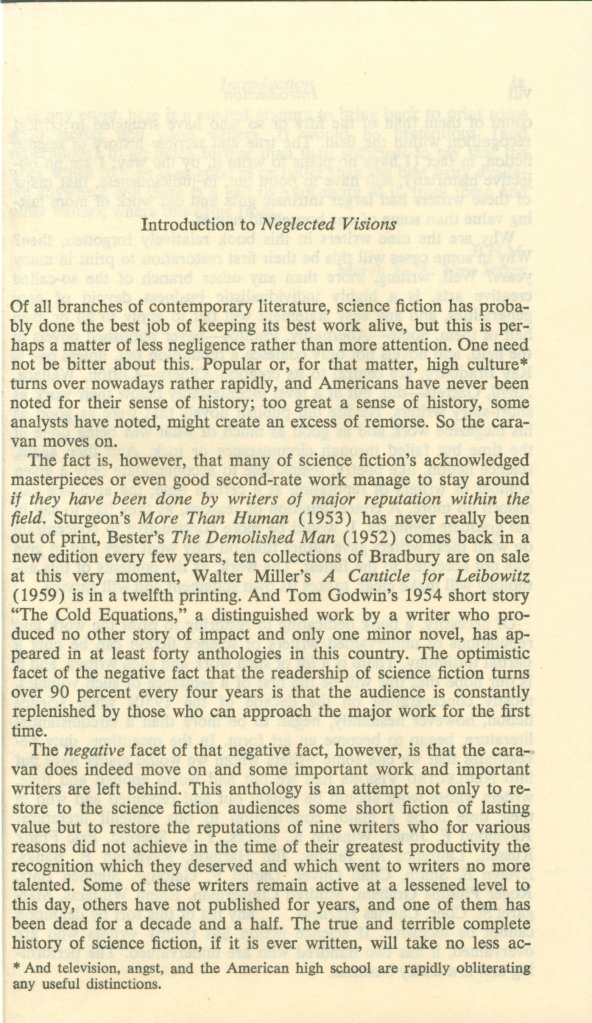
The only significant anthology that reprinted the story was Neglected Visions (1979) edited by Barry Malzberg, Martin H. Greenberg, and Joseph Olander, whose goal was “an attempt to restore the reputations of eight writers who did not achieve the recognition they deserved.” “Clerical Error” was also reprinted at SciFiction.com in 2002, an early internet effort to reprint classic science fiction online. Barry Malzberg also edited The Science Fiction of Mark Clifton back in 1980. Long out of print, but copies are available on ABEbooks.

In other words, “Clerical Error” has its fans who have tried to save it over the years, but the first time I read it, I found the whole beginning muddled, too full of info dumping. This time I also found the first part impenetrable and stopped reading. I then gave it a rest and started researching the story online. I could tell Clifton was trying to do several things at once in the first half of the story. He was setting up the much simpler second half, but he was also using the story to expound on science, scientists, and the perception of science, among other things.

Clifton also worked hard to develop his characters, and convey them psychologically, and even have us understand the psychological understanding of the psychiatrist. But this requires close reading.

I then read Barry Malzberg’s introduction to “Clerical Error” where he gives us some background on Mark Clifton. After reading that, and thinking about what I had read so far, I went back and started the story for a third time. For some reason I was in the right mood, and I zoned in on what Clifton was doing. This time the story worked great. Here’s Malzberg’s introduction.

I really wanted to hear this story too, but I couldn’t find any audiobook narration of the story. I even downloaded a pirated copy of a Mark Clifton collection in .pdf format and loaded it into the Edge browser which has a very good text to speech function. It works to a degree, but ultimately, I had to give up.

The story’s set up involves a scientist, David Storm, going insane. Because Storm works for the government in a high security job, the government doesn’t want to release him to outside doctors. He babbles about technology that will change the world. Dr. Ernest Moss, the psychiatrist with security clearance in charge of Storm requests that Storm be given a lobotomy. Dr. Kingston, the psychiatrist administrator over Dr. Moss doesn’t want to allow the lobotomy until he understands the case, but he doesn’t have top level security.

Dr. Kingston tries several end-runs around bureaucracy desperately to save Storm. Each step gives Clifton a chance to pontificate about science versus the government. Since Malzberg points out that Clifton was an industrial psychologist, this means his insights have some weight.

One reason why the story is so hard to get into is it digresses in so many directions. Clifton focuses on Dr. Kingston and his secretary Miss Verity. She is the top secretary in the psychiatric division, and Clifton represents them as the two most powerful people in the story. Miss Verity has a mind of her own concerning how things should be done. She wants to protect her boss Dr. Kingston. Dr. Moss tries to bypass Dr. Kingston by trying to get Miss Verity to sign off on the lobotomy for Kingston. That’s when she alerts Kingston to the problem. The rest of the story is Kingston trying to get help for David Storm, which would require sending him to doctors without security clearances.

This is all straightforward. Clifton complicates things by using the power struggle between Kingston and Moss to comment on psychiatry and science. This is why the story is in Astounding, because John W. Campbell Jr. loved these kind of discussion stories that challenge how people think, how they contend with authority, and how the status quo should be questioned.

I can understand how an insane scientist who babbles about government secrets could be a problem, but would a lobotomy even stop him from talking? It could quiet his constant anxiety and rage, but would it erase what he knows? I’m not sure how lobotomies work. Storm has also gone through a series of electroshock treatments that hasn’t shut him up.

Clifton uses “Clerical Error” to promote psychiatry as a science. But he also develops each character with a lot of psychological insight. This adds another layer to the story. And it’s why I said the story is hard to get into. Clifton is doing three things at once. Expressing politics, showcasing psychiatry and psychology, and telling a story. Along the way he also gives several reasons for the title of the story.

Like I said, it all came together for this third reading. I think if I read “Clerical Error” a fourth or fifth time, I’d get even more out of it. There’s a lot to it. It’s a shame that Clifton’s stories aren’t in print. But that’s why we’re doing this group reading for The Best SF Stories of 1956, to find forgotten classics that deserve more attention. I really like what Barry Malzberg said in his introduction to Neglected Visions. I hope he doesn’t mind me reprinting it here.

Unfortunately, Mark Clifton seems to be mostly out of print. You can find his original magazine publications using ISFDB and Archive.com. However, Amazon does have The Second Golden Age of Science Fiction MEGAPACK ®: Mark Clifton for 99 cents. It doesn’t have “Clerical Error,” but it does have a handful of stories and a couple of serials. In 2020 Dover published What Have I Done?: The Stories of Mark Clifton. The paperback is currently $7.48 for 288 pages, but the ebook is $3.99 but claims to only have 21 pages. That worries me. It appears to only be the first story.

James Wallace Harris 11/30/23