I’ve been craving a new science fiction novel, at least something less than ten years old. I admit, I’ve been stuck in mid-20th century science fiction, and I’m mostly out of touch with 21st century science fiction. I have read forty or more science fiction novels that were published after 2000 — the more famous ones — but there’s been thousands of science fiction novels published since then. I’m feeling out of touch with current science fiction. I keep hoping to find a new science fiction novel that will dazzle me like the science fiction novels I discovered as a kid in the 1960s. I’m beginning to feel that won’t ever happen again.
Sea of Rust as Sci-Fi
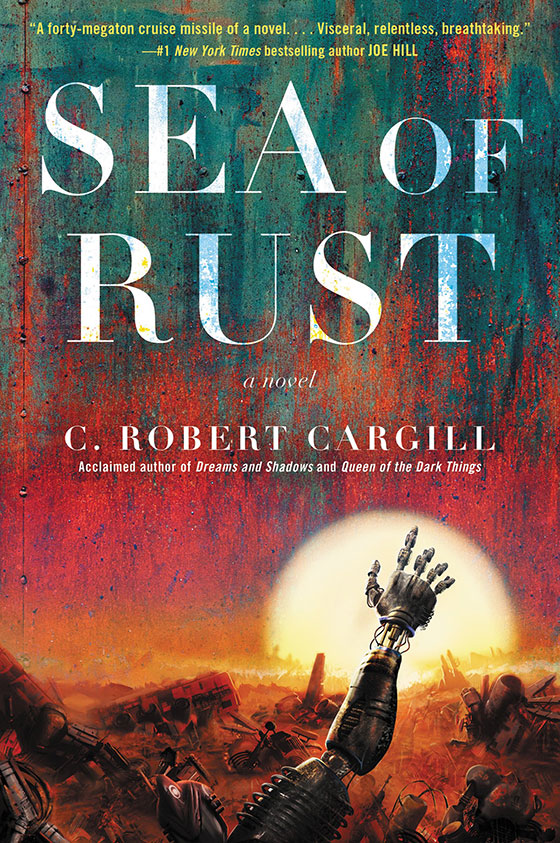
Sea of Rust by C. Robert Cargill came out in 2017. I picked it to read because I watched a couple YouTubers review it positively, and because it’s about robots after humans have gone extinct. I love that concept. It’s slowly growing into a mini-sub-genre. One of the earliest stories on this theme is “Rust” by Joseph E. Kelleam from 1939. (See my short review.) Another is “Who Can Replace a Man?” by Brian W. Aldiss from 1958. Of course, the real classic is City by Clifford D. Simak, but the theme is only used in the fictional intros that tie stories together. Those intros describe a world without men occupied by robots and intelligent dogs. There’s also “Three Robots” an episode in the Netflix series Love, Death + Robots based on a John Scalzi short story, and the more famous film, Wall-E. And Rudy Rucker’s Ware Tetralogy eventually gets into this theme too. There are many more.
Sea of Rust is a fun adventure story about a cadre of armed robots helping a robot, Rebekah, on an important mission to save free robots from an OWI (One World Intelligence – think Borg for bots). Their destination is in a wasteland called Sea of Rust, formally, the American Rust Belt. That’s the territory were crazy robots go, and where poachers go to kill the crazy robots and harvest their parts. Sea of Rust feels a bit like a Mad Max film, but instead of people surviving a harsh desert post-apocalyptic environment, it’s robots. It especially reminded me of Mad Max Fury Road, only because it becomes an endless race of good guys being chased by bad guys.
The main POV character is Brittle, who started out as a caregiver robot for humans, but after their extinction, becomes harden, surviving by killing other robots for their parts. Her nemesis is Mercer, another caregiving robot who is also a poacher. They want to kill each other to survive. When the OWI, CISSUS, attacks a holdout for free individualistic robots, these two joins up with Rebekah, 19, Herbert, One, Two, Doc, and Murka. At first Brittle goes along to survive another day, but eventually believes in Rebekah’s mission too.
Sea of Rust also feels like a western, with parallels to The Magnificent Seven, because of a group of diverse misfits, some of which aren’t so nice, work together for a noble cause. Each has their weapon of choice. Sea of Rust also remind me of many war movies where a squad of soldiers are on a suicide mission, and one by one get killed off.
I recommend Sea of Rust to readers who like action-oriented science fiction like what they see on television or at the theater. It’s fun. It’s nowhere near as fun as We Are Legion (We Are Bob) by Dennie E. Taylor or Hail Mary by Andy Weir. But it’s like them in that Sea of Rust is breezy and entertaining.
When I ask myself why We Are Legion (We Are Bob) and Hail Mary are better books, it’s because I admire their main characters, and envy their skills. They are positive. Brittle is a mass murderer of humans, and robot con artist and murderer. It’s strange how much modern fiction features heroic bad guys.
— Beyond Here Lie Spoilers —
Don’t read beyond here because I’ve going to be critical of Sea of Rust, but most of my criticism doesn’t apply to the average science fiction reader, especially those who only read for fun and don’t want to get overly analytical. It might seem like I’m attacking Sea of Rust but I’m using it as an example, to explain the kind of science fiction I want to read.
Sea of Rust as Speculative Fiction
I like science fiction that speculates about real possibilities. Very few science fiction novels do this. Most science fiction takes a fun theme and produces a new variation. Sea of Rust is about robots, but the robots in science fiction aren’t like the robots we see in the real world. Nor are fictional robots anything like what current robots will evolve into. I find that disappointing.
In Sea of Rust all the robots act like humans wearing robot suits. There is some minor speculation, but science in the novel seemed inspired by the average PC user, and not computer scientists. The technical terminology doesn’t go beyond CPU, RAM, memory, hard drive, and core. It’s just a fun story, a light-hearted thriller with lots of guns, and gun battles. Similar visually to what people see in video games.
All the robots in this story have human qualities, and that’s my main critical issue. I’m disappointed that science fiction writers don’t or can’t imagine robots with non-human qualities. I can’t think of any robot story where the robot isn’t anthropomorphized. Is that some kind of barrier writers just can’t break through?
The idea of intelligent robots existing after humans is extremely fascinating. What kind of civilization would they build? I can’t believe it would be a cliche Mad Max post-apocalypse. I doubt robots will ever have gender or even be able to comprehend it. I doubt robots will have emotions or be able to comprehend them. None of the experiences we get from being biological creatures will be understandable by AI minds.
I’m waiting for science fiction writers to imagine states of mind that robots will evolve. I’m waiting for science fiction writers to speculate how robots will think differently from us. Sure, this will be hard, as hard as humans imagining the umwelt of octopuses.
Now that I’m an old science fiction fan, I’m beginning to see the limits of what science fiction can achieve. What I want probably needs to come from speculative nonfiction, and not speculative fiction.
My other major problem with Sea of Rust is its use of guns. We live in a culture that has a lust for guns. It’s a kind of pornography. But the use of guns in fiction is a kind of crutch, at least to me. Too much fiction is based on gun violence. Too much plotting and plot motivation centers around gunplay.
Conflict is vital to fiction, but too many writers depend on gunplay as their basis of conflict. Consumers of books and movies can’t seem to get enough of fiction with gunplay, so it might be silly to criticize the use of it. But I’m bored with gunplay-based conflict. I’m also reading Raymond Chandler books this summer, and they have extraordinarily little gunplay in them, and they are considered the gold standard for hardboiled detective mysteries.
Sea of Rust would have impressed me if Cargill had imagined robots involved in some kind of conflict that was realistic for evolved AI minds, and that didn’t involve guns or kill or be killed. I’m guessing robots won’t be violent like us because they won’t have our genetic disposition for xenophobia, greed, reproduction, and territory.
It could be, at 71, I’m finally outgrowing science fiction. I don’t want that to happen. I’m like a religious person that’s lost all their faith, and should be an atheist, but I can’t give up my upbringing. What I want is science fiction that will validate my belief in science fiction again, but Sea of Rust didn’t provide that. I know many young people consider this a 5-star read, and I do recognize it has the qualities that would appeal to many readers. So, don’t take my reaction as a buyer’s guide.
I wrote this review using Sea of Rust to explain where I’m at and what I want from science fiction. Thinking about novels about robots, I’m not sure science fiction has ever dealt with them in a realistic way. Asimov, Williamson, and Simak certainly did not. Neither did Philip K. Dick.
Living in the 2020s has brought us real robots and Artificial Intelligence, as well as commercial space exploration. Reality is leaving science fiction in the dust. I keep waiting for science fiction to catch up to reality and leap into the future again. I’m starting to think that might not even be possible.
Yes, I hunger for new science fiction that realistically speculates about the rest of the 21st century, but I just can’t find any. I’m beginning to wonder if science fiction has ever realistically speculated about the future.
James Wallace Harris, 7/25/23
 Classics of Science Fiction
I didn’t like this book either. It felt like their was too much info dump and the author should of fescue on what makes the robots different from humans.
LikeLike
I really enjoyed it
LikeLike