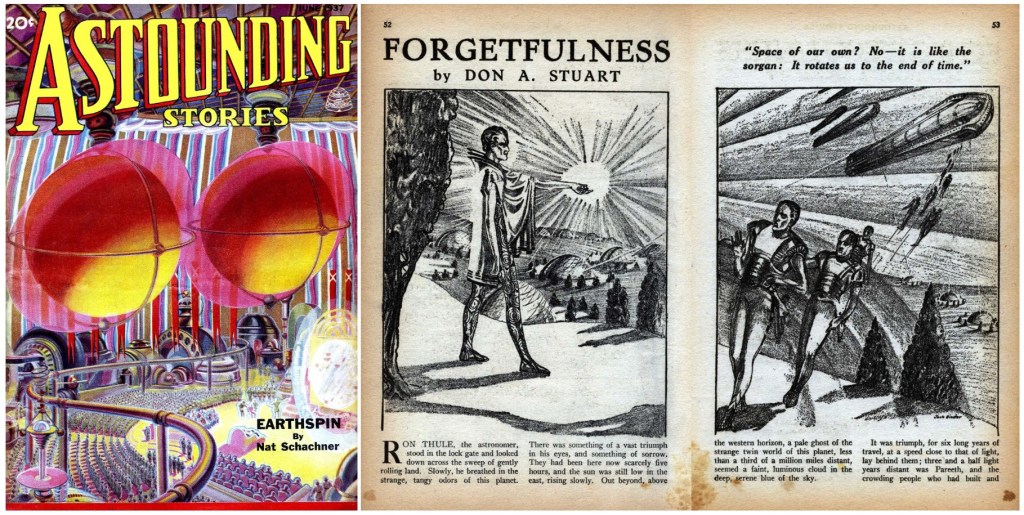
“Forgetfulness” by John W. Campbell

“Forgetfulness” by John W. Campbell, Jr. is story #2 of 52 from the anthology The World Treasury of Science Fiction edited by David G. Hartwell (1989) that my short story club is group reading.

Instead of counting all the titles and authors of science fiction books I’ve read, I’m starting to tally all the far-out concepts science fiction has given me. In “Forgetfulness” John W. Campbell took one of my favorite concepts, walking in ancient dead alien cities, which was probably an old SF concept even in 1937, and gave it a couple twists. It’s going to be impossible to talk about this story without giving spoilers so think of this essay as an analysis of SF concepts and not a review. You can read the story online here, or buy it in a $2.99 Kindle edition of Campbell’s collection Cloak of Aeshir. However, I don’t recommend buying unless you’re a big fan of John W. Campbell.

“Forgetfulness” begins with a spaceship landing on the planet Rhth, one of nine planets in the system. The main point-of-view character is Ron Thule, an astronomer, from the planet Pareeth. They have traveled for six years, in a spaceship 2,500 feet long and 400 feet in diameter, covering 3.5 light-years, traveling at nearly the speed of light. These people from Pareeth are looking for a world to colonize, and are disappointed that Rhth is already inhabited. They hope to settle in the remains of a majestic city that was built by spacing-faring race millions of years ago and discover its secrets.

Try and pronounce Rhth. If nine planets weren’t a giveaway, the name Rhth should be. There they meet Seun, a very tall, graceful human-shaped being, clothed in a golden outfit, with a beautiful colored cape. All the people of Rhth wear gold suits and colored capes and live in opalescent domes twenty to thirty feet in diameter situated under giant green trees near the dead city. The buildings of that titanic city are three thousand feet high, but the winds have filled the streets with five hundred feet of dirt.

Seun has told Ron Thule and the commander of the Pareeth mission, Shor Nun, that the builders of the city had once visited their world. And that their world, Pareeth, once orbited the same sun as Rhth, but had been torn away by a rogue star. This hints that maybe the builders had conducted a kind of panspermia across the galaxy. As the story progresses the achievements of the builders become greater and greater. However, the people of Pareeth eventually discover secrets that can shatter their minds and their hopes.

Most of us find a great sense of wonder reading about the rediscovery of lost cities. So, it’s not a remarkable feat of creativity for a science fiction writer to imagine humans finding long-dead alien cities. Still, it’s one that sets off a powerful sense of wonder and has been used time and again in science fiction.

Campbell puts a twist on this concept, by having aliens discover a city from a long-dead civilization of mankind. John W. Campbell has a reputation that claims he wanted humans to be the galactic crown of creation, and this story supports that. In his earlier story, “Twilight” he had a human time traveler discover a far future deserted human civilization. That gave him a chance to imagine the engineering marvels of what we could achieve someday. In “Forgetfulness” he has aliens discover dead human civilization, but this time, Campbell imagined an even more impressive future for us built by super-science. You should read both stories to see just how hopeful Campbell was for the human race.

Both “Twilight” and “Forgetfulness” could be considered Dying Earth stories, although H. G. Wells in “The Time Machine,” William Hope Hodgson in The Night Land, and Olaf Stapledon in Last and First Men, took that idea, even much further.

Unfortunately, “Forgetfulness” is hard to read. Part of that is due to a dated writing style, but also because Campbell didn’t really have much of a story to tell. They came, they discovered wonders, they were frightened, they were disappointed. There’s no drama or revealed emotions. “Forgetfulness” was reprinted in the classic 1946 anthology Adventures in Time and Space but has been mostly forgotten since. Damon Knight remembered it in his 1966 anthology Cities of Wonder, and Brian Aldiss and Harrison brought it back again in 1973 for The Astounding-Analog Reader. Both are very minor anthologies. The second contained just seven stories from Astounding covering 1937-1941, a rather odd collection.

It’s interesting that a story about remembering has been forgotten. The big concept in “Forgetfulness” is visiting the remains of an astonishing civilization millions of years after its citizens have gone. Campbell puts his own twist on it by having that civilization be a future version of ours. However, there’s another important concept he wanted to get across, and that’s how we forget the past. Shor Nun and Ron Thule can’t understand why Seun doesn’t understand how the city works. But then Campbell reminds us we couldn’t explain the technology of cavemen, or from other periods of human civilization. Remember all the discussions about how did the Egyptians build the pyramids? Well, it turns out Seun has even newer technologies that are even further advanced than the builders and they have merely forgotten earlier primitive technology.

I have to wonder if Arthur C. Clarke’s story “Rescue Party” wasn’t inspired by “Forgetfulness” and “Twilight.” Or that the screenwriters for Forbidden Planet hadn’t read “Forgetfulness” too. Or were their ideas independently invented?

That’s the thing about science fiction. Concepts keep getting reused. Are they forgotten and then reinvented? Or does science fiction evolve over time as concepts merge and mutate? Will some young writer in the 2020s come up with a story about a far-future space race discovering a future Earth and finding the ruins of what our civilization will become? How will this writer imagine the pinnacle of our success? Campbell wanted to believe that humanity will evolve until it has god-like powers. That idea has shown up in science fiction over and over again. But do we still believe that? Right now the peak of our civilization might end this century.

James Wallace Harris, 5/9/23

Science Fiction Book Reviewers on YouTube

I have become fascinated by science fiction book reviewers on YouTube. Most are young, and what’s particularly fascinating to me is how they are reading old books to learn the history of science fiction. That’s something I’ve been curious about for years, how do younger people feel about older science fiction. Of course, some of them bring a woke perspective, but I don’t mind, I often accept their criticism. On the other hand, some of the woken lack compassion for what it meant to grow up in the past.

Most of these book reviewers don’t review new books. I’m used to those book reviewers in science fiction magazines reviewing the books that are just coming out or will be soon. So I assume these YouTube reviewers aren’t getting ARCs or review copies. Some of these reviewers seem to be making money off their YouTube channel, maybe enough to make a living. Or that’s the hope. My favorite reviewer is Bookpilled, and he admits his YouTube channels are the way he makes his living. That might be changing since he’s about to become a world traveler. Not all of his videos review books. He makes money by buying used SF and reselling it online, and some videos are showing what’s up for sale.

Bookpilled is my favorite because reviews books intelligently, and with a lot of insight. I don’t know his real name, but I think it’s Matt. He actually gets me to read books. The link above is to his main site, but here is his last favorites video:

The next channel I like is Fit 2B Read. I liked this particular review because it made me want to read/reread all five books. I wish these reviewers would use their own names. I like how Fit 2B Read sought out forgotten classics. That’s what I’m doing myself. The guy is very camera ready and his show is either scripted or he’s very good at talking off the cuff. One of the main problems with watching YouTube videos is they waste the viewer’s time by either giving us information unrelated to the video or by slowly meandering around a topic or just never getting to the point.

I probably shouldn’t say this, but some YouTubers just don’t speak well enough or look good enough to watch. Fit 2B Read does a good job of being a talking head. He doesn’t get too close to the camera. He speaks fast, but not too fast. And he’s coherent. Like many of these YouTubers, he cranks out the content, finding different reasons for creating a topic to film. This doesn’t always work, but I know that YouTubers have to constantly produce new content or they’ll lose viewers. YouTube has some kind of statistical science for promoting videos, and that puts YouTubers who want to build their channel and make money on the rat race treadmill. Fit 2B Read does make some slick-looking videos.

And talk about a slick production, I’m quite impressed with The Library Ladder. His production is eye-catching, he has a radio announcer voice and a camera-ready mug. But what really wows me about this guy is his collection. I assume he’s wealthy because he often shows books that are rare collectibles. The video of his that makes me drool is the one on Gnome Press.

One of the strangest reviewers is the one for Media Death Cult. His stage name is Moid Moidelhoff, but I don’t know if that’s a real name. Moid is quite a character. In many of his videos, he’s wearing a gun. Moid goes all out for his channel. He’s even started interviewing famous writers. Here’s his review of two lesser-known Philip K. Dick novels. (He hopes to review them all.)

Next up is the Secret Sauce of Storycraft. I was impressed with her take on The Sparrow but today I watched an earlier video, Classic SciFi Sampler, and she disappointed me with how many mistakes she made and how often she admitted she didn’t know something and didn’t want to look it up. That was an older video and I think she evolved quite a lot. Right now I’m forgiving of her mistakes because she seems young and fairly new to science fiction. But what I like is how she’s working to catch up.

I thought the premise of the video below was a great idea. She wanted her users to know what kind of books she disliked because if she only reviewed books she liked they wouldn’t completely understand her as a reviewer. Unfortunately, she only gives a litany of her emotional reactions to the 8 books, and no useful details as to why. The reason why I liked her review of The Sparrow is she worked out a framework of ideas to judge the book and that gave me something to think about. The woman who does Secret Sauce of Storycraft does know how to make a video, speaks well on camera, is camera ready, and stays on topic. I’m expecting her to improve. She needs to give us more details about the book and I hope she comes up with more analytical thinking about the themes in books like she did for The Sparrow.

The Shades of Orange, by a young woman named Rachel, also shows potential. She gives a bit more detail about the books than the reviewer on The Secret Sauce of Storycraft. I’m showing this video because she rereads Shadow & Claw by Gene Wolfe, a book my friend Mike is reading, and one I’ve been thinking about reading. She starts with some new releases. I want to see more of that. I’m completely out of touch with newer science fiction.

I wish these reviewers would give more details about the books and less about their impressions. I do not like spoilers, so I know it’s hard to present a book without ruining the story for people like me. I liked how she said that Shadow & Claw was about a regressed society which she didn’t learn right away in her first reading, but made a big difference in enjoying the book in her second reading. That’s a good detail and it’s not a big enough spoiler.

The Outlaw Bookseller often creates videos on topics I’m most anxious to watch but I have trouble watching them. My problem is he doesn’t get down to business quick enough, or he digresses, but when he is on target, he’s often the most knowledgeable about the genre of the reviewers mentioned here. And he covers the books and topics I’m most interested in. For example, I recently wanted to read a D. G. Compton novel. The Outlook Bookseller does give the level of detail I want, but he sometimes tells too much about the story. The details he does give are a description of what happens in the book. That’s great if they aren’t spoilers, but I also want analysis. The Outlaw Bookseller does give me most of what I want from a review, but I have to admit the presentation doesn’t work well for me. The reviewer has the details I want but gives them too fast, and in a kind of stream of conscious way that’s hard to hang onto cognitively. I think I would do better reading his reviews. I’m sticking with this channel, trying to adapt to the presentation, because this guy knows his stuff.

My guess is these YouTube book reviewers (BookTube?) have a greater potential of promoting and selling books than bloggers and magazine reviewers. I’d like to find reviewers who focus on new books, so if you know of any, give me a link in the comments.

James Wallace Harris, 5/6/23

“Harrison Bergeron” by Kurt Vonnegut

“Harrison Bergeron” is a political satire set in the year 2081. Kurt Vonnegut imagines everyone is not only equal under the law but handicapped to be made equal in all ways. Stronger people are weighed down, talented people are made less talented, and intelligent people have to wear earplugs that make various kinds of noises to distract them from thinking deeply. In this rather short story, George and Hazel Bergeron are watching a ballet on television. They have forgotten their 14-year-old son Harrison has been arrested for being too handsome, too smart, and too strong. During the course of the TV show, their son appears on the ballet stage having escaped to start a rebellion. (You can read it here, or read a detailed synopsis on Wikipedia.)

“Harrison Bergeron” is not a subtle satire, instead it goes for the absurd. It’s a very likable story. Vonnegut tells it in simple language with vivid details. You immediately agree with him that this dystopian world is wrong. This short story has become quite famous, having been adapted to the screen four times. National Review, the conservative magazine founded by William F. Buckley even reprinted the story. The National Review keeps using “Harrison Bergeron” – here’s it being used again in 2015 against economic inequality in “Inching Towards ‘Harrison Bergeron.’

Usually, satire attacks something, and I have to wonder what Vonnegut was attacking. While reading it I thought maybe he was protesting laws designed to create equal opportunity. Then when I read about National Review and that Supreme Court Justice Antonin Scalia quoted the story in PGA Tour, Inc. v. Martin then I began to wonder even more. And it’s referenced in academic papers, including a 2013 one about transgender athletes. I thought Vonnegut was liberal. Wikipedia did say he wasn’t against his story being used in a Kansas court situation, he didn’t agree with their interpretation.

So why have conservatives embraced “Harrison Bergeron” so thoroughly? Are they using its satire the way Vonnegut intended? A site called What So Proudly We Hail promotes the story with a very pointed introduction:

Central to the American creed is the principle of equality, beginning with the notion that all human beings possess certain fundamental rights and equal standing before the law. Our concern for equality has expanded over the past half century to focus also on inequalities in opportunities, wealth, achievement, and social condition. What good is an equal right to pursue happiness if one lacks the native gifts or the social means to exercise it successfully? In this satirical story (1961), set in a future time in which “everybody was finally equal . . . every which way,” Kurt Vonnegut Jr. (1922–2007) challenges our devotion to equality and invites us to consider the costs of pursuing it too zealously. Although the story is not explicitly about racial, ethnic, or gender equality, the questions it provokes about the kind of equality we should want, and the costs of pursuing it, are relevant also to campaigns to eliminate inequalities among racial and ethnic groups or between the sexes. Does the society portrayed here represent a fulfillment of the ideal of equality in the Declaration of Independence, or rather a perversion of the principle? Does opposing invidious distinctions, envy, and feelings of inferiority require reducing all to the lowest common denominator, and is this the true path to “social justice”? Would homogeneity attained by artificially raising up the low, producing a nation of Harrisons rather than a nation of Hazels—a prospect offered by biotechnological “enhancement”—be any more attractive?

The story does resonate with conservative thinking and even more so today. Are there other ways to read it? On the surface, the bad guys in the story are the government and laws that try to make everyone equal in every way. However, was that what Vonnegut was protesting. Was he all fired up and wrote this story the way the conservatives have used it?

I have no idea, but I do wonder about something. Vonnegut’s story is silly, absurd, and far from real. Vonnegut was often silly and absurd. I wonder if he just didn’t get the idea of a government taking the idea that everyone should be equal, and imagining how they could go about making it happen. It was published in a science fiction magazine. If Vonnegut was serious about his satire, why didn’t he publish it in a serious magazine? And back then, bizarre speculation on social change was common in SF stories.

The story came out in 1961, well before the liberal sixties. Eisenhower was probably president when he wrote it. A similar idea about making everyone equal had been used in the 1959 novel, The Sirens of Titan. In the 1950s the main political push to make people equal was providing equal education to African Americans. And that effort was to make people better educated, not dumber. My guess is “Harrison Bergeron” is based on a silly idea that came to Vonnegut and he wrote a story to illustrate it. Conservatives have just run with it.

What’s also interesting is Hazel, the wife, has no handicapping applied to her. She’s average. Was Vonnegut saying something about women? 1961 was also before the Second Wave of feminism in the 1960s. Was he being liberal to make the Handicapper General of the United States, a woman? She had the funny name Diana Moon Glampers? Was this a dig at women?

I don’t think I’ve read “Harrison Bergeron” before. Its basic idea is so memorable that I can’t believe I’d forget it. I could have since it’s been around since the October 1961 issue of The Magazine of Fantasy and Science Fiction. It’s also been reprinted quite often and I could have read it and thought it so absurd as to be completely minor, and did forget it. “Harrison Bergeron” has 9 citations in The Classics of Science Fiction Short Stories v. 2. I just read it because our short story club has just started reading The Treasury of World Science Fiction edited by David G. Hartwell. That anthology is a monster of over one thousand pages of classic science fiction where Hartwell also introduces science fiction from around the world.

Despite its fame, I still think “Harrison Bergeron” is a silly story. I’d only rate it ***+ in my system – three stars mean well-written, and a + means I liked it a lot. Four stars would mean it’s a story I’ll want to reread now and then, and I don’t feel that.

I’m going to try and review as many of the stories as possible from The Treasury of World Science Fiction. I haven’t given up on my Heinlein project, but after gorging on his work for months, I’ve been taking a break. I’ve wanted to get into a science fiction novel I never read but I’m still on a short story kick.

James Wallace Harris, 5/6/23

Five Reviews of The Sparrow by Mary Doria Russell

I first read The Sparrow by Mary Doria Russell in 1997. Then in 2005, I listened to it when it came out on audiobook. I remember it being an exceptional novel of first contact involving the Jesuits. Russell explored both religion and science fiction at the same time. Essentially, the story asks why bad things happen to good people, especially why would God be so cruel to one of his faithful. It asks this ancient philosophical question in a special context involving aliens, aliens who essentially make the query meaningless, or does it?

However, I don’t really remember the details of the book. This week I accidentally watched three reviewers review this book on Youtube and discovered most of them are part of a science fiction alliance of reviewers. That led to two more reviews. Watching all of them tells us a whole lot about how books are perceived by readers, and how reviewers take different approaches to evaluating books for our consideration. Here they are:

Bookpilled:

Kalandai:

Fit 2B Read:

Secret Sauce of Storycraft:

Media Death Cult:

The Library Ladder:

I’m afraid I’m going to have to study these reviews carefully and reread The Sparrow. Bookpilled is my favorite science fiction reviewer on YouTube and he did not like the book. He had very specific criticisms, some of which I’ve made against other books. I don’t remember thinking about those criticisms when I read The Sparrow.

The Sparrow is on the Classics of Science Fiction list with 23 citations. It is a novel that’s widely admired. But it’s over a quarter of a century old, and it’s been eighteen years since I last read it. I’ve changed, society has changed, and maybe it will be a different reading experience for me this time. Watching these reviewers has brought up a number of questions for me:

  • Are reviewers too easy or hard on books?
  • Are readers too easy or hard on books?
  • Will these reviewers change how I reread The Sparrow?
  • Are there positive qualities that all readers can recognize?
  • Are there flaws that all readers can perceive?
  • Are the value or faults of novels entirely subjective?
  • Have these reviewers found insights I missed?
  • Are novels merely Rorschach tests or do novelists have something specific to say?
  • Do we waste our time by reading books that aren’t worth discussing?

I like this group review by the Science Fiction Alliance. Kalandai doesn’t seem to be part of the group but her review fits in. I hope this group does other group reviews. Some novels are worth the extra focus.

James Wallace Harris, May 2, 2023