History vs. Fiction vs. Science Fiction

Isaac Asimov would open his introductions to each of the 25-volume series, The Great SF Stories (1939-1963) with “in the world outside reality” and then describe actual world events of that year. Several paragraphs later, Asimov would start over with “in the real world” and relate what happened in the subculture of science fiction. Because I grew up addicted to reading science fiction, I actually thought like that. I was born in 1951, and I became aware of atomic bombs and ideas about WWII and WWIII from reading and watching science fiction. I eventually learned differently as I got older in the second half of the 1960s, but still, most of my conceptualizations about nuclear wars came from science fiction. In other words, I learned about reality from science fiction and fiction before studying history.

But even as an adult, I assumed that most people got most of their ideas about what it might be like to survive nuclear war from science fiction. That’s why I wrote “Science Fiction About Surviving a Nuclear Holocaust Pre-1960.” And that might be true for people born after 1950, but in researching my essay I realized that it wasn’t true for people born before 1950. Between 1945 and 1950, and probably for several years into the 1950s, atomic warfare was widely discussed and speculated about in public — in newspapers and magazines, and on radio and newsreels. After that, I theorize people’s conception of what nuclear war would be like was shaped more by fiction and science fiction.

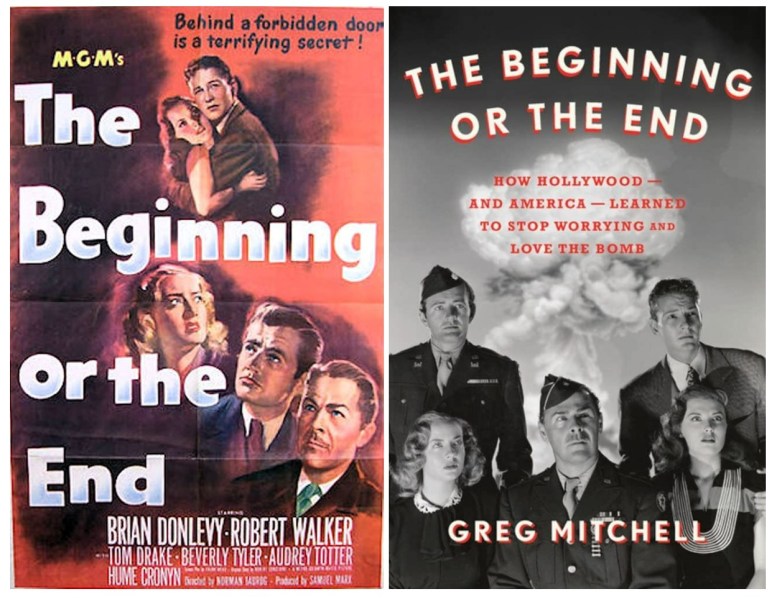
While researching these blog posts about nuclear war and science fiction I discovered I already owned The Beginning Or The End by Greg Mitchell, a 2020 nonfiction book about the making of a 1947 film, The Beginning Or The End. That MGM film is one of the first fictional accounts of the making and use of atomic bombs. What Mitchell’s book shows is how Hollywood and the Army worked together to tell their version of the story while the scientists who built the bomb wanted to tell a very different version — one closer to actual history and fact.

The book’s subtitle is “How Hollywood and America Learned To Stop Worrying and Love the Bomb,” and that’s accurate and inaccurate at the same time. For a short while (maybe 1945-1947), the government and the military tried to convince the American public that the bomb wasn’t as scary as the scientists claimed. The public might have accepted that official view during those years, but soon most people were scared shitless about the bomb. And fiction and science fiction made their fears even worse.

Mitchell’s book is a cold case study proving fiction distorts our understanding of history, and I highly recommend it. The Kindle edition is currently just $4.29 at Amazon. There’s also a hardcover and audiobook edition. The DVD of the 1947 movie is currently $18 but I don’t recommend it. It’s actually a crummy flick even though at the time MGM aimed to make one of the greatest films ever. You’ll be able to discern their lousy artistic effort by watching the equally lousy print of the film on YouTube.

Once I started looking for old documentaries about atomic bombs YouTube started offering what I think must be public service films created to inform the public about atomic warfare. It seems that each test explosion had its own documentation. And watching those films has been immensely revealing in understanding history from that period. I thought I knew more than I did, especially since I grew up in that period. But I realize, what we know about the world before puberty, and in the decade just before we were born, has been highly distorted by pop culture. The older I get the more I realize that my awareness of 1945-1960 is mostly based on science fiction, fiction, television, movies, and rock music. Talk about a reality distortion field!

I thought atomic warfare would be a great test case for studying the influence of science fiction because it’s so recent in history with 1945 being the starting point. I’m discovering science fiction gave me a very low-level kind of awareness of reality while I was growing up. If I’m brutally honest, I’d say SF was just two steps up from comic books, and one step up from television and movies. But as a kid, I didn’t want to believe that. As a twelve-year-old, addicted to sense-of-wonder, I wanted to believe science fiction offered a sophisticated education about reality and future possibilities.

Mitchell’s book let me jump back to 1945 and follow along one path about how the public learned about atomic bombs. The book goes into great detail starting just after the bombing of Hiroshima about how movie studios wanted to make a fictional film about the development and first use of the atomic bomb. The book chronicles how fiction, especially movies created that reality-distortion field I was talking about above.

Mitch does mention science fiction early on, but the book mostly focuses on the making of the MGM film, and for a while, a competing film from Paramount. By the way, the screenwriter hired for the Paramount film was Ayn Rand, and she could be considered a science fiction writer. Here’s Mitchell’s early tip of the hat o science fiction:

However, this was small potatoes compared to what film moguls and screenwriters were already working on. On October 28, 1945, Donna Reed got a letter from her old chemistry teacher, Ed Tompkins. Tompkins was part of a group of scientists working at Oak Ridge that were freaked out about the possibilities of atomic bombs and wanted to warn the public. He asked Donna Reed in a series of letters to give them to someone in power at MGM who could make a movie about their fears. Reed gave the letters to her husband Tony Owen, an agent, who contacted Samuel Marx, a producer, who got them an interview with Louis B. Mayer. Mayer flew Owen and Marx out to Oak Ridge on MGM’s private DC3. Eventually, the movie people got an interview with President Harry S. Truman, who supported the idea but for different reasons.

The Beginning Or The End got quickly made in 1946 and came out in 1947. But it wasn’t the only picture being made on the subject. It did have a rather striking opening. The film begins with a fake documentary of a bunch of actors portraying famous scientists and military men involved with the bomb installing a time capsule that’s supposed to be open in 500 years. What they put in the time capsule is the film The Beginning Or the End.

However, right from the start of making the movie, the scientists involved thought the film distorted their message. The rest of the book is about the problems of making the film. Those details illustrate what I’m talking about how fiction gives us a false conception of history. It’s quite fascinating. As I said, I recommend this book. Vanity Fair picked it as one of the top books of 2020. Read clips of various reviews here.

The book also deals with the argument on whether or not we should have used the A-bomb on Japan. That history has been presented in other books, but it’s an important factor in this one because it was a major motivation for lying to the public. In this case, fiction, the film The Beginning Or The End, intentionally lies. That’s one kind of distortion of history. But I’m also interested in how fiction speculates and become memes that fixate in the public’s minds.

For example, science fiction quickly moved to imagine atomic wars that would wipe out civilization and kill most people. In the early 1950s, it used radiation as a magical reason to create movies about giant insects or horrible mutant humans. A good comparison is science fiction about pandemics. Those stories often imagine a plague that kills 90% or 99% percent of everyone, even though in history, the worse plague events might have killed 25-35% of the population of specific cities. Fiction imagines the worse, for obvious dramatic reasons. But how often does fiction imagine a realistic limited nuclear war? We generally assume that any use of nuclear weapons will lead to all-out global warfare, and that’s because of fiction. Maybe that fiction has kept us from using nuclear weapons again, but isn’t it also another kind of distortion?

What I want to explore in my essays about science fiction and nuclear war is how fiction distorts reality.

James Wallace Harris, 3/22/23
10 Reasons How I’m Reevaluating My Interest in Science Fiction

Reason 1

Ever since I had an operation last August I’ve noticed that my enthusiasm for science fiction is waning. Partly, that’s due to a loss of vitality after the operation and partly, I’m getting older and just more tired. I know this because I can measure my activity level by how well I keep up with my reading group. It reads and discusses one science fiction short story every day. I was reading and commenting on every story before my operation. Now, I can’t keep up.

Reason 2

I read about 1,500 science fiction short stories between 2019 and 2022. Most of those came from retrospective anthologies and best-of-the-year anthologies that featured outstanding examples of the genre. The memory of so many great stories brings high expectations to anything new I read now. I can no longer tell if a story is ho-hum because it’s not very good or because I’m jaded by the ideas that the story uses. I suspect younger readers find many of these stories very exciting.

Reason 3

Our group also reads the finalists for various awards that cover the previous year, which means I’m also reading a lot of current science fiction. Unfortunately, new science fiction seldom feels as good as science fiction from the past. I don’t know if this is because I’m old and out of sync with modern science fiction. Or, because I’ve read so much science fiction for over sixty years makes it extremely hard for new science fiction to feel original. Or, older science fiction had a storytelling style I prefer. Do I just give up on current science fiction and retreat into the past? Or do I work harder to find new SF I like?

Reason 4

Last year I read several mainstream/literary novels which I thoroughly enjoyed. I felt like I was covering a new and exciting territory. I love it when I read science fiction that covers new territories, but that rarely happens anymore.

Reason 5

I have become more excited about reading and thinking about the genre than reading science fiction. While reading each new short story or novel I get most of my reading pleasure from considering how the story fits in the evolution of all the stories covering the same theme. I seldom read a new story and get excited by just that story. One example where I did was “Two Truths and a Lie” by Sarah Pinsker. Another example is “You Have The Prettiest Mask” by Sarah Langan (excerpt). Neither of these stories is really science fiction.

Reason 6

Amazon has decided not to carry five science fiction magazines I’ve been subscribing to for years: Analog, Asimov’s, F&SF, Lightspeed, and Clarkeswork. I seldom read these magazines, but I wanted to support them. I keep thinking that one day I’ll write a story and want someplace to send it. I figured my $20 a month was a tiny way of being a patron of the arts. And I liked having copies of these magazines on my iPhone so I could quickly find a story to read when the group picks it, or when it was mentioned online. These magazines might show up in Kindle Unlimited but since I don’t read them regularly, subscribing to KU won’t get them as much money. I could use another ebook source but I detest keeping up with ebook files, and they would never be as convenient to read and manage as they were in my Kindle app. I’m considering subscribing to print magazines, or buying them on the newsstand. I could kill two birds with one stone by buying them at my favorite bookstore. That way I’m supporting my bookstore and the magazine.

However, I’m not keen on piling up a bunch of magazines I’ll seldom read unless our group reads the story. We’re currently going through the finalists for Asimov’s Readers’ Choice Award, and will do the same for Analog. However, all those stories are put online. I also read newer stories when we read best-of-the-year anthologies.

I’d hate not to support the magazines. This is a quandary for me. I’m not sure I even like modern science fiction anymore, but I’ve always loved science fiction magazines since the mid-1960s. I don’t know if I can give up on them now. On the other hand, I have more back issues on my shelves to read than I could read in several lifetimes, and I have digital scans of nearly all the science fiction magazines from the 20th century. I’ve got more than enough to read.

Reason 7

I think I need to spend less time reading. At 71, I need to be more active. I need to get into hobbies where I’m not just staring at words all the time. However, giving up a lifelong addiction is hard. I might have to accept that basically, I’m just a science fiction fan. That, being a science fiction reader was my purpose in this life.

Reason 8

On the other hand, I want to read a greater variety of fiction and nonfiction. I’m sure I’m missing out on other great genres and subjects. However, I have been reading more that’s not science fiction and I feel like I’m moving in too many directions at once. It’s much easier to read more about science fiction than read more about the world and the history of the world. Again, this is another mental conflict I need to resolve. But I have hundreds of nonfiction books on many subjects waiting on my shelves to be read. I collected them for years planning to read them in my retirement. However, I’ve spent a lifetime specializing in science fiction and to learn a new specialty would be impossible.

Reason 9

I’ll start with an analogy. Back in the 1960s and 1970s, I spent a lot of time flipping through record bins at record stories. When I was young I could barely afford one album a week. And even after I got a regular job I seldom bought more than four albums at a time. But I flipped by thousands of albums I wanted to buy. Now with Spotify, I can go back and listen to all those albums that looked interesting but that I couldn’t afford.

The same is true for science fiction. I have a choice between reading a book I didn’t pick back then or reading a new science fiction novel that just came out. Both in terms of music and science fiction I’m strongly drawn to the years 1950 to 1980.

Think of it this way. The past and present are two extremely large picture puzzles. I have more pieces in place seeing a more complete view of the picture for the past puzzle. Filling in the holes in that puzzle is more rewarding. Or think of it this way. The SF genre is one giant puzzle. I’ve got more pieces in one area put together, and fewer in another area. Theoretically, if I read all science fiction it would fill in the entire puzzle. I would see connections between all time periods. I’d love to fill in the picture between 1950 and 2023 but I have more pieces I see fitting together in the 1950-1980 area that I want to be matched up first.

Reason 10

I don’t like where current science fiction is going. The science fiction I grew up with was mostly set in the solar system and nearby stars. Humans were humans. Too much of modern science fiction is about faraway places and post-humans. I really dislike the idea of brain downloading and uploading. Sure, it’s a fun idea, but too unbelievable. A lot of modern science fiction feels like it’s inspired by comic books or movies which push ideas, characters, and plots into ridiculous places.

I’m realizing something about science fiction with my study of fiction about surviving nuclear war. I used to think science fiction promoted certain new concepts into the public consciousness. I thought science fiction lead when it actually was following. So far, I’ve found nearly all the concepts about nuclear war were public knowledge before science fiction stories and novels used them. Actually, by reading much older science fiction, stories, and novels from 1850-1950, many of the science fiction concepts I thought were original with science fiction after 1950 weren’t. And I suspect the science fiction writers back then got their ideas from concepts already spreading around in the public mind.

This makes me want to go back and reread science fiction and see if it was ever creatively original. One reason I don’t take to modern science fiction is that it feels like recycled old science fiction. How many concepts do science fiction writers keep repackaging over and over again? When were they first discovered? Where can science fiction still innovate?

James Wallace Harris, 3/11/23

Science Fiction About Surviving a Nuclear Holocaust – Pre-1960

Starting March 16th I’m going to lead a book discussion on Beyond Armageddon edited by Walter M. Miller, Jr. and Martin H. Greenberg for our Facebook group, Best Science Fiction, and Fantasy Short Fiction. We had voted on reading a science fiction theme anthology and Miller’s anthology won for the Post-Apocalypse theme. Y’all are welcome to come read along and discuss the stories. Here is a link to the thread on this group read.

I thought the book would be about post-apocalypses in general, but it turns out Miller was riled up about Reagan’s Star Wars and nuclear proliferation back in the 1980s and the anthology focuses mainly on surviving a nuclear holocaust. (Read his intro.) This got me thinking. How many different kinds of post-apocalypses are there? Most of the famous ones deal with nuclear war, an extreme plague, or a catastrophic encounter with an astronomical object.

Since Miller wanted to focus on nuclear war I would too. I’ve always wanted to create a database of science fiction themes. I’ve pondered creating a theme taxonomy or even developing a Dewey Decimal type system for identifying each specific theme. Recently, I played around with ChatGPT to see if it could help with this task. The job would be a big one. So, focusing on one narrow theme would be a great start.

For our discussion of Beyond Armageddon, I decided to study short stories, novels, movies, and TV shows about surviving a nuclear war. I figured I’d bring up these precedents as we discussed the stories. Over the weeks we’ll be discussing the stories I’ll build up a timeline about this theme. I also want to use the same time to learn about Walter M. Miller, Jr., but that’s for another post.

Even with the narrowed focus on nuclear war apocalypses, there are many ways to cover the subject. A crude beginning would be to divide them into Before the Bomb (warnings), Being Bombed (surviving), and After the Bomb (new societies).

Famous movies like Fail-Safe and Dr. Strangelove end with the bombs going off. Their focus was on how to avoid a nuclear war.

Then there are stories that feature characters that live through an atomic war and the immediate aftermath, like the movie Threads. These stories usually begin just before bombs start falling, and usually end after the devastation showing us how bad nuclear war could be.

Finally, there are novels like A Canticle for Leibowitz, The Long Tomorrow, or movies like Mad Max, where the war is in the past and new societies are emerging. Often these kinds of stories use their creativity to imagine how humanity adapts to new situations.

For this essay, I want to be very specific. I’m looking for short stories, novels, television shows, and movies about people surviving worldwide all-out nuclear war. I’m going to exclude fiction about the anxiety of a pending war, such as Dr. Strangelove, and also ignore stories about new societies developing after a nuclear war, such as A Canticle for Leibowitz and The Long Tomorrow. I want to specialize in fiction about people who survive a nuclear war and what they do immediately afterward, maybe including the first generation born after the war. The film Threads is a perfect example.

However, my research is turning into a very large project. For this post, I’m going to focus on the fiction that came out before 1960. Hiroshima and Nagasaki were in August 1945. I’ve yet to discover any science fiction that deals with surviving a nuclear war before then. However, Beyond Armageddon includes “By the Waters of Babylon” by Stephen Vincent Benét, which was originally published in the July 31, 1937 issue of Saturday Evening Post. It describes civilization being destroyed by fire, that poisoned the earth and air. That’s good enough for me. But it’s an afterward story, a long afterward story, where our descendants have forgotten the past and assume the beings who fought this great war were gods. Like many stories of this kind, people live in primitive tribes and talk like cliches of Native Americans.

Even though America had dropped atomic bombs on Japan in 1945 it took a while for science fiction writers to imagine nuclear war, especially one that could destroy human civilization. Russia didn’t explode its first fission bomb (A-bomb) until 1949 and its first thermonuclear bomb (H-bomb) until 1953. That was the same year they began the development of their first ICBM. We started the Atlas missile program in 1954. Russia’s first successful launch was in August 1957, and ours was in late November 1958.

(Revision: Thanks to Joachim Boaz’s comment below I now know about Nuclear Holocausts: Atomic War in Fiction by Paul Brians. It’s online here. Evidently, there have been a number of articles and monographs on this subject. I’ll make further revisions to my list below as I get to read more.)

By the Waters of Babylon” (1937) might be the first story about a nuclear holocaust, but it’s not for sure, and not the specific kind I’m looking for. Remember, I want stories about people experiencing a nuclear war.

Thunder and Roses” (1947) by Theodore Sturgeon is a short story with a very unique perspective on atomic war. The link is to a copy of the original magazine publication.

You Can’t Beat the Atomic Bomb (1950) was a public service documentary about atomic bombs. The link is to YouTube in case you want to watch it.

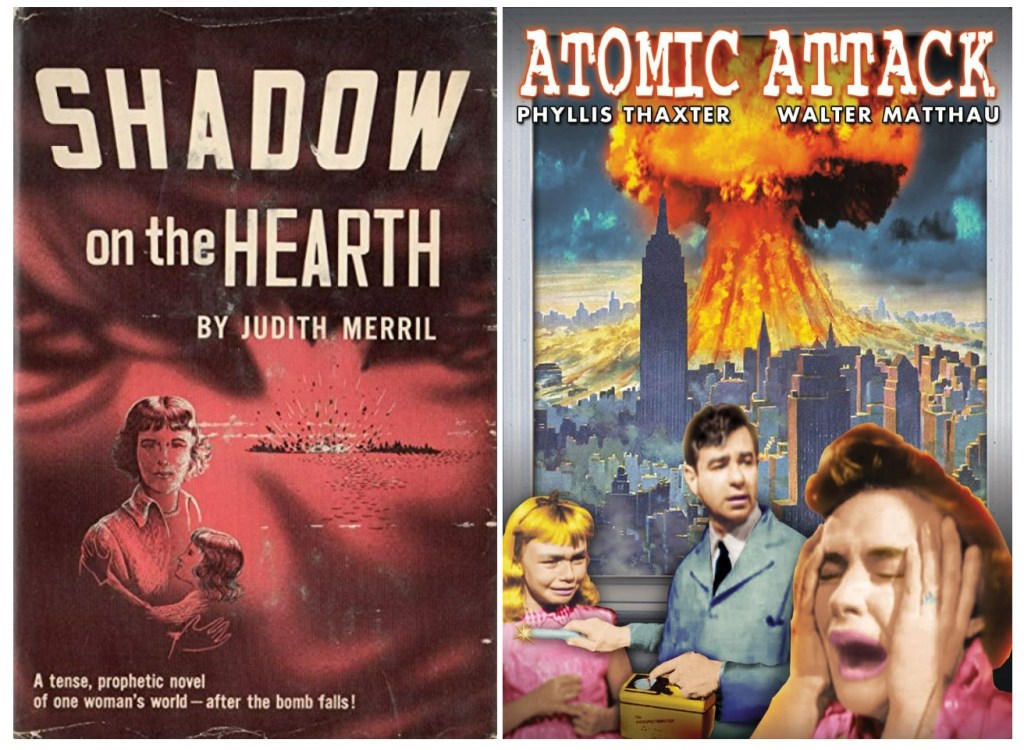
Shadow on the Hearth in 1950 by Judith Merril is the earliest science fiction novel I know about that deals with surviving an atomic war. In 1954 it was televised as “Atomic Attack” on Motorola TV Theater, see below. If you know of others leave a comment below.

It took time for science fiction writers to put two and two together and imagine an atomic war that could create total annihilation of our species. I’m having trouble discovering when the public first encountered ideas about atomic war in the news and popular science and when science fiction writers used the ideas. Were the writers first? Could Nevil Shute have been the first to imagine self-extinction in On the Beach?

Judith Merril might be the earliest science fiction writer who explored a limited atomic war. However, I haven’t read her book yet, but in the TV drama, many of the major American cities are destroyed, and we destroy many of the enemy’s big cities, but people in small towns survive. CONELRAD was established in 1951 and is featured in the TV drama, but I think it was too early for the novel. That means the public was well aware of the atomic war possibility, I’m just not knowledgeable by how much. What did science fiction writers have to work with at this time?

According to Wikipedia, Five (1951) is the first film to portray people surviving an atomic war. I have not seen it yet, and I guess it ignores the television drama “Atomic Attack.” It is available to rent.

There Will Come Soft Rains” (1950) by Ray Bradbury imagines an automated home in the future continuing to function after humans have died in an atomic war. We don’t know how universal the deaths are in this story.

Lot” (1953) by Ward Moore is one of my favorite science fiction short stories. It’s “Cold Equations” type brutality hits you hard in the end. I’ve always felt that Panic In Year Zero! a 1962 film with Ray Milland might have been inspired by “Lot.” Moore story had a sequel, “Lot’s Daughter” which is even more Biblical and daring.

Atomic Attack” (1954) was an episode on Motorola TV Theater based on Judith Merril’s 1950 novel – see above. I’d love to have a DVD of Motorola TV Theater series. This episode is available to watch on Tubi and YouTube and for sale on DVD from Amazon. Even though the production quality is low by today’s standards, I thought the 1954 television tale was an A+ story for what I was looking for. The link is to YouTube, but this version is part of a mix of videos about atomic war. See items on the right side. (I’m curious, is this just a bad film copy, or is it a kinescope?)

Project XX: Three, Two, One, Zero (1954) television documentary on the atomic bomb. Part 1 below. Part 2 is linked at YouTube upper right.

Tomorrow! (1954) by Philip Wylie compares survivors in two smaller towns that weren’t bombed in a nuclear attack, one with prepared civil defense and the other not.

On the Beach (1957) by Nevil Shute was a bestselling novel by a mainstream writer. Shute imagined radioactive clouds circling the globe slowly killing off life. Because the war took place in the northern hemisphere, radioactive clouds took weeks to get to all of the southern hemisphere with Australia, New Zealand, South Africa, and the lowests parts of South America. Everyone dies. Is this the first novel of total nuclear annihilation?

Doomsday For Dyson” (1958), a televised play by J. B. Priestley. Can’t find much about this but it appears to have been a dream about surviving a nuclear war. Love to see it if anyone knows where I could watch it. J. B. Priestley was a mainstream English novelist, playwright, screenwriter, broadcaster, and social commentator. It seems that so far, mainstream writers were more interested in writing about nuclear war than science fiction writers. However, there might be many SF novels and stories I don’t know about yet.

Red Alert (1958) by Peter George was the basis for Dr. Strangelove.

Underground” (1958) was a 1958 episode of Armchair Theatre, a British TV show on ITV. I doubt I’ll ever get to see it. I’ve read British TV producers didn’t try and save stuff like American producers. Still, it’s another clue in how much the general public was interested in this subject.

Alas, Babylon (1959) by Pat Frank was another novel about people surviving an atomic war. It’s still very readable today. When I was a teenager in the 1960s prowling used bookstores I constantly saw used copies of On the Beach, Alas, Babylon, and Limbo. I figured they must have been very popular. Limbo wasn’t about nuclear war, but cybernetics.

Level 7 (1959) by Mordecai Roshwald. I just learned about this novel yesterday when I mentioned to my old friend Connell I was writing about books about atomic war. He said our buddy George gave it to him back in the 1960s and he still vividly remembers it. I’m going to get a copy.

On the Beach (1959) was a popular film starring Gregory Peck.

The World, the Flesh and the Devil (1959) was a film starring Harry Belafonte as the sole survivor of a nuclear war using radioactivity dispersed aerially. This film deserves a lot more attention than it gets. However, it’s more about being the last man on Earth, a kind of Robinson Crusoe story.

Time Enough at Last” (1959) was one of the most popular Twilight Zone episodes that featured Burgess Meredith as Henry Bemis, another sole survivor of an atomic war. The Twilight Zone often dealt with nuclear war, but this entry was an ironic humorous one.

How To Survive An Atomic Bomb in the 50s. Not sure when this film was made.

Help Please:

If you know of other works of fiction that cover this topic leave a comment below.

If you are old enough to remember the late 1940s and 1950s and can tell me how you learned about the idea of nuclear war, please leave a comment. Did it come from television, newspapers, word-of-mouth, or science fiction?

References:

How Will SpaceX’s Starship Change Science Fiction?

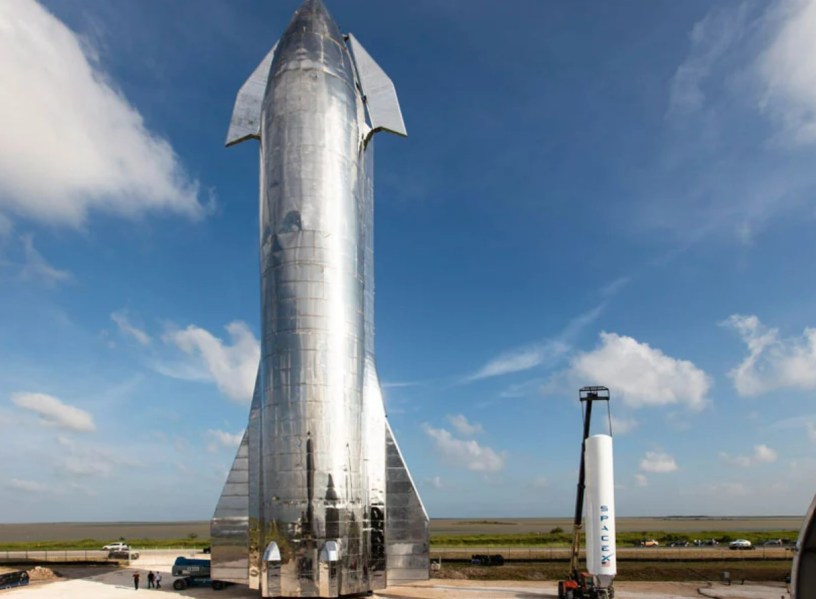
Except for a few alternate reality stories, science fiction writers no longer write about the first trip to the Moon. NASA’s successes have had a tremendous impact on science fiction written after the1960s. If Elon Musk’s plans for his Starship succeed it should change the course of science fiction too. If you follow The Space Race on YouTube it appears SpaceX’s Starship is going to happen. Yesterday’s video was about how SpaceX is working towards the industrial capacity to build one Starship a day. What would that mean?’

Elon Musk could become Heinlein’s, D. D. Harriman – the man who sold the Moon. Musk wants to put a million colonists are Mars in the 2030s. And SpaceX is now working in conjunction with NASA to return to the Moon.

After NASA’s planetary probes in the 1960s science fiction stopped writing about Mars and Venus being inhabited. Before that Mars was a wintery desert world and Venus was a steaming jungle world but with life, even intelligent life. After the Mariner probes, Mars was as lifeless as the Moon, and Venus was hot enough to melt lead.

If Elon Musk succeeds then he will shape the future of the Moon and Mars, and of science fiction that will be written about those worlds. There is no guarantee Musk will succeed. SpaceX might get people to Mars and people might discover it’s a horrible place to live and not want to colonize the planet. Or that Mars is so toxic that it’s not practical to live on Mars. But if colonization is possible we’ll see how a colony on Mars will be designed. That design will shape the direction of science fiction for decades.

SpaceX’s Starship isn’t revolutionary. It’s not powered by nuclear engines or some other exotic drive. It’s stainless steel, methane, and oxygen along with some highly refined chemical rocket engines. But it could become the Model T of space travel.

Along with SpaceX, there are two other technologies that could reshape the evolution of science fiction. The first is AI. The second is Boston Dynamics robots. When the two are combined we might not need human explorers in space. Science fiction has always pictured robots becoming like humans. ChatGPT can process thousands of concurrent queries at the same time. Soon robots will be stronger, faster, and more agile than humans. What happens when we have a robot that has all recorded knowledge in its head and can multitask thousands of problems at once? Isn’t the Singularity getting awful near?

Science fiction often pictures robots acting like humans, even being our pals. Human minds will appear to them as gerbil minds appear to us. Right now we picture humans using Starship to conquer the solar system. Just think how much more efficient it would be to combine Starship with AI robots? Intelligent robots are perfect beings to live in space. What if we sent a million intelligent robots to Mars instead of a million humans? They could build us a deluxe civilization to move into much quicker than we could.

I’m not reading much science fiction that speculates realistically about the near future. Too many stories are about super-science that will probably never exist. Or it’s about cute robots that vastly underestimate what robots can do. Or they are silly stories about people falling in love with sexbots. Or even worse, there are lots of silly stories envisioning robots wanting to be human. That’s like us fantasizing about becoming a gerbil or having a love life with one.

The whole point of a Singularity is one day AI will be equal in capacity to the human mind. But the next day it will be 2x us, and a little while later 10x, and pretty soon 1000x. Why hasn’t science fiction explored the idea we’ll be the second banana in this neck of the galaxy soon.

By the way, have y’all read any science fiction stories based on Elon Musk’s plans for Mars and the Moon?

James Wallace Harris, 3/5/23