Baby Boomer Science Fiction

Science fiction stories are fairytales for teenagers that fuel their imaginations about the future. Science fiction creates myths about tomorrow for each new generation. And science fiction offers both hopes and fears about what’s to come. Readers from each new generation embrace their own flavor of science fiction.

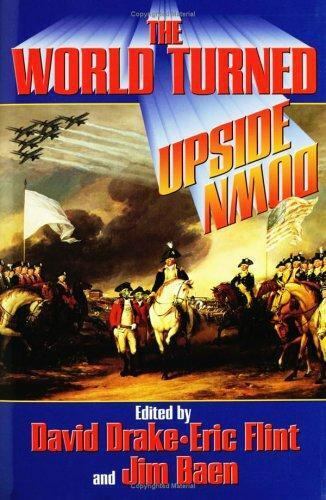
The World Turned Upside Down is an anthology where the editors picked science fiction stories that wowed them when they were teens. Currently available in print for the Kindle for $8.99 or free online for misers and the poor. And for collectors, the hardback is readily available used. I dearly wish there were an audiobook edition because I’d love to hear these stories read by a professional reader.

David Drake (b. 1945) and Jim Baen (b. 1943) are from the Silent Generation (1925-1945). Eric Flint (b. 1947) is from the second year of the Baby Boomers (1946-1964). I was born in 1951, the fifth year. All three editors started reading science fiction in the 1950s and I started in 1962. I believe science fiction fans that discovered the genre in the 1950s and 1960s during the Baby Boomer era imprinted on a certain type of science fiction that’s distinctly different from later generations’ science fiction. I believe the stories in The World Turned Upside Down will appeal the most to Baby Boomers.

One significant extra to this anthology is the personal recollections from the three editors. The introductions and follow-ups are bite-size memoirs. The editorial comments added extra enjoyment to reading this anthology. And I felt on the same wavelength as the editors.

Picture a graph with a bell curve stretched out on the trailing edge. Each year hundreds (thousands?) of science fiction stories are published, but only a small number become popular and are embraced as favorites by a generation. The newest stories are the leading edge of the curve. Then the long stretched-out trailing edge is where stories are remembered as they fade away in pop culture memory. Growing up I mostly read science fiction short stories that were at the peak of the curve. They were mostly 5-20 years old. Now those stories are 55-70 years old.

As I’ve gotten older, that bulge has diminished. In The World Turned Upside Down 5 stories are from the 1930s, 5 from the 1940s, 15 from the 1950s, and 4 from the 1960s. You should be able to visualize the curve just from that tiny bit of data. Readers today from the current generations will like or know very few of these stories. They are now far away from the leading bulge of popular stories. In 20 years, that bulge in the 1950s will thin away in future anthologies. Anthologists whose teen years were during the 1980s or 2010s will seldom pick stories that old.

For the past couple of months, our Facebook group has been reading and discussing the 29 stories from The World Turned Upside Down. I thought the age of the group member had an impact on which stories they liked. Current with reading these old stories on Tuesdays, Thursdays, and Saturdays, we read newer stories from The Good New Stuff edited by Gardner Dozois on Mondays, Wednesdays, and Fridays. I also thought the contrast to it in the comments was age-related. Austin Beeman reviewed The World Turned Upside Down on his blog and overall liked most of the stories, but the stories he responded to best were a bit different from my favorites. And I thought he liked stories in The Good New Stuff a lot more than I did. I believe he’s 25-30 years younger than I am. Jeppe Larsen reviewed the anthology on his blog and liked fewer stories. My hunch is he is younger. But it’s also possible, he’s not young, and like many people, just likes to keep up with the times. I actually prefer the older stuff, even if it feels old. And to also skew my impression, most of the active members are hardcore SF fans that love a wide range of science fiction.

Generally, a great story is usually liked by any age group, but less famous stories seem to have a generational appeal. My guess is writers write under the assumption they are speaking to the current generation but some of them end up speaking across the ages.

The stories in The World Turned Upside Down were first published from 1933 through 1967, but the most common decade represented was the 1950s. Here are the stories with my ratings (1-5 stars).

1930s

  • Shambleau • (1933) • novelette by C. L. Moore (*****)
  • Who Goes There? • (1938) • novella by John W. Campbell, Jr. (*****)
  • Black Destroyer • (1939) • novelette by A. E. van Vogt (*****)
  • Heavy Planet • (1939) • short story by Milton A. Rothman (***+)
  • Spawn • (1939) • novelette by P. Schuyler Miller (****+)

My father (b. 1920) would have been a teen when these stories came out. He was from the Greatest Generation (1901-1924). These are also stories that appeared with the generation of First Fandom. Those were the old guys of science fiction when I was a teen. I’m not sure if any of them are around anymore. The star of that era was E. E. “Doc” Smith. Most of the fiction from then felt dated in the 1960s and even more so in the 2020s, even to me, a guy who loves to read old science fiction.

1940s

  • Quietus • (1940) • short story by Ross Rocklynne (****)
  • Environment • (1944) • short story by Chester S. Geier (***+)
  • Rescue Party • (1946) • novelette by Arthur C. Clarke (*****)
  • Thunder and Roses • (1947) • novelette by Theodore Sturgeon (*****)
  • The Only Thing We Learn • (1949) • short story by C. M. Kornbluth (***+)

These stories came out during the teen years of the Silent Generation. This has been called The Golden Age of Science Fiction, but people who felt that are mainly dead. Stories collected in anthologies stay around for a few decades, and I was reading these stories as a teen in the 1960s. I thought 1940s SF was science fiction from the good old days. They felt somewhat dated when I read them in the 1960s, but they were still fun. Today, even to me, they feel quite quaint.

1950s

  • Liane the Wayfarer • (1950) • short story by Jack Vance (****)
  • Trigger Tide • (1950) • short story by Wyman Guin (***+)
  • A Pail of Air • (1951) • short story by Fritz Leiber (****+)
  • All the Way Back • (1952) • short story by Michael Shaara (***+)
  • Thy Rocks and Rills • (1953) • novelette by Robert E. Gilbert (****+)
  • Answer • (1954) • short story by Fredric Brown (*****)
  • The Cold Equations • (1954) • novelette by Tom Godwin (*****)
  • Hunting Problem • (1955) • short story by Robert Sheckley (****)
  • A Gun for Dinosaur • (1956) • novelette by L. Sprague de Camp (****)
  • The Last Question • (1956) • short story by Isaac Asimov (****+)
  • The Gentle Earth • (1957) • novella by Christopher Anvil (***+)
  • The Menace from Earth • (1957) • novelette by Robert A. Heinlein (*****)
  • Omnilingual • (1957) • novelette by H. Beam Piper (*****)
  • St. Dragon and the George • (1957) • novelette by Gordon R. Dickson (****)
  • The Aliens • (1959) • novelette by Murray Leinster (****)

Now, these were stories that were often anthologized in the 1960s when I was a teen and a number of them are considered classics. They seem just a little bit old to me when I was a teen. Like 1950s Rock and Rollers, who were in their twenties when I was a teen in the 1960s, but they were still so cool!

1960s

  • Code Three • (1963) • novella by Rick Raphael (***+)
  • Turning Point • (1963) • short story by Poul Anderson (***+)
  • Goblin Night • (1965) • novelette by James H. Schmitz (****)
  • The Last Command • (1967) • short story by Keith Laumer (****)

It’s interesting that these stories did come out when I was a teen, but they were some of my least favorites in the anthology, although still a lot of fun to read. I’m surprised Flint, Drake, and Baen picked them because none of them became classics. These kinds of stories were the salt of the Earth content of the SF magazines in the 1960s, but not the stories I thought defined the generation. At the time, Samuel R. Delany, Roger Zelazny, J. G. Ballard, and Ursula K. Le Guin were the bright stars in the sky.

Even though fiction being called science fiction was around in the 1920s, 1930s, and 1940s, it wasn’t until the 1950s that the general public recognized it. The 1950s was a boom time for science fiction when it regularly began appearing in book form – both paperback and hardback. Plus, it became popular in the movies and in the early days of television. In 1953 there were three dozen science fiction magazine titles being published. When I grew up stories from the 1950s boom felt like they defined the genre.

I felt the most famous SF from the 1950s would be the classics all my life and into the future. However, I’ve now lived long enough to see those stories age and fade away. It sometimes hurts me to see my favorite science fiction novels and short stories being forgotten, rejected or even vilified. This is why it’s difficult to recommend The World Turned Upside Down to younger readers. But I feel its stories capture an era so nicely. The stories aren’t the most famous Baby Boomer science fiction stories, but then the most famous stories are often over-anthologized while so many other good stories need to be remembered. I’m guessing Drake, Flint, and Baen wanted to preserve a picture of our era taken from a different angle. Of the stories I hadn’t read before, I was very glad to be introduced to them.

I would love to review each story one by one and natter about how they each aged and guess how each appealed to their generation. But this post is already longer than what 99% of internet readers read. I know, I’m way too verbose.

JWH

“Blowups Happen” by Robert A. Heinlein

Only dumbasses, egotists, and the delusional think they can predict the future, although there are a number of professions that try. I do believe Robert A. Heinlein was smart and sane enough to know he couldn’t see beyond the horizon of the moment, but he wrote plenty of stories that tried. “Blowups Happen” is one that stands out. Heinlein’s 1940 novelette imagines the dangers of commercializing atomic energy in peacetime. That was five years before Hiroshima.

I grew up being taught that atomic research during the war was an extremely well-guarded secret. What I didn’t know, and I assume most other people didn’t either, was how much atomic energy was widely discussed before the war. John W. Campbell, Jr. liked to brag about how the FBI came to his offices in 1944 because of Cleve Cartmill’s story “Deadline,” implying the G-men thought it gave away some of the secrets of the atomic bomb. I thought Heinlein’s story felt far more knowledgeable. I now have to assume the well-educated public before WWII knew far more than I ever imagined regarding atomic physics.

“Blowup Happens” is set in the near future from 1940 in the Astounding Science Fiction magazine version, and from 1950 as it was rewritten for the collection, The Man Who Sold The Moon. Those two dates are important because the story is about atomic power, and the magazine version was written before Hiroshima and the book version afterward.

The setup of the story is the United States has come to depend on atomic power even though a breeder reactor in Arizona could theoretically destroy the country or even the planet. The General Superintendent of the plant, King, has to hire one psychiatrist for every three engineers to monitor their work with the reactor because engineers have nervous breakdowns after a short career and must be continually replaced. King brings in Dr. Lentz, one of the country’s top psychiatrists to find ways that allow engineers to handle the stress.

Later in the story, Superintendent King learns that mathematical models that previously showed the reaction in the breeder reactor is probably controlled are wrong. New mathematics prove the reactor could go into a runaway reaction that would destroy the planet. If they bring down the breeder reactor the country would lose a good portion of its industrial power and ruin the economy. King knows the corporation that owns the plant won’t accept the new research because it would be financial ruin for it.

The solution to the problem has been emerging all along in a tangential subplot about two engineers, Erickson and Harper, developing atomic power for rockets.

“Blowups Happen” has a great deal of infodumping where Heinlein tries to educate his readers about the science behind atomic energy. Reading those passages today is tedious unless you are researching early speculation about atomic energy. So, how do we judge “Blowups Happen” as a story in 2022?

We want science fiction that is visionary. We want the future to be exciting. Ultimately, most, if not all science fiction becomes historical curiosities. Time has a way of eroding our genre. I didn’t like “Blowups Happen” when I first read it as a teen back in the 1960s. It was already too dated. Now that I’m rereading it in my seventies in 2022 I have to admire Heinlein’s speculation. “Blowups Happen” is an ambitious story. I’m starting to think science fiction writers are at their most ambitious when they are working closest to the present.

In “Blowups Happen” Heinlein explores the impact of atomic energy before the world is startled by the reality of Hiroshima. Sure, the idea of atomic power had been around since Einstein’s most famous equation. The reason why the science fiction of the 1950s had been so exciting is it just preceded NASA of the 1960s. And the reason why cyberpunk was so exciting in the 1980s is that it just preceded the World Wide Web in the 1990s. Science fiction writers get the details wrong, but they still anticipate the wonder and the chaos. This thought makes me rethink Heinlein’s Stranger in a Strange Land anticipation of the 1960s.

When we judge an old science fiction story for its visionary qualities I think it’s important to look at the story’s original publication. “Blowups Happen” was first published in September 1940. It was first reprinted in The Best of Science Fiction edited by Groff Conklin in 1946, and then in 1950, it was rewritten for The Man Who Sold the Moon. However, for that edition, Heinlein rewrote the story to include the knowledge of the bombing of Hiroshima in 1945. By 1950 the public and science readers knew much more about atomic energy. I’m guessing “Blowups Happen” was already outdated even in 1950.

Ten years makes a lot of difference in a science fiction story, although I doubt anyone in 1940 could have imagined what the next five years would bring, much less ten. Science fiction writers do not and cannot predict the future, but we do have to admire Heinlein for imagining the political implications of a country having atomic energy in 1940, and what the dangers might be for developing peacetime uses of atomic power. He gets the details wrong, but what he gets right is the essence of great science fiction. By the way, in the 1940 version, the power plant is called a bomb, but in 1950 the label was changed to pile. I’m guessing Heinlein imagined the power plant as being a controlled explosion.

Within the 1940 version, Heinlein described a nuclear explosion as “forty million times as explosive as TNT. The figure was meaningless that way. He thought of it, instead, as a hundred million tons of high explosive, two hundred million aircraft bombs as big as the biggest ever used.” To give his readers a better picture, Heinlein has his character say to himself about ordinary big bombs, “He had once seen such a bomb dropped when he had been serving as a temperament analyst for army aircraft pilots. The bomb had left a hole big enough to hide an apartment house. He could not imagine the explosion of a thousand such bombs, much, much less a hundred million of them.”

Then in the 1950 version, the same character thinks of it as “a hundred million tons of high explosive, or as a thousand Hiroshimas.” Heinlein didn’t need to write anything more. By then, readers had seen films about atomic explosions. They knew exactly what that meant, but in 1940 I doubt readers could imagine anything close to reality.

Psychiatry and psychology are so commonly talked about today that we also forget that it was new at one time. I’m an old movie fan, and psychiatry became a hot subject matter for films after WWII and into the 1950s. I’m guessing Heinlein was doing just as much speculation about the future impact of psychiatry as he was doing for atomic energy in “Blowups Happen.” But how sophisticated his Heinlein’s expectations about the field? Heinlein loved popular scientific speculations published in popular books of the 1930s. But he also was a fan of many pseudo-scientific works too, stuff we’d consider New Age today. In his Future History stories, Heinlein seemed just as interested in the soft sciences as the hard sciences.

Heinlein describes Dr. Lentz, the top psychiatrist of the day this way:

Notwithstanding King’s confidence, Lentz did not show up until the next day. The superintendent was subconsciously a little surprised at his visitor’s appearance. He had pictured a master psychologist as wearing flowing hair, an imperial, and having piercing black eyes. But this man was not overly tall, was heavy in his framework, and fat—almost gross. He might have been a butcher. Little, piggy, faded-blue eyes peered merrily out from beneath shaggy blond brows. There was no hair anywhere else on the enormous skull, and the apelike jaw was smooth and pink. He was dressed in mussed pajamas of unbleached linen. A long cigarette holder jutted permanently from one corner of a wide mouth, widened still more by a smile which suggested non-malicious amusement at the worst that life, or men, could do. He had gusto.

Heinlein, Robert. The Man Who Sold the Moon and Orphans of the Sky (p. 131). Baen Books. Kindle Edition. 

Is Heinlein serious about giving us a shrink that goes around in public in his pajamas? Is Heinlein just imagining a colorful future with odd fashions? Or is this satire? Would 1940 science fiction readers believe the fashions we see on TV today? Heinlein had his sociological speculations too. There is another scene at a bar where the atomic energy scientists go to unwind, that features a B-girl who is also a prostitute. Such women were common in the 1930s, but it was a lower-class thing. I got the feeling that Heinlein expected society would change its attitudes toward these women in the future.

But, we’re back to my original question. Is “Blowups Happen” a fun science fiction story to read in 2022? I don’t think so. Scientific lectures can slow a story, or even ruin it, but scientific lectures about out-of-date science are even harder to endure. Would “Blowups Happen” read better today if he had left out all the lectures? They weren’t needed for the story. Lester del Rey’s “Nerves” is another story about atomic energy from the 1940s that’s outdated, but it still works dramatically. It has problems with length, and some plotting, but overall, I remember it being a better story. I don’t know if Heinlein wanted to be educational, show off his knowledge, or provide evidence for his speculation, but I don’t think the story needed those infodumps.

“Blowups Happen” does offer one lesson for would-be science fiction writers. Speculating about the near future will have the greatest impact on current readers, but you risk writing a story with a limited shelf life. Most stories never become classics anyway, so I think Heinlein boosted his career significantly in 1940 by writing “Blowups Happen.” And there is a downside to writing far-future science fiction that’s pure storytelling. I find science fiction that feels like fantasy fiction far less appealing. Although “Blowups Happen” is now just a historical curiosity I still admire it for Heinlein’s ambition. I seldom find science fiction stories with that kind of ambition being written today.

Near-future SF stories with serious speculation do show up but are rare. I am impressed with The Mountain in the Sea by Ray Nayler, and even though it just came out, I’ve already heard good things about it from several readers. There’s something exciting about science fiction that speculates about the near future with ideas that could come true.

James Wallace Harris, 12/12/22

“Coventry” by Robert A. Heinlein

“Coventry” by Robert A. Heinlein first appeared in Astounding Science Fiction in July of 1940 and marks the end of his first year of publishing science fiction with eight stories. “Coventry” is also part of his Future History series and was first published in book form in Heinlein’s collection Revolt in 2100, which is still in print, including audio and ebook.

Heinlein’s legacy suggests he was hardcore libertarian, and that might have been true at times, but not always. “Coventry” shows a streak of liberalism or even utopianism. The “Coventry” of the title refers to land set aside for those citizens who do not want to abide by the Covenant, a future constitution of what the United States became after the Crazy Years. Under the Covenant, all citizens are guaranteed the freedom to pursue their happiness so long as they don’t commit violence against another citizen.

The story begins with the trial of David MacKinnon who is convicted of damaging another citizen’s freedom. David freely admits he punched out a guy but rationalizes he committed no offense because the guy had insulted him. The judge tells him that’s no excuse. I thought this was rather amusing because, in later Heinlein novels, Heinlein’s characters often claim that rudeness should be a capital offense, and sometimes his characters do kill people for being offensive.

David is given a choice: go to Coventry, or submit to psychological reeducation. David has a big ego, and he’s quite self-righteous about his actions, so he accepts being sent to Coventry. However, he has the illusion that it’s a wide-open frontier and he can go there and live in peace like a pioneer of old. He is allowed to take anything he wants into Coventry and converts his savings into fancy camping equipment.

Coventry is behind a giant force-field, and well guarded. David is told he can ask to leave at any time if he’s willing to undergo psychological reeducation. He swears that will never happen, and they open a portal in the barrier just large enough for David to drive his all-terrain vehicle through it. At first, Coventry seems like open free land, but soon David arrives at a guard station where he’s told he must pay customs duty. This enrages him and he refuses. The guards, which he thinks of as thugs, take all his possessions and start dividing them up. Once again, David goes before a court. He soon discovers that there are governments and laws within Coventry, three of them, each with their own approach to how things should be run. David is outraged that Coventry isn’t the unspoiled frontier he imagined. Again, he refuses to cooperate with the local laws and gets himself imprisoned. Eventually, David realizes he was wrong and wants to leave Coventry, but it’s not that easy.

It seems to me, Heinlein uses Coventry to model America in 1940, and the country of the Covenant to model how he imagines life should be in the United States. Heinlein also imagines another near utopia in his early novel Beyond This Horizon (Astounding, April and May 1942). Heinlein’s unpublished novel, For Us the Living written in 1938-1939 is also near utopian. Much of it was recycled for his early stories and Beyond This Horizon.

But after WWII, I’m not sure Heinlein ever imagined a positive big government again. Many of his stories, maybe even most, had characters trying to escape a big government by becoming a space pioneer, or by overthrowing a government. So it’s quite interesting to see Heinlein imagining a large well-run government. Wait — I’ve thought of one exception, Starship Troopers. If you can recall another, leave a comment.

And when I said Heinlein was being near utopian, I don’t mean he was advocating a perfect society, but one that was very well designed and had few problems. Heinlein obviously thought we could do much better than we were in 1940.

One of my friends regularly tells me she wishes the states could be divided up between conservatives and liberals so we didn’t have to live with each other. “Coventry” is Heinlein imagining this wish in a way. Most people accept the big government of the Covenant, while the anti-government folks are sent to a reservation where anything goes. What Heinlein does in the story is say anything goes leads to power structures run by strong men and gives three examples. One is a theocracy made of renegades from his earlier short novel, “If This Goes On—.”

Heinlein’s collection Revolt in 2100 includes “If This Goes On—,” “Coventry,” and “Misfit.” But you really need to read all the other early Future History stories, and to get them you need to track down a used copy of The Past Through Tomorrow. See my “Heinlein’s Super Collections” about which short stories collections to buy used.

Of course, what I’m calling a near utopia Heinlein might call a libertarian society. However, it is a big government running things so everyone is given the maximum freedom to pursue their happiness. I’m not sure theories about small government existed back then, not in the way some conservatives think about it now.

For those Heinlein fans who really want to get into Heinlein’s politics and philosophy, I highly recommend reading “Chapter 5: Heinlein and Civic Society” and “Chapter 6: Heinlein and the Civic Revolution” in Farah Mendlesohn’s The Pleasant Profession of Robert A. Heinlein. I was at first somewhat disappointed with her book because she didn’t go story by story and write about each in depth. But as I write these reviews, I can see of the value of her writing about them theme by theme, referencing the stories by how each fit into Heinlein’s beliefs. It makes it hard to quote her about any particular story, but if you read each of her chapters as a whole, it has an overall cumulative summation of all of Heinlein’s stories.

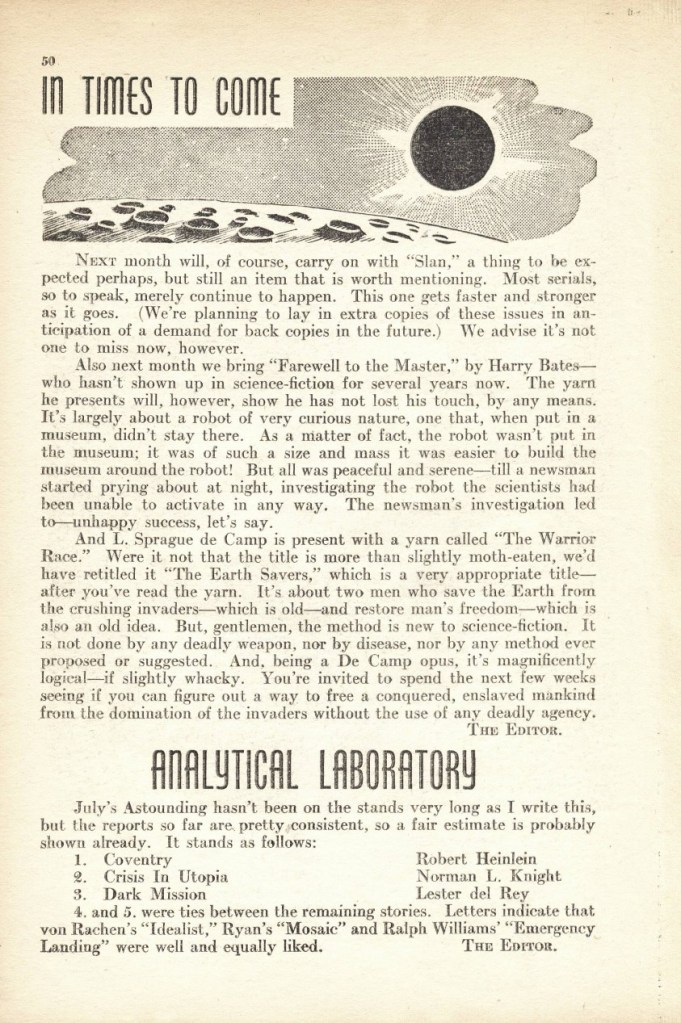
“Coventry” came in first in the Analytical Laboratory but there were not any devoted letters about it in the letter column. I’ve been a little disappointed with the letter column because Campbell doesn’t give that much space to the discussion of stories. And quite often fans wrote about the artwork instead. At this time, Final Blackout by L. Ron Hubbard was still getting most of the story discussion comments. I need to read that novel. (“Brass Tacks” was divided into two sections. The first part was story comments, and the second section was devoted to science discussion. I think Campbell preferred spending space on this section more.)

James Wallace Harris, 12/3/22