Near vs. Far Science Fiction

I’ve recently turned 71 and beginning to realize, once again, that my taste in science fiction is changing due to aging. I’m in a Facebook group where we read and discuss one science fiction short story a day. That exposes me to many different kinds of science fiction, both old and new, covering the endless possible themes that science fiction explores.

I push myself to read every story, even when I’m not enjoying them. I try to give each story the best possible chance but things are starting to change. That could be for several reasons. After reading a couple thousand SF short stories over the last five years, I might be burning out on certain kinds of science fiction. And I’ve been having health problems, and I only have half the vitality I did just a few years ago. Meaning, I might not have the psychic energy to consume as much science fiction. Ultimately, I believe it’s because getting older is making me more down to Earth, changing what I want from science fiction. Then again, I might be getting old and just losing my patience.

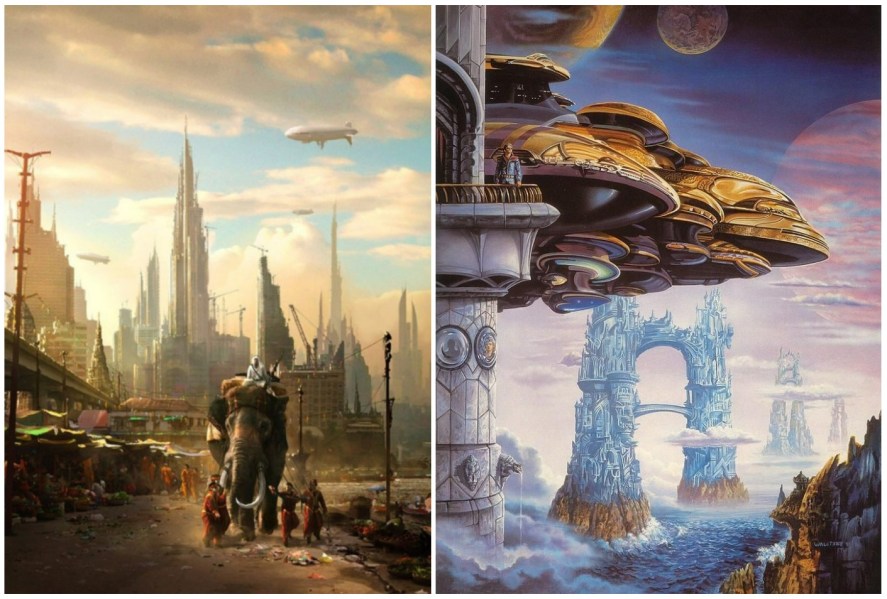
For some of my Facebook comments, I’m starting to use the excuse that I didn’t like the story because it’s science fiction is too far away for me. By that I mean, the setting is too far away in space or time. I’ve never been much of a fan of fantasy, and science fiction that’s far away in space or time feels like fantasy fiction. Some of these stories are beautifully written, with fantastic world-building, and wonderful character development. I should like them just for the storytelling, but I don’t. I feel like I’m wasting my time. I just don’t care about characters that live in unbelievable settings.

I’m not sure this attitude is entirely consistent. I’ve been meaning to reread Hothouse by Brian Aldiss, which is set in the far future and is very fantasy-like. I’ve read it twice in the last half-century, and it’s a beautiful tale. Would I still like a book I loved before if its setting is too far away? I don’t know, but I’ll report if I ever reread it again. Right now, I tend to be forgiving of old science fiction. I’m harder on new science fiction.

I keep trying to read the New Space Opera writers, and I just can’t get into them. I want to read the Culture novels by Ian M. Banks. Theoretically, they’re something I think I’d love, but I just can’t get into them. They are too far away.
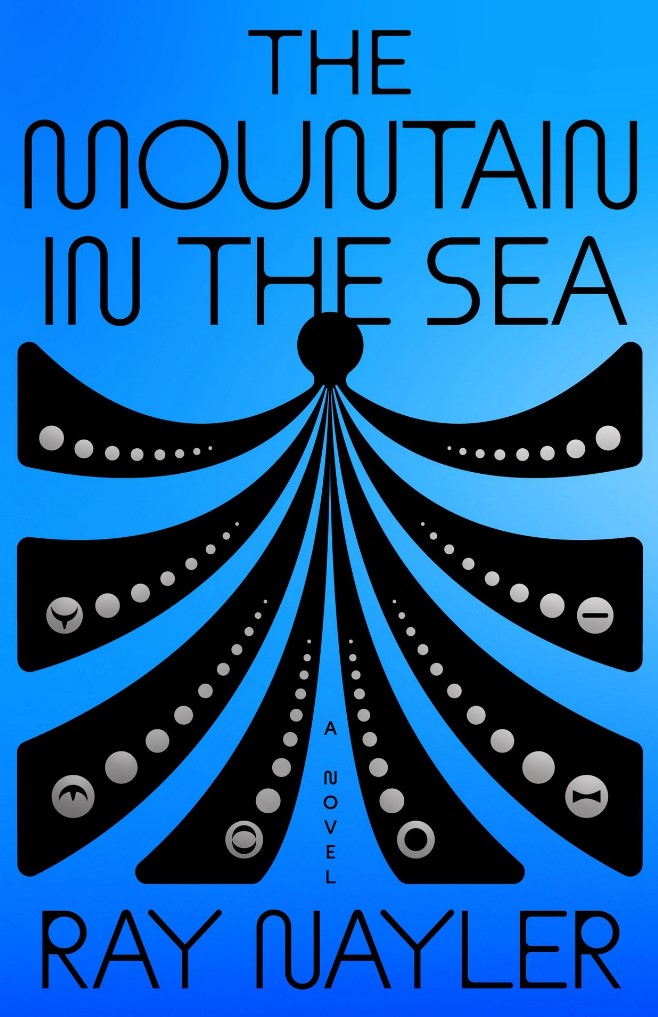
This week I started listening to The Mountain in the Sea, Ray Nayler’s first novel I believe. I’m loving it, but then its setting is very near, on Earth, in the foreseeable future. The basic plot is about discovering a species of octopus that are social, tool-making, and developing a language. Since I’ve recently read The Soul of an Octopus by Sy Montgomery and watched My Octopus Teacher on Netflix, Nayler’s speculation is very realistic. And that makes his science fiction very near.

A second major theme of The Mountain in the Sea is artificial intelligence, and Nayler handles it in a very realistic way too, again making his science fiction very near. I’ve been admiring Nayler’s short stories for a while now, but sometimes they are about AI and downloading human minds into machines or people, and I find that science fiction too far away for me. In fact, I dislike the whole theme of brain downloading and uploading.

One thing Nayler does in his novel is quote two future nonfiction books: How Oceans Think by Dr. Ha Nguyen and Building Minds by Dr. Arnkatla Mínervudóttir-Chan in chapter headings. These two authors are also characters in the book. This gives Nayler a clever way to infodump in his story and injects his story with philosophy and science.

There are several other themes in the novel that are valid to us today, slavery, over-fishing, exploiting the environment, loneliness, self-destruction on a personal and species level, and so on. This is a heavy book. I have a few hours left, so I can’t give away the ending, but I’m most anxious to find out what happens.

The Mountain in the Sea reminds me of other great near science fiction novels, such as Stand on Zanzibar by John Brunner, Timescape by Gregory Benford, The Windup Girl by Paolo Bacigalupi, and The Ministry of the Future by Kim Stanley Robinson. It also reminds me of the popular science books by Dr. John C. Lilly, who was a famous dolphin researcher back in the 1960s, and who went on to explore states of inner space. I’m especially reminded of The Mind of the Dolphin: A Nonhuman Intelligence and Programming and Metaprogramming in the Human Biocomputer: Theory and Experiments. Books I read when I was young that has made me think about some of the things which Ray Nayler is making me think about again now that I’m old. It’s interesting that in the 1960s we thought dolphins were the closest intelligent species to us, but now we’re thinking it might be octopuses.

James Wallace Harris, 11/27/22

“The Roads Must Roll” by Robert A. Heinlein

“The Roads Must Roll” is one of Heinlein’s most famous shorter works, yet I’ve never been very fond of it. Science fiction writers love to be inventors. They often imagine a gadget and then write a story around their imaginary invention. Secretly, I think they want to think up things before anyone else, and then get credit for them in the future after real inventors get around to building their fictional machines.

In “The Roads Must Roll” Heinlein envisions giant moving walkways, called Roadways or Roadcities, that carry people over vast distances at high speed. Just picture an airport slideway scaled up to take people throughout cities, between cities, and even across the country. To me, it’s always been one of the dumbest ideas Heinlein ever had.

Just contemplate a moving roadway that carries a million passengers a day. If one thing goes wrong, a million people are stranded. It’s much saner to have one car break down and allow 999,999 people to keep on schedule. And what about freight shipping? How do you push boxes or freight containers onto the roadways? Heinlein has passengers getting onto these moving roadways by stepping onto a slow-moving 5-mile-per-hour belt and gradually moving across a series of faster belts until they reach a wide 100-mile-per-hour belt where people can sit, shop, or eat while they travel.

The energy expenditure for such a system would be far greater than having individual cars and trucks. However, Heinlein did imagine these roadways being powered by solar panels. And it’s interesting that Heinlein, who was such an individualist, promoted mass transit for the future.

Once again Heinlein begins his story with a public discussion, a union meeting with an agitator. Heinlein loved public discussions because they give the illusion of drama and action. The plot involves Shorty van Kleeck, the Chief Deputy Engineer, convincing union members they are more important than any other worker in America, so they should be the leaders of America making the important decisions. Van Kleeck proposes a “New Order” in which he plans to be the leader. Concurrent with this action, Larry Gaines, the Chief Engineer of the Diego-Reno Road Town, has to entertain the Minister of Transport for Australia, Mr. Blekinsop, who wants to learn about the rolling roads technology. This allows Heinlein to do a lot of infodumping and describe how the roadcities work. While taking Blekinsop on a trip on a roadway, there is a catastrophic failure, and Gaines leaps into action. Eventually, Gaines meets up with van Kleeck and learns the failure was intentional, a demonstration of power by van Kleeck and his revolutionaries.

Most of the action sequences involve Heinlein showing Gaines’s importance. He’s able to snub the mayor and governor because his experience and knowledge trump everything. This is an annoying trick Heinlein often uses. Heinlein likes to set up superman-like characters who answer to no one. I can’t help but feel that’s how Heinlein felt about himself. It’s rather ironic that Heinlein worshipped the military and often used its structure in his stories, but personality-wise, he was a go-your-own-way kind of guy.

Heinlein was involved in California politics in the 1930s, and he saw a lot of violence, especially union and political violence. I assumed that experience inspired this story. Plus Heinlein was also obsessed with the American Revolution and revolutionaries. My hunch has always been that Heinlein wanted to design a better society. Heinlein pictured the roadway system being managed by the United States Academy of Transport, with workers having ranks.

Heinlein also likes to read books about social theory, and quite often used such theories in his stories. In “The Roads Must Roll” Heinlein even mentions a book by name, Concerning Function: A Treatise on the Natural Order in Society by Paul Decker, published in 1930. In this case, Heinlein is using “The Roads Must Roll” to attack the book.

I can’t find this book on ABEbooks or Wikipedia, nor in a quick search on Google. Google’s top returns deal with “The Roads Must Road.” So I don’t know if this was a real book or not. If anyone knows, leave a comment.

Overall, “The Roads Must Roll” flows along, full of action, and good world-building, with 1940s slang, and wit. Heinlein is a good storyteller, even when I disagree with his speculation. “The Roads Must Roll” was included in The Science Fiction Hall of Fame, Volume One, where science fiction writers voted for their favorite science fiction stories that were published between 1929 and 1964. “The Roads Must Roll” actually came in 7th in the overall voting after “Nightfall,” “A Martian Odyssey,” “Flowers for Algernon,” “Microcosmic God,” “First Contact,” and “A Rose for Ecclesiastes,” and tieing with “”Mimsy Were the Borogoves,” “Coming Attraction,” and “The Cold Equations.” Obviously, “The Roads Must Roll” is a well-loved story by the first generations of science fiction writers.

[I sure would love to know which stories from 1929-1964 science fiction writers working in 2022 would vote for today.]

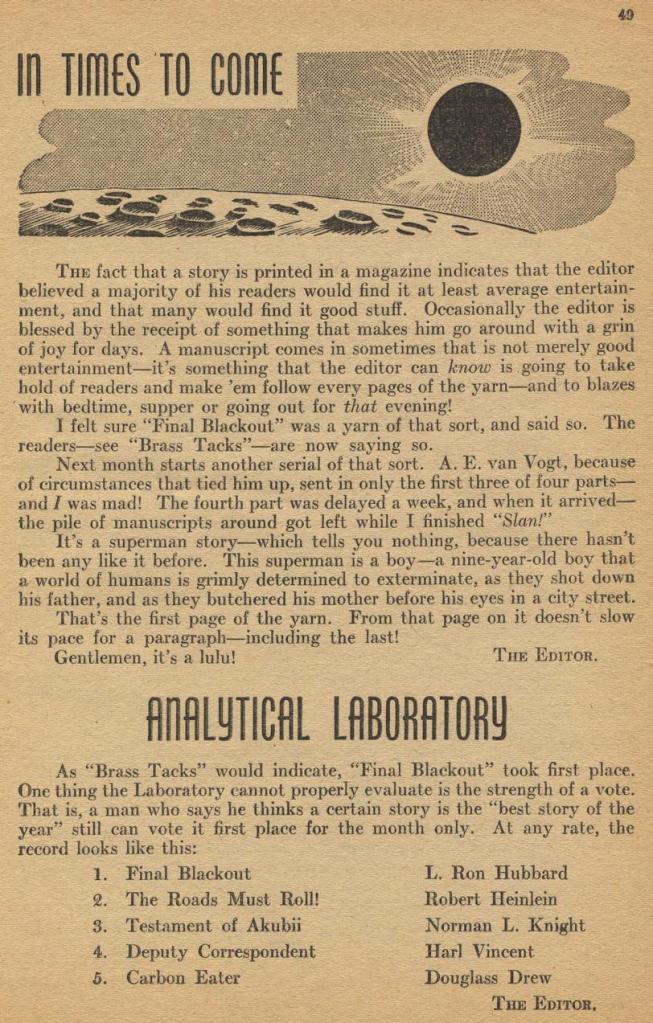
“The Roads Must Roll” came in second in the Analytical Laboratory (August 1940). But then serials usually come in first, and it was a big one, Final Blackout by L. Ron Hubbard. However, a letter writer praised the seriousness of Final Blackout, If This Goes On, and “The Roads Must Roll’ as proof that science fiction wasn’t just escapism. Another reader focused just on Heinlein:

It’s interesting, that on the cover of the June 1940 Astounding, which illustrates “The Roads Must Roll” we see individual vehicles shown in action. I assume they are the support vehicles the maintenance crews use below the rolling roads, and even then, they are not like how I pictured them in the story. The interior illustration got attacked in the letter column as being just a smear. It’s a shame that neither illustration pictures the roadway like Heinlein did in the story.

James Wallace Harris, 11/26/22