Science Fiction Can’t Save Us

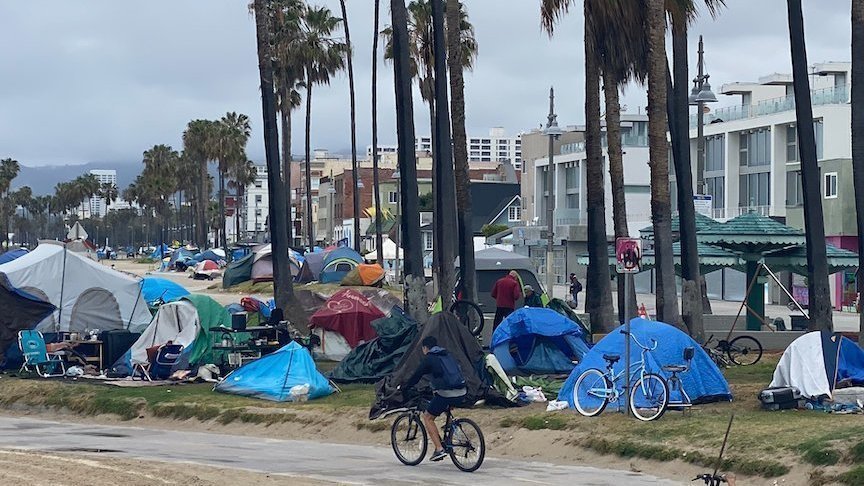
In the latest issue of Uncanny Maureen McHugh in “The Goldfish Man,” tells a story about a woman, Sima, who became homeless during the pandemic and eventually gets Covid while living in her car. I love McHugh’s writing and what I’m about to say isn’t a criticism of her story. Up to a point, the story is completely literary and could have been published in The New Yorker because it’s so well-written. My problem is with the implied ending, which is science-fictional and reflects a severe limitation of our genre.

Any writer concerned with our contemporary problems will want to write about them but I believe science fiction writers are at a disadvantage. If they want to sell their stories to a genre magazine it will need a genre hook and for many of the problems we face, coming up with a legitimate hook is a challenge. Our best minds can’t solve homelessness, and we’ve made quite a mess with our response to Covid. Literary writers can write about the impact of these two problems on individuals, which is what McHugh has done beautifully for most of the story.

Don’t read beyond this point if you don’t want to know spoilers for the story.

I’m not saying writers have to solve the problems they present in their stories but if they do, readers should be able to evaluate and judge them. And that works on two levels. First, and mainly, we judge plot solutions at the storytelling level. But second, at least for me, we have to judge how problems are solved on their real-world practicality.

In “The Goldfish Man” Sima might have solved her problem by hitching a ride with aliens, or she might have not. McHugh’s last line is “What happens next is impossible to explain.” That’s a great last line because it leaves what happens up in the air. If she actually left with Lane and Randy for a science fiction adventure Sima probably couldn’t explain it to us because it was too far out to comprehend. If Lane was insane, and she doesn’t leave, maybe McHugh can’t explain what happens to Sima.

I feel what this story shows us is science fiction can’t save us. If science fiction can only offer us rides to other planets, the ability to shift dimensions, or hop to new time periods, it’s no solution to Sima being homeless or a clue to how we might solve homelessness. If Sima does leave Earth I’m disappointed with the story. McHugh hasn’t given us an adequate explanation of how Sima will survive her new problems of making her living on other planets, in other times, or on alternate Earths.

If Sima stays, how will she survive now that she’s losing her support person Linda? I know McHugh doesn’t have a solution for homelessness, but how does Sima survive? McHugh described Sima’s problems in great detail and I now care about her. Because the story was so realistic I wanted a realistic ending, not a science fictional one. The idea that Sima takes off with Lane and Randy for the Twilight Zone annoyed the crap out of me. That seems like an ending we’d give a child. A soothing fantasy. It’s why the faithful say there are no atheists in foxholes. I’m an atheist and if I was in a foxhole in Ukraine I’d be praying for God too, but it’s still wishing for a magical solution to save me.

I believe magical science fiction solutions also reveal a weakness in our genre. Literary fiction can explore realist solutions that science fiction usually can’t.

This story reminds me of “Why I Left Harry’s All-Night Hamburgers” by Lawrence Watt-Evans and its third sequel “How I Found Harry’s All-Night Hamburgers” (Asimov’s 3/19). In the first story, which is a 5-star classic of the genre, the protagonist doesn’t leave our Earth when he gets the chance. It’s a rejection of science fiction, which makes the story brilliant and deeply moving. In the third sequel, a new protagonist does choose to leave. It’s a good story, on the level of some similar stories by Robert Sheckley, but it’s no classic like the original. The difference between the two is the lesson that science fiction won’t save us.

Science fiction is fun fiction but sometimes people want to believe in science fiction. Like religion, I no longer believe science fiction can deliver on its promises. I’m sure many reading this will say that science fiction never promised anything but stories and escapist pleasures, but I think there are whole generations that bought science-fictional beliefs like previous generations bought the beliefs of religion.

A major example is colonizing Mars. Colonizing other worlds has become the belief many people embrace for what to do after we destroy the Earth. People also want to believe that recoding their souls and putting them into robots or clones is a possible form of scientific immortality now that they have rejected life after death that religion promised. Neither of these science-fictional solutions will save us. For many years I believe we shouldn’t have all our genetic eggs in one planetary basket, but now I see I was wrong. The Earth is the only home we’ll ever have. Sure, a few people might live on the Moon or Mars for short periods, but there’s no other home for humanity other than Earth. And to put it flatly, we’ll never escape death, either with science or Jesus.

Growing up I had alcoholic parents that dragged me and my sister from home to home and from state after state. Science fiction did save me back then. Or I thought it did. It let me solve my problems by ignoring them. Psychologically that helped me survive, but looking back now, it wasn’t a good long-term solution.

I now see magical solutions in fiction as a terrible solution even for make-believe characters.

James Wallace Harris, 4/26/22

Old and New Science Fiction

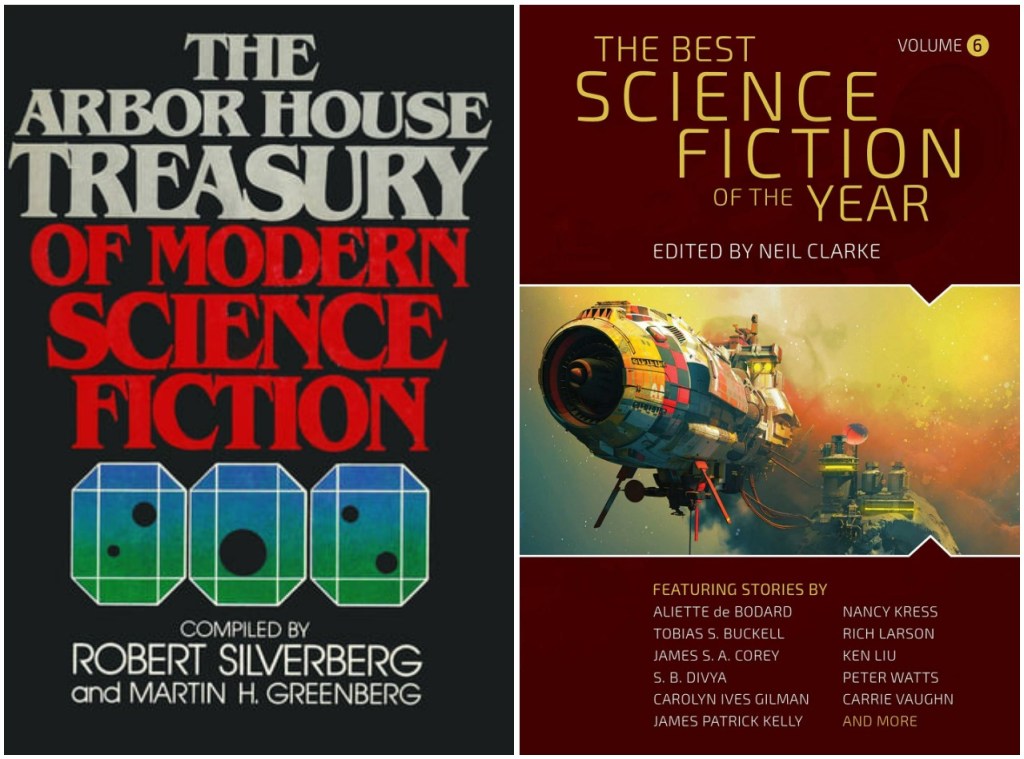
The Facebook group Best Science Fiction and Fantasy Short Fiction will begin discussing The Best Science Fiction of the Year v. 6 edited by Neil Clarke on April 24th for Group Read 38, and The Arbor House Treasury of Modern Science Fiction edited by Robert Silverberg and Martin H. Greenberg for Group Reading 39 on April 29th. That means during May, June and some of July will be alternating between old and new science fiction short stories each day.

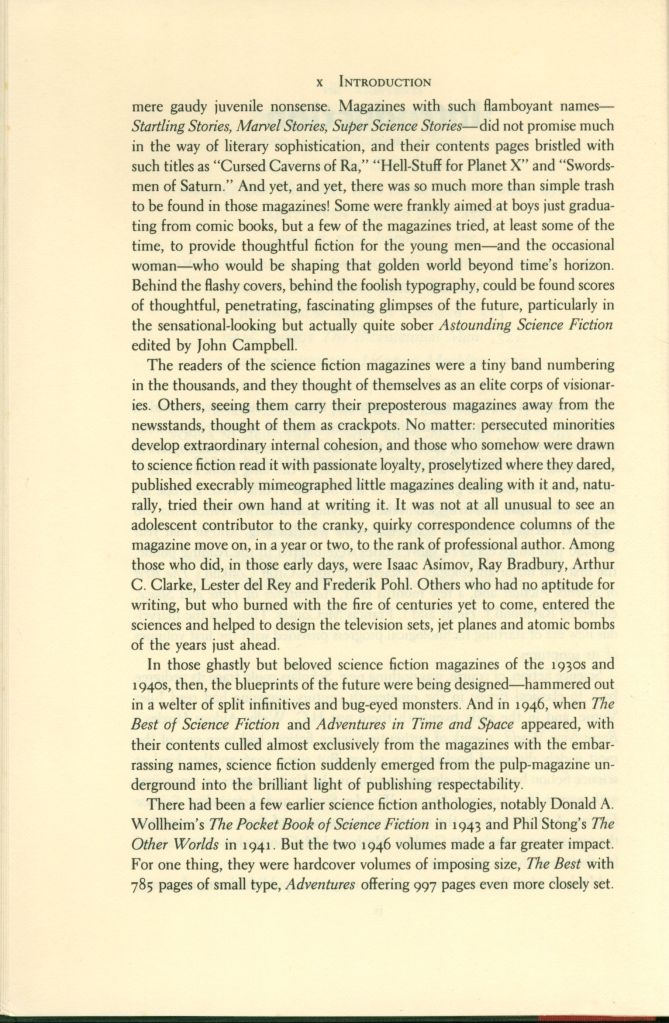
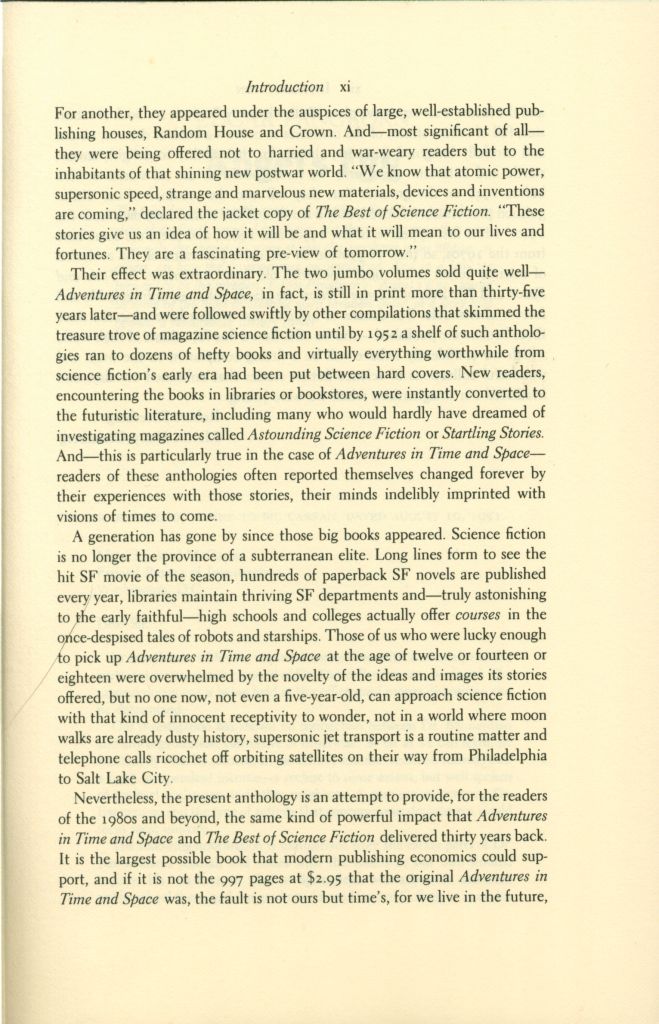
Silverberg and Greenberg compared their anthology to the two classic SF anthologies from 1946: The Best of Science Fiction edited by Groff Conklin, and Adventures in Time and Space edited by Raymond J. Healy and J. Francis McComas. For decades, readers found those two anthologies in their libraries and were standards for introducing readers to short science fiction. They hoped The Arbor House Treasury of Modern Science Fiction would cover 1946-1979 like those two classic anthologies did for science fiction before 1946.

The Neil Clarke volume is his pick of the best short science fiction of 2020. Group Read 38 schedule. Group Read 39 schedule.

Now that I’m regularly reading old and new science fiction short stories I’m learning how both science fiction and writing science fiction are evolving. Part of my daily routine is reading the next day’s story, and then thinking about it when I’m going to sleep at night so that in the morning I can type up a short review for the group when I start my day. Belonging to this Facebook group has been a real education, kind of a graduate course in science fiction literature. More than that, it’s been a meditation on my lifelong relationship with science fiction. I’ll try to write longer reviews for this blog for those stories that really inspire me.

I hope Silverberg and Greenberg won’t mind me reprinting their short introduction because it says so much about remembering science fiction short stories. 75 years later, the CSFSS list only recalls one story from the Conklin anthology and four from the Healy/McComas book. 42 years later, the list remembers 10 from the stories Silverberg and Greenberg picked out. But how many of those 10 will remain in another 33 years?

James Wallace Harris, 4/23/22 – updated 4/27/22

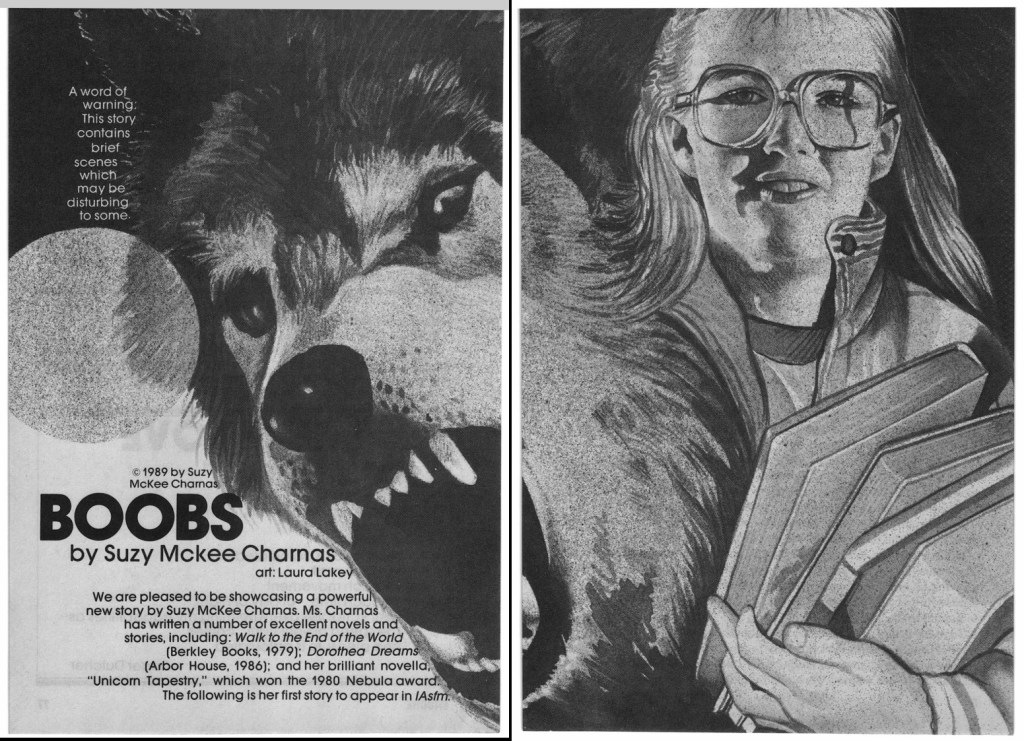
“Boobs” by Suzy McKee Charnas

Today’s story at the Best Science Fiction and Fantasy Short Fiction group on Facebook is “Boobs” by Suzy McKee Charnas. You can read it here. In the first comment, Jeppe said he was surprised it won the Hugo, which was my reaction too. It is a slight story about a girl hitting puberty and becoming a werewolf, but it’s been reprinted quite a bit, indicating its popularity. The group is reading Hugo and Nebula Award Winners from Asimov’s Science Fiction edited by Sheila Williams.

So, I asked myself, “Why would this story win an award?” I came up with two theories, neither of which involves the quality of writing.

First, “Boobs” is about being different and being bullied. Kelsey is a young girl who is developing faster than her peers and when she starts wearing a bra gets the nickname Boobs from the school bully, Billy. This reminded me of a recent phone call with my old friend. Connell had been extra tall in high school and it had been an unpleasant time for him. He told me the reason why I hadn’t been bullied in school was that I had been average-looking. I didn’t stick out. And that was true. I was of average height, average looks, average clothes, and average intelligence.

“Boobs” is about sticking out and being ridiculed and bullied, and I have a feeling that might have been true for a lot of science fiction fans. A story that resonates deeply with an old hurt might get the vote on an award ballot.

The second reason probably deals with the same psychology. “Boobs” is revenge porn. Kelsey eventually kills and eats Billy when she’s in her werewolf state. That was a quite satisfying way to plot the story, but isn’t giving the class asshole the death penalty a little harsh? If you pay attention to stories and movies, revenge against bullies is a popular plot. Revenge might be the number one plot for westerns. Westerns are often about grown-up bullies, and the common solution is to kill them. The recent western, Power of the Dog, has been described as being about toxic masculinity. It’s about a bullied kid who gets his revenge. The deep-down desire to see violent people come to a violent end is probably another reason why “Boobs” got its votes for the Hugo.

And who knows, maybe if young girls did turn into werewolves and fed on bullies and stray dogs society would be much nicer. I bet guys like Putin or Trump would never have survived adolescence.

I thought the best thing about “Boobs” is how Charnas describes being a wolf, especially perceiving the world through smells. It was also interesting that “Boobs” was a science fiction story about a young girl getting her first period. “Even the Queen” by Connie Willis was also a Hugo award-winning short story about menstruation. Are there other SF stories on this topic? Enough to create an anthology? Have any of them won awards?

Although I thought “Boobs” was a slight story, I did think it was a good story. And it reinforces my belief that straightforward science fiction/fantasy stories set closer to the present, and ones readers can relate to emotionally, will be more successful than dazzling complicated stories set in the future.

All too often we expect award-winning stories to be profound, brilliant, dazzling, impressive, complex, etc. Maybe just pushing the right emotional button is all you need to get readers to like your story.

James Wallace Harris, 4/13/22

Is There Any New Territory for Science Fiction to Explore?

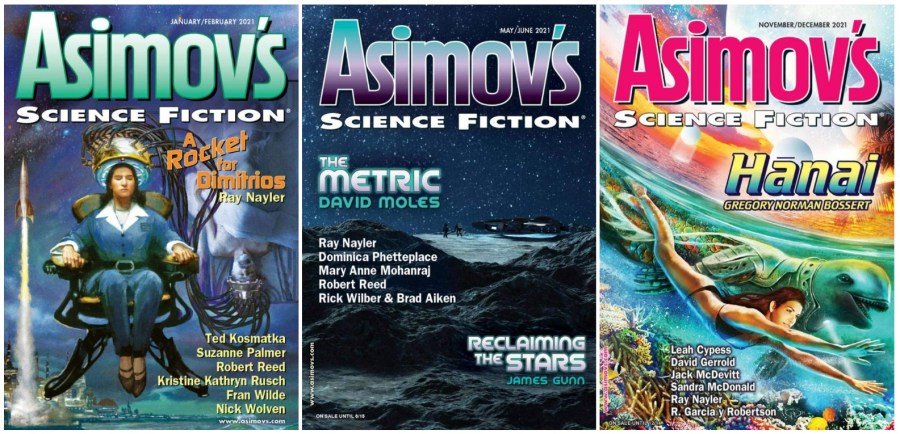
Ray Nayler had a successful year writing science fiction short stories in 2021. Three of his stories made the Asimov’s Readers’ Award Finalists poll: “A Rocket for Dimitrios” (novella), “Año Nuevo” (novelette), and “Muallim” (short story). That doesn’t include four other stories he had published in other magazines in 2021. The Facebook group Best Science Fiction and Fantasy Short Fiction has been reading and discussing all the finalist stories and Nayler’s stories have been popular with our group. We tend to be an older crowd that’s been reading science fiction for a long time, and Nayler’s stories fulfill our need for new science fiction that feels like older science fiction.

Before I say what I want to say, just let me assure you I’m not picking on Ray Nayler, but questioning science fiction in general. I enjoy Nayler’s stories and consider them among the best science fiction coming out today. I’m looking forward to his first novel, The Mountain in the Sea coming out in October.

While reading all the finalists for the Asimov’s Readers’ Award, and especially Nayler’s stories, I couldn’t help but wonder if science fiction has any new territory left to explore? All the stories seem to be variations on old themes. I always wanted to be a science fiction writer, but reading these stories made me think just how hard it must be to write new science fiction, especially original science fiction. Our Facebook group has read hundreds of SF stories, and it’s obvious that few stories succeed with a majority of our readers. Writing a major science fiction short story is very rare.

Nayler’s stories stood out for me of the sixteen finalists. They were the most enjoyable to read, and I felt the most successfully told. However, they all seemed like old friends wearing snazzy new threads. I can’t help but wonder if new science fiction writers ever come up with new science-fictional ideas? Or has our genre explored all the territory to be explored?

Of course, this is my problem since I’m 70 years old and I’ve been reading science fiction for 60 of those years. Younger readers might not see any problem at all. If you live long enough, you begin to feel like Solomon writing Ecclesiastes 1:9 and saying “There is nothing new under the sun.” That feels like an oxymoronic adage when talking about science fiction. (Yet, I felt “A Rose for Ecclesiastes,” by Roger Zelazny was something new under the sun in 1963.)

My favorite of Nayler’s stories was “A Rocket for Dimitrios.” (Story links are to pdf files to read.) However, its plot was inspired by A Mask for Dimitrios by Eric Ambler, called A Coffin for Dimitrios in the U.S., which better connects to Nayler’s title. I haven’t read that novel, but I’ve seen the Sidney Greenstreet/Peter Lorre movie from 1944, so that’s how I pictured it when reading Nayler’s novella. Both stories about Dimitrios overlap in interesting ways with exotic flavors.

“A Rocket for Dimitrios” is an alternate history story, so it’s a double retread, It’s rewriting history, and writing a classic mystery novel. That’s quite clever, and I think that points to Nayler solving the problem I’m discussing. If you can’t produce a new science fiction idea for a story, repackage old ones in clever ways. And is that what all the new science fiction writers must do today? Or, am I seeing something different? Are new writers reinventing science fiction with each new generation because they haven’t read the old science fiction? Is it a variation on the famous quote, “Those who cannot remember the past are condemned to repeat it” by George Santayana?

“A Rocket for Dimitrios” is a sophisticated alternate political history that reflects a great deal of our current political reality. After America finds a crashed flying saucer in 1938 it becomes the sole superpower using advanced technology discovered in the UFO. The story creates an alternative geopolitical view from around 1960 I guess. (FDR is in his 7th term.) Because Nayler is in the foreign service and has been stationed in the Caucasus, he obviously knows the history of Turkey after the fall of the Ottomans. This local coloration gives the story its strongest appeal, but then that was true of the movie, and probably the novel.

Fictional characters Sylvia Aldstatt, Alvin Greenly, and Chief Inspector Rafik Bayar are mixed with alternate history characterizations of Franklin Roosevelt, Eleanor Roosevelt, and Hedy Lamarr. Greenly is in the OSS and Aldstatt is a medium that uses alien technology to speak to the dead Dimitrios Makropoulos. This story is far more complex than the other nominated stories for the Asimov’s Reader Awards which suggests a growing writing maturity by Nayler. This was my second reading of this story and I rate it a strong four stars out of five.

Even though this is a fun story I can’t help but believe it’s Nayler’s philosophical statement about current world affairs. In that sense, it’s quite interesting to compare “A Rocket for Dimitrios” to David Brooks’ latest editorial in The New York Times. Both Nayler and Brooks want to be positive, but they see the growing trend toward nationalistic thinking since the 2016 election, and it’s not positive. The obvious connection to both story and essay is humans are an intelligent species, just not quite intelligent enough to survive. Both Nayler and Brooks are hopeful, I’m not.

Muallim” is a wonderful story about a teaching robot and a student-teacher in Khynalry, Azerbaijan. The plot is rather simple, about how the village tricks the student teacher who wants to change their old ways, but the story is far richer. I think we should ask why? “Muallim” is an exceptional science fiction story, but what makes it so?

The obvious answer is the setting. Nayler’s foreign service experience, and knowledge of languages, along with being a keen observer of local details, infuses wonderful details into this story. Would this story have been as good if it was set in Los Angeles? Maybe, but I think not. An exotic setting can really make an old science fiction theme stand out.

Writers have reached the saturation point of writing about robots and AI. It’s extremely hard to do anything different. The foreign color of this story is what made it impressive. The story itself is just a retelling that sentient robots are just as good as humans.

I also think “Muallim” shines because it’s built on layers. The outsider, the student-teacher, rejects what Irada, the female blacksmith, and the other villagers want for their children. But then, there are other people outside of the village, who reject the robot. We know these people have been there for hundreds of years and they don’t like change, but some of them do accept the robot. Azerbaijan is in a part of the world where some of the oldest civilizations began. There’s quite a contrast between old and new. Finally, I think the story stands out for characterization. I rate it a strong four stars out of five.

Año Nuevo” caressed all my science fiction zones but didn’t give me a sense-of-wonder orgasm. That might be due to me being old. I liked Nayler’s story mostly because he’s writing good old-fashioned science fiction in an era when good old-fashioned science fiction is being left behind.

“Año Nuevo” uses twin storylines to effectively evoke two classic science fiction themes: the alien that’s unlike us, and the Jesus alien. Science fiction writers have always been challenged to describe a real alien first encounter. Of course, Nayler pulls a twist on this one and a good twist at that. Where my uncertainty comes from regarding this story is with the Jesus alien.

I’m calling aliens who bring us salvation, uplift, transcendence, or special powers, the Jesus alien. Religion has always worked in that psychological territory, so it’s interesting when science fiction offers alien saviors. I remember Arthur C. Clarke covering this topic several times. It always aroused suspicion in me, but then I’m an atheist.

We’re actually given two reasons for Bo’s transformation from a surly teenager to a loving son – he’s infected by the alien, and he has sex with Aliyah, neither of which should have brought about such a dramatic personality transformation. I also thought it too melodramatically cliche that Bo was brutally beaten by Aliyah’s brothers. That plot choice hurt the story for me. It would have passed if the story had been set in Azerbaijan but not in modern America.

Nayler is a skilled writer, but I can also see the machinations in his storytelling. This is the third finalist story in the Asimov’s Reader Awards by Nayler that our Facebook group has read. Such prolific output requires a certain amount of hackwork. “Muallim” and “A Rocket for Dimitrios” felt more original than “Año Nuevo,” but all three reveal Nayler’s approach to writing science fiction. Ray Nayler knows what readers love, hopes to give them more, and is succeeding. I give this story a strong three stars.

Nayler isn’t breaking any new ground but he’s entertaining and very readable. Is there any new territory to be found in our genre anymore? That’s the trouble with being an old science fiction reader, we’ve read it all before.

JWH

Does Too Much Suspension of Disbelief Ruin a Story?

The willing suspension of disbelief is required to enjoy many forms of fiction, especially science fiction. On the other hand, at what point does ignoring reality ruin a story?

Some readers and moviegoers are willing to accept anything the story asks of them. If the story moves along quickly and is exciting, most readers aren’t going to stop and ask questions. Other readers will slow, pause, or even stop reading when they hit a logical speedbump.

Yesterday I read “Glitch” by Alex Irvine. I hope the author won’t mind me using his story as a lecture about the overuse of the suspension of disbelief. It’s up for the Asimov’s Science Fiction 36th Annual Readers Award. You can read it here. It’s a fun story based on a neat idea. Several people in our short story group rated it highly, with one member giving it five stars out of five.

I liked “Glitch,” but I hit several speedbumps where I couldn’t suspend my disbelief.

The story begins with Kyle Brooks waking up in a hospital room wondering how he got there. We quickly learn that Kyle was killed in a terrorist attack by a white supremacist. His mind had been backed up and he had a new body without scars, tattoos, or piercings. That implied to me it was a clone.

Speedbump #1

Where did Kyle’s new body come from? Since the doctor examines Shari’s wounds and gives her a prescription it’s implied that it’s right after the bombing. Did they grow a clone body in hours? Did they have one in storage? No one else in our group asked about this.

Obviously, Irvine wants to ignore this, so I will too. Mind uploading is a very popular topic in science fiction right now, although it’s been around for decades. I fondly remember Mindswap by Robert Sheckley from 1966 and less fondly I Will Fear No Evil by Robert A. Heinlein from 1970. I don’t believe mind swapping will ever be possible but I’m willing to suspend my disbelief for stories about this theme. It is a fun concept.

Speedbump #2

We quickly learn that Kyle isn’t alone in his new body. For some reason, Brian, the terrorist bomber is sharing Kyle’s mind. This is much harder to believe. Kyle is at a special hospital for restoring minds. Evidently, it’s quite a regulated business. How in the world could two people be in one mind? Irvine does some hand waving that is completely unsatisfactory to me.

Great Idea #1

However, this is a very cool plot twist so once again I’m willing to suspend my disbelief. The possibility of a liberal who is about to marry a person of color coexisting with a white supremacist is a great fictional situation. Again, I let my suspension of disbelief go. I love the possibility of a bad guy walking a mile in the shoes of a good guy.

Speedbump #3

The police show up at Kyle’s house the next day. They have evidence that suggests the terrorist bomber is inside Kyle’s mind, but Kyle tells them no, even though he knows Brian is there. The cops even tell Kyle that if he’s lying, he can be prosecuted as a conspirer for Brian’s crime. This is the hardest part of the story for me to buy. Kyle should have immediately told the cops that Brian was in his mind. Kyle obviously doesn’t want him there, and he has no resources to remove him, why wouldn’t he ask for help from people who did have the resources?

I know why Irvine made this plot choice. He wanted Kyle to become the action hero of the story. Personally, I always find stories where an ordinary person becomes an action hero to be completely unbelievable. I really don’t want to suspend my disbelief on this point, but I’ve got to buy into it because I want to know how Kyle rids himself of Brian.

This is why I’ve stopped watching thrillers and action movies because movies have made everything with this kind of comic book logic. Comic book logic is the most extreme version of suspension of disbelief. Anything is possible. All a writer must do is say it’s so. They expect the reader to accept that whatever is suggested is real. No critical thinking is assumed as standard.

Alex Irvine does write for comics and I’m afraid “Glitch” descends into full comic book logic from here on out. As the plot speeds up, so does the frequency in which Irvine asks us to suspend our disbelief. Irvine isn’t alone in doing this. It’s become a common practice in science fiction stories that involve action.

Science fiction books used to be more realistic. Movies and television shows have always leaned towards comic book logic. Buck Rogers and Flash Gordon started out as comic strips in the newspapers. In modern times, as comic book movies have dominated box office sales, comic book logic has infected all genres of movies based on action. I think this has inspired science fiction writers to use it more and more in their books and short stories.

The result of this is that readers don’t just suspend their disbelief at basic conceptual science fiction ideas, they have turned it off for any kind of characterization or plotting. We’re asked to accept the absurd, the impossible, the unbelievable, the illogical, the inane, actions people would never do, to move the plot forward, usually at a breakneck speed.

When I point this out most people tell me, “It’s just a story – chill out.” And I suppose that would be okay if we were all five years old and still believed in Santa Claus. But if you look at our society, comic book logic has corrupted all ages in all levels of society. The world is filling up with gullible people who expect reality to be like comic books and movies. They expect anything is possible, they want anything they believe to be true. Is this because of the fiction we consume? Has the suspension of disbelief needed for fiction transferred to how we live our lives?

One of the early critics of science fiction suggested that good science fiction should only have one suspension of disbelief per story. That after the fantastic concept everything else should be realistic. This is true for two other stories I’ve read recently, “Fire Watch” by Connie Willis and “Speech Sounds” by Octavia Butler. The first gives the ability to time travel to historians, and the second has a plague that destroys speech. After those starting points, we’re not asked to suspend our disbelief again. Both short stories are classics of science fiction.

I believe the science fiction norm has changed over time so that writers seek to cram in as many speculative ideas as possible because it keeps their readers constantly thrilled. The side-effect of this paradigm shift is that we’re asked to suspend our disbelief over and over.

If “Glitch” had only expected me to believe that mind swapping will be happening after the mid-21st century, and two minds could occupy one body, I would have been happy to let the story unfold. In fact, I was looking forward to several possibilities playing out. I’ll call these Expectations.

Expectation #1

I wanted Irvine to work out how two minds in one body would function. The old saying about walking a mile in my shoes has come true, so I wanted to see what would happen. How much of our personality is determined by our body and how much is determined by our experiences? Would Brian, the white supremacist, change because he was in a new environment?

Irvine didn’t go in that direction. Irvine spent the rest of the story having Kyle do everything possible to rid himself of Brian. Now that’s logical, but since we’re in a story about two people in one body, I wanted to imagine how that would work. Basically, it works just enough to maintain an action-oriented plot where Kyle would become a hero. I can accept that, but I also expected Kyle’s actions to save himself would be realistic from now on in the story. I also expected Kyle to grow from this experience, gain insights, or have an epiphany. Nobody grows in this story.

Speedbump #4

To save himself and prove to the police he’s not guilty of cooperation under the habeas mentis law, Kyle figures he needs to find the bad guys, stop the next bomb, and prove himself the hero. This has become such a cliché plot point that I groaned at having to read it. In science fiction, there is a suspension of disbelief over fantastic ideas, but in storytelling in general, there’s also a suspension of disbelief in basic plotting. This plot motivation is so tired that I usually stop reading or watching. Still, I wanted to find out how Kyle rids himself of Brian.

Speedbump #5

Kyle decides he needs help and remembers a programmer from work named Abdi. The magical hacker is the new fairy godmother in fiction. Abdi can quickly solve all of Kyle’s problems with his band of fellow hackers and cog swappers.

Speedbump #6

Irvine introduces us to cog swapping. Kyle needed a hospital to put a copy of his mind back into his body, but Abdi and his merry band can swap minds and stream real-time brain backups with tiny nifty gadgets. Think magic wands. This is when the story got downright stupid. I no longer could suspend disbelief at all. It was now moving a comic book panel speed.

Great Idea #2

When Kyle reaches the hideout of the bomb makers he is attacked by Brian in his body. It turns out the Brian in Kyle’s head is a copy, and the Brian with a body has no need of him. Kyle’s Brian is furious at being betrayed. This is a fantastic plotting idea. If Great Idea #1 is having the bad guy in the good guy’s head, walking a mile in his shoes, then Great Idea #2 is having the bad guy see himself. This reminds me of Bob Dylan’s song “Positively 4th Street.”

I wish that for just one time

You could stand inside my shoes

And just for that one moment

I could be you


Yes, I wish that for just one time

You could stand inside my shoes

You’d know what a drag it is

To see you

Expectation #2

If we could travel back in time one week and spend that week with ourselves, would we like each other? When the real Brian showed up in “Glitch” I was thrilled. This was a new plot twist. This was something different. And it inspired my hopes that the story would turn around.

“The enemy of my enemy is my friend” is an old saying that should have applied here. My first expectation was internal Brian to change because of walking a mile in Kyle’s shoes. My second expectation was that the internal Brian would side with Kyle to fight external Brian. I saw this as a great symbolic solution to the story. Internal Brian would change, help Kyle catch external Brian, and then fade away inside of Kyle as Brian’s evil personality was overwritten by Kyle’s goodness. That’s what the doctors told Kyle would happen at the beginning of the story.

This would be deeply positive symbolism. By the story’s logic, we should blow up all white supremacists. That’s its solution to racism. But that’s not a practical solution in the real world. We need to overwrite racism with positive personality traits. We need racists to see that they are wrong. Simple fiction has simple bad guys with simple solutions – kill the bad guys. That’s Old Testament thinking. New Testament thinking involves conversions and salvation.

Simple fiction needs bad guys to kill without remorse. Terrorists are the safe one-dimensional bad guy to use in fiction. I wanted “Glitch” to go deeper.

But this story didn’t follow my expectation.

Speedbump #7 and #8

Kyle kills external Brian by setting off the bomb. This was clearly foreshadowed early in the story. Kyle awakes in the same hospital that he did at the beginning of the story. He is free of internal Brian. How? Abdi’s magic of course. If it was that easy, why didn’t the hospital erase Brian at the beginning of the story? And Kyle has another new body. Where the hell does all these clones of Kyle keep coming from?

Conclusion

“Glitch” was fun to read. I tripped over one speedbump after another. I’m old, so I’m probably too judgmental and cranky. I thought Irvine has a great idea for a novel. The story unfolds much too fast. It should have been longer with subplots and proper pacing. It needs depth and subtlety. Even with the existing plot, it would probably make a lot of readers happy. I wouldn’t want to read it though, not as is. However, if it was fixed without all the speedbumps I might.

It would be entirely unfair for me to expect Irvine to write a story other than the one he wrote. I have to wonder if other readers aren’t like me and as they read react to stories with ups and downs, or with hopes that the tale will go in different directions and explore the territory the story inspires in our minds?

James Wallace Harris, 4/1/22