Story #12: “A Martian Odyssey” by Stanley G. Weinbaum
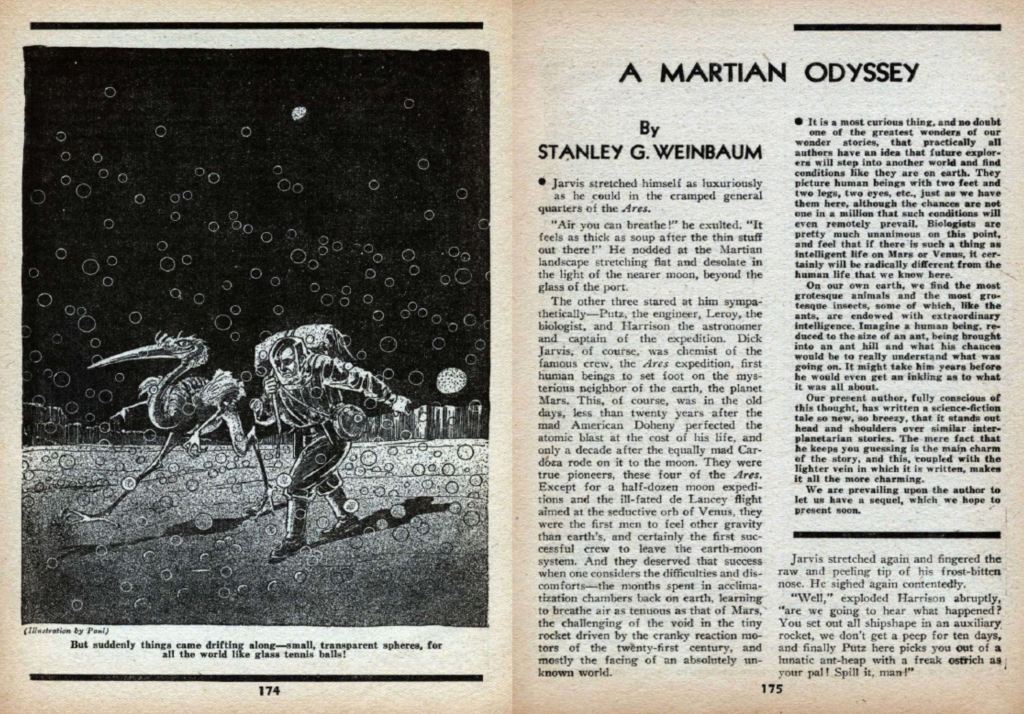
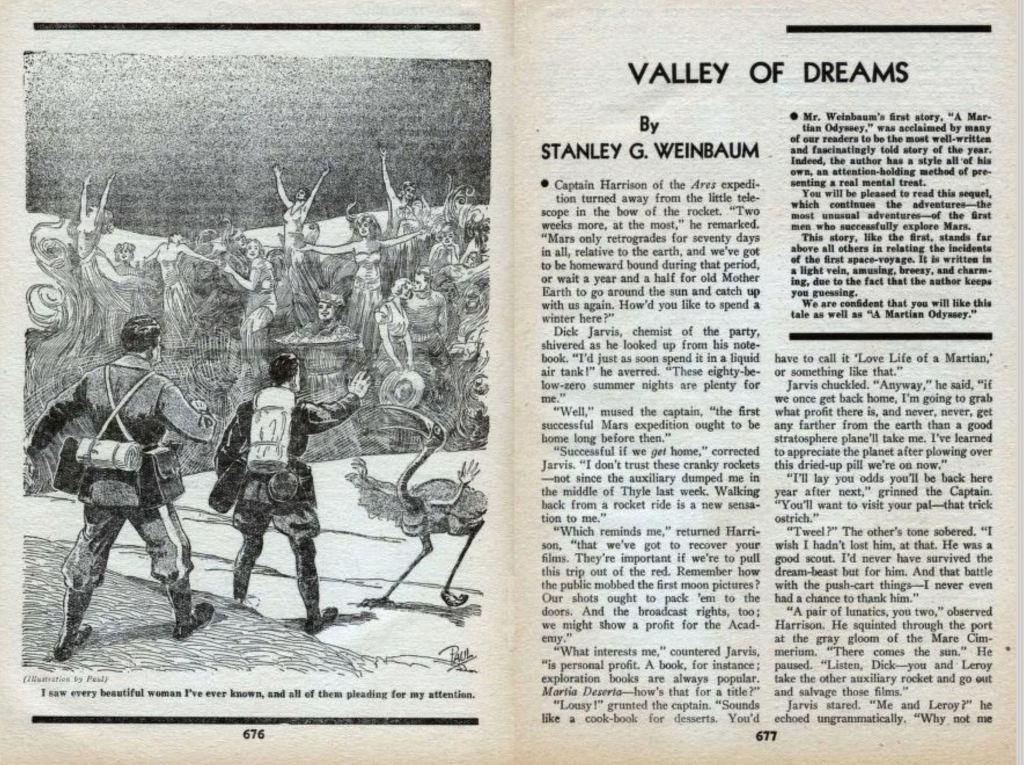
This is the fifth time I’ve read “A Martian Odyssey” and the third time reading “The Valley of Dreams,” the lesser known second part of the story. It’s a shame the Mars of that story isn’t the Mars that NASA’s rovers explore. Humans have been piddling around in LEO since 1972 when all along we’ve known that Mars is our real destination. Maybe we haven’t gone because we know the Mars out there isn’t the Mars of Stanley Weinbaum or Ray Bradbury.
I’m watching For All Mankind on Apple TV+. It’s an alternate history story that begins in 1969 when the Russians become the first nation to land men on the Moon. Our failure spurs us to build a permanent base on the Moon, and from then on, history keeps changing. I call this kind of story a “I could of been a contender” tale after the Marlon Brando character in On the Waterfront. Ever since Apollo 17 space enthusiasts have wondered what could have been if we’d kept going. This show soothes those regrets. I’m seeing more science fiction that retells recent history but with better results. Mary Robinette Kowal is doing the same thing with her Lady Astronaut series.
The alternate history I’d want to relive would be where “A Martian Odyssey” was incorporated into our reality, and not fiction. My favorite era of science fiction is from “A Martian Odyssey” from 1934 to “A Rose for Ecclesiastes” by Roger Zelazny in 1963. Those two stories are the alpha and omega in the table of contents for The Science Fiction Hall of Fame Volume One edited by Robert Silverberg. That’s where I first read “A Martian Odyssey” over fifty years ago.
What can I say about “A Martian Odyssey” that hasn’t been said before? If you haven’t read it and its sequel “Valley of Dreams” from the November 1934 issue of Wonder Stories, then go read them here and here. And if you don’t want to do that, here’s an excellent summary of “A Martian Odyssey” at Wikipedia.
What I want to write about is the legacy of the story. “A Martian Odyssey” was first published in Wonder Stories, July 1934, and then reprinted just five years later in Startling Stories, in the November 1939 issue. Then in 1943, Donald Wollheim reprinted it in The Pocket Book of Science Fiction, a book some consider the first real SF anthology. But the next jump is a big one, when members of SFWA voted it into The Science Fiction Hall of Fame Volume One in 1970. Why hadn’t Groff Conklin, or any of the other classic anthology editors of the 1950s and 1960s reprinted it? Did they feel that everyone had a copy of Wollheim’s 1943 paperback, or bought the 1949 hardback, A Martian Odyssey and Others from Fantasy Press (or its Lancer paperback reprint in the 1960s)? After that big gap from 1943-1970, “A Martian Odyssey” has been regularly reprinted almost every year or two since.
“A Martian Odyssey” is now considered a classic. This novelette epitomizes science fiction about Mars. But is it really about Mars? Well, not the Mars NASA explores. Martians aren’t quite as well known in literature as ghosts, goblins, fairies, elves, wee folk, and other imagined creatures of fantasy, but almost. Mars has always been our best hope for another planet for humanity, one where our sense of wonder runs rampant. Once all of Earth had been explored in the early 20th century, Mars became the location for lost civilizations and exotic lands.
“A Martian Odyssey” is a first contact story and all it involves. Tweel is everybody’s favorite alien. “A Martian Odyssey” anticipates both ET and Arrival. And I think that’s the heart of what I’m trying to get at in these essays. The best science fiction stories are those that come closest to the ideal forms of science fiction. And, like I said before, I believe the ideal forms of our genre are not very many. Mars has become the ideal planet, but the ideal doesn’t have to be Mars. Like Tweel is the ideal first contact with an alien, but the ideal doesn’t have to be Tweel.
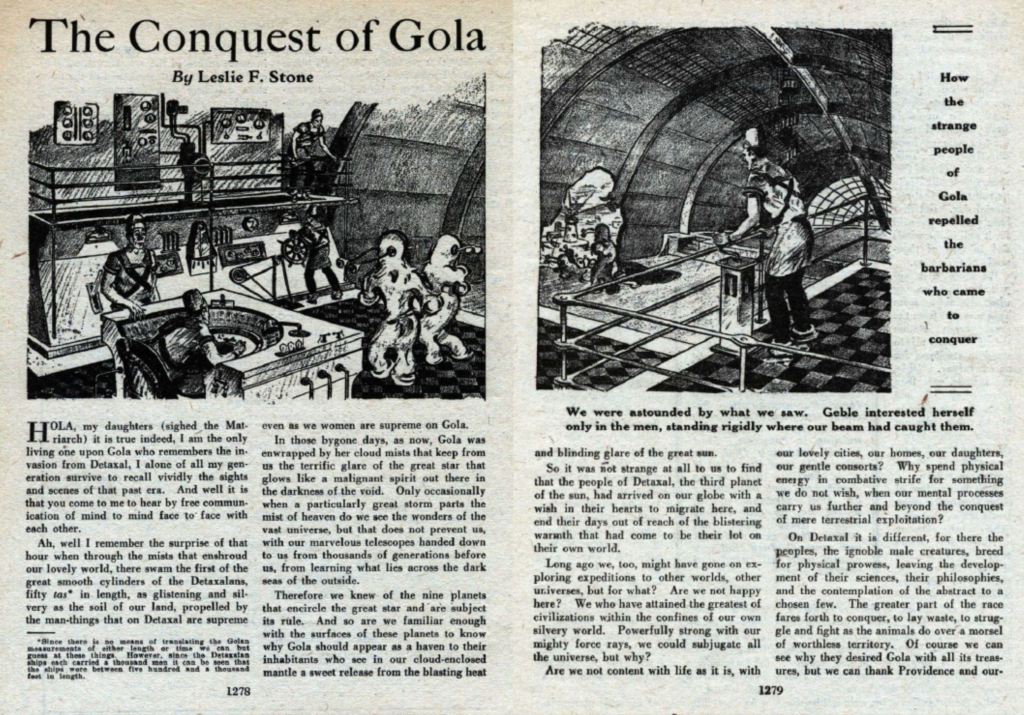
Then why isn’t “The Conquest of Gola” remembered as well? Why don’t we remember Venus and the first contact with Golans from that story like we do Mars and Tweel from “A Martian Odyssey?” Even though the females from Gola are described as being very interesting beings, they weren’t likable. And their world, Venus wasn’t appealing either.
Dick Jarvis, the human that befriends Tweel has a great adventure on Mars, seeing many wonderous things and beings. Mars is as magical as Oz. “The Conquest of Gola” reminds us of the battle of the sexes on Earth. It reminds us that humans exploit other lands and peoples for profit. It reminds us we’re violent, intolerant, and can’t communicate.
If you want to write an enduring science fiction classic be positive. Make the humans, aliens, and planet appealing. We want enchantment more than scolding. I first fell in love with Mars when I read The Red Planet by Robert A. Heinlein in 1964. I was twelve. It had Willis and the Old Ones, mysterious Martians, and Mars was full of exciting adventures for Jim and Frank. However, Heinlein’s bad guys, the bureaucrats from Earth contrasted the bad old ways of Earth against the good life of pioneers on the red planet. That worked. Leslie F. Stone just didn’t inspire us to colonize Venus.
Finally, I don’t know why “Valley of Dreams” isn’t nearly as popular as “A Martian Odyssey since it continues the same story.
Story #11: “The Conquest of Gola” by Leslie F. Stone
“The Conquest of Gola” first appeared in the April, 1931 issue of Wonder Stories, but more importantly, it was reprinted in The Best of Science Fiction edited by Groff Conklin, one of two giant retrospective anthologies published in 1946, the other being Adventures in Time and Space edited by Healy & McComas. Those two volumes were widely acquired for library collections. Over the next three decades, baby boomers would discover those anthologies and others, learning about the history of the science fiction magazines, and expand the growing population of science fiction fans. Conklin was the John the Baptist of the genre, editing over forty anthologies from 1946-1968. I loved his anthologies growing up, always searching for them when I went to a library. (See “Why Anthologies are Important to Science Fiction.”)
In recent years “The Conquest of Gola” has been reprinted many times in both genre retrospectives and anthologies showcasing women science fiction writers. Beside being written by a woman in the early days of pulp science fiction, it’s also about a matriarchal society on Venus. Story #11 is the second tale featuring a female dominated utopia. However, in both stories, it was a dystopia for the males.
In “The Conquest of Gola,” Gola is the planet Venus, which is ruled by female super-beings. Males are considered gentle consorts, kept for pleasurable companionship. When two ships from Earth arrive, crewed only by men who want to exploit Venus by promoting trade and tourism, the female rulers of Venus are annoyed. They see males from our planet as vastly inferior. They assume the females of Earth have allowed their males extra freedom and gave them spaceships as playthings. When the rulers of Gola discover the Earthmen are the dominant gender from our planet, that blows their minds. After repeatedly being told to leave, the Earthmen turn to violence, destroying the capital, and conquering the other cities. Earthmen then start convincing the males of Gola to join them. Finally, the females of Gola have enough, kill all the humans, and put their males back in their old roles, and live happily ever after.
“The Conquest of Gola” is a pretty good yarn, a bit clunky sounding today because of the typical writing quality common to SF pulps back then. Yet, it has many interesting bits of speculation. First, and this was common for the time, was the idea that superior beings possessed telepathy and other extrasensory powers. “The Man Who Evolved” was in the same issue of Wonder Stories. That’s another SF theme I’d like to trace over time. Second, is the focus on gender. Like in “Sultana’s Dream,” males are considered stupid and violent, whereas females are peaceful and intelligent, the obvious gender to be lead society. But I don’t think that originated in science fiction. People have long speculated what it would be like if women ruled the world. Another idea in the story I’ve seen in other SF stories, is the belief that once a species reaches a certain level of maturity, it will become less materialistic. The inhabitants of Gola had spaceships long ago but gave them up.
Reading this story has me thinking about building a subject database for the science fiction stories I read. I struggle with memory. First, I’m getting old, and my recall is flaky, but second, I’ve read thousand of science fiction stories. Often, I only vaguely remember a story by a particular topic, and can’t remember the title or author. I’d love to have a database that would allow me to retrieve stories by themes, topics, or subjects. For example, list all stories about societies ruled by women. That query should help me remember “Sultana’s Dream” and “The Conquest of Gola.”
I showed a spreadsheet sample for remembering subjects when I reviewed “The Comet” by W. E. B. Du Bois. That was a quick and dirty solution, but to really get the job done would require a relational database because I’d want each story to be able to have unlimited subjects attached to it.
And is subject the right word? Should it be theme? Or concept, or idea? What is the right word for describing what a science fiction story is about? For “The Conquest of Gola” there are several keywords I’d like to link with the story so when I want a list of stories that deal with a specific subject, it would add “The Conquest of Gola” to the listing. For this story I’d link it to these subjects:
Aliens
Venus
Gender
Superior Being
Utopia
Female
Feminism
Telepathy
ESP
Conquest
You can probably see how this gets tricky fast. Why do I need Gender and Female? Or even Feminism? What if I wanted to list all SF stories that deal with gender roles in society? (Think The Left Hand of Darkness.) But another time, wanted a list of all stories where females are the dominate gender? Will all such stories be about feminism? What if I wanted just a list of stories that promoted feminism? Is “The Conquest of Gola” really about feminism? I’m not sure. It’s often used as an example for women writing science fiction, but does that fact make it about feminism? The Handmaid’s Tale is obvious a work I’d tag with feminism in the subject field. I’d put feminism in “Sultana’s Dream” subject field for sure, but I don’t think I would for “The Conquest of Gola.”
See why creating a subject database for science fiction stories is tricky? It’s probably why we don’t see any. ISFDB started the “Tag” field, and if you search for “Feminism” it brings up only 13 entries. My guess is they gave up on that project, suggesting it I might be waste my time.
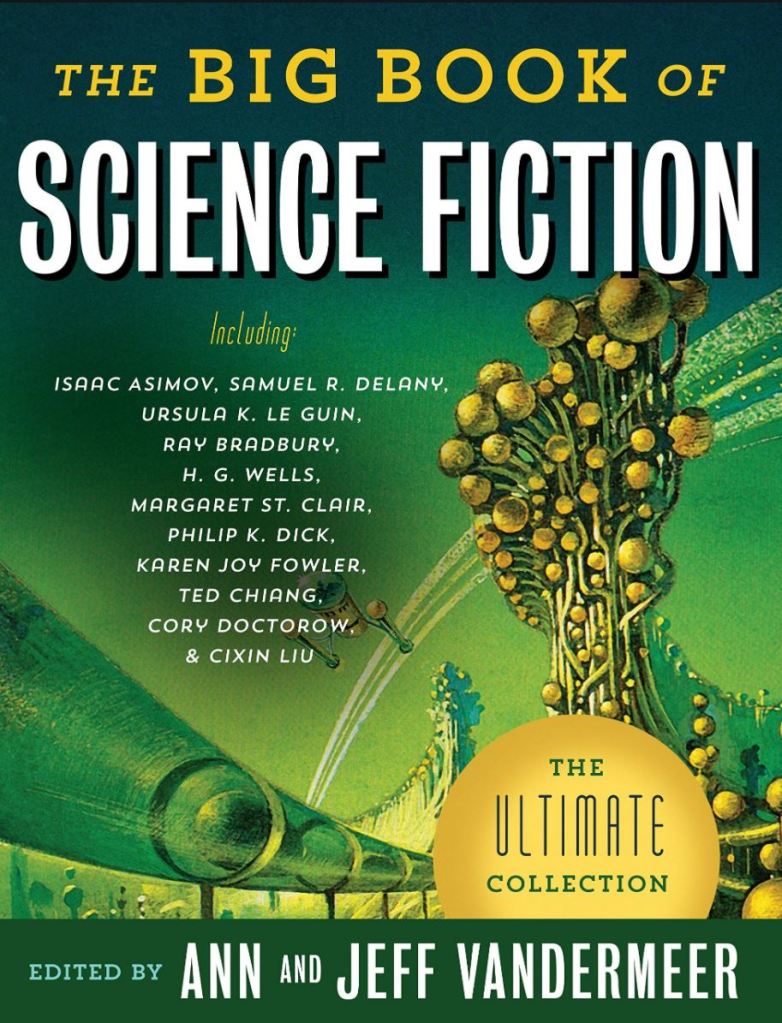
However, as I review the 107 stories of The Big Book of Science Fiction I might build a test database. It sure would help me to remember SF stories if I had a database with a carefully designed subject field. Each title could have any number of subjects tagged to it, but does that mean the number of subjects would be unlimited? Would it help manage complexity if I used two fields: Theme and Subject? We’ll see.
It only took us to the tenth story in this giant retrospective science fiction anthology to get to the galactic civilization, probably the the most cherished of all science fiction concepts, and the destination fantasy of true fans. “The Star Stealers” anticipates both Star Trek and Star Wars. The galactic civilization is to science fiction what Middle-Earth is to fantasy.
“The Star Stealers” is the second of seven stories (1928-1930) in Hamilton’s early space opera series, Interstellar Patrol. Those stories are among the earliest science fiction about interstellar travel, and among the few to leave the galaxy. This story could have been the inspiration for Star Trek since it involved a Federation governing the galaxy, a captain commanding from a bridge of a Federation ship, and even a second officer who is a woman. Edmond Hamilton and E. E. “Doc” Smith were the pioneers of space opera.
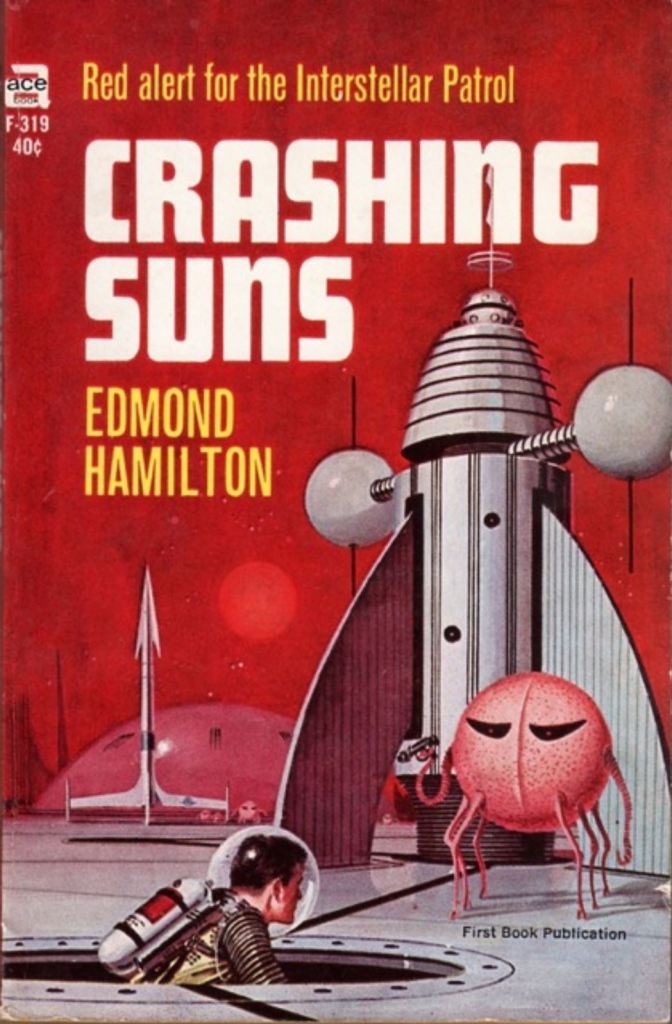
Five of the Interstellar Patrol stories were first published in book form in 1965 as Crashing Suns, the year before Star Trek premiered. All of them were republished in 2009 as The Star-Stealers: The Complete Adventures of The Interstellar Patrol, The Collected Edmond Hamilton, Volume Two, a collector’s edition from Haffner Press that’s now out of print and costs hundreds of dollars used, if you can find a copy. However, because it took decades for these stories to be reprinted suggests they weren’t fan favorites. Most of Hamilton’s early magazine work wasn’t published in book form until the late 1960s or 1970s. Edmond Hamilton is most famous for his Captain Future series, but even those fan favorite stories from the 1940s weren’t reprinted as books until 1969, and then as cheap Ace paperbacks. Hamilton’s appeal seems rather limited. “Doc” Smith’s Skylark and Lensman series vastly overshadowed Hamilton’s space operas.
I’m still trying to discern the VanderMeers’s methodology for the stories they collect in The Big Book of Science Fiction. Anthologies usually have a design behind them. The simplest approach is to bundle a bunch of stories you expect readers will enjoy. Because this anthology is a retrospective of 20th century science fiction I assume the stories showcase the genre. In the introduction the VanderMeers tell us they want to broadening the history of the genre by including women writers and foreign-language stories in translation. I thought that was an excellent ambition. But I assumed when they did include traditional SF stories, those stories would be the classics, and maybe the best example of each writer’s work.
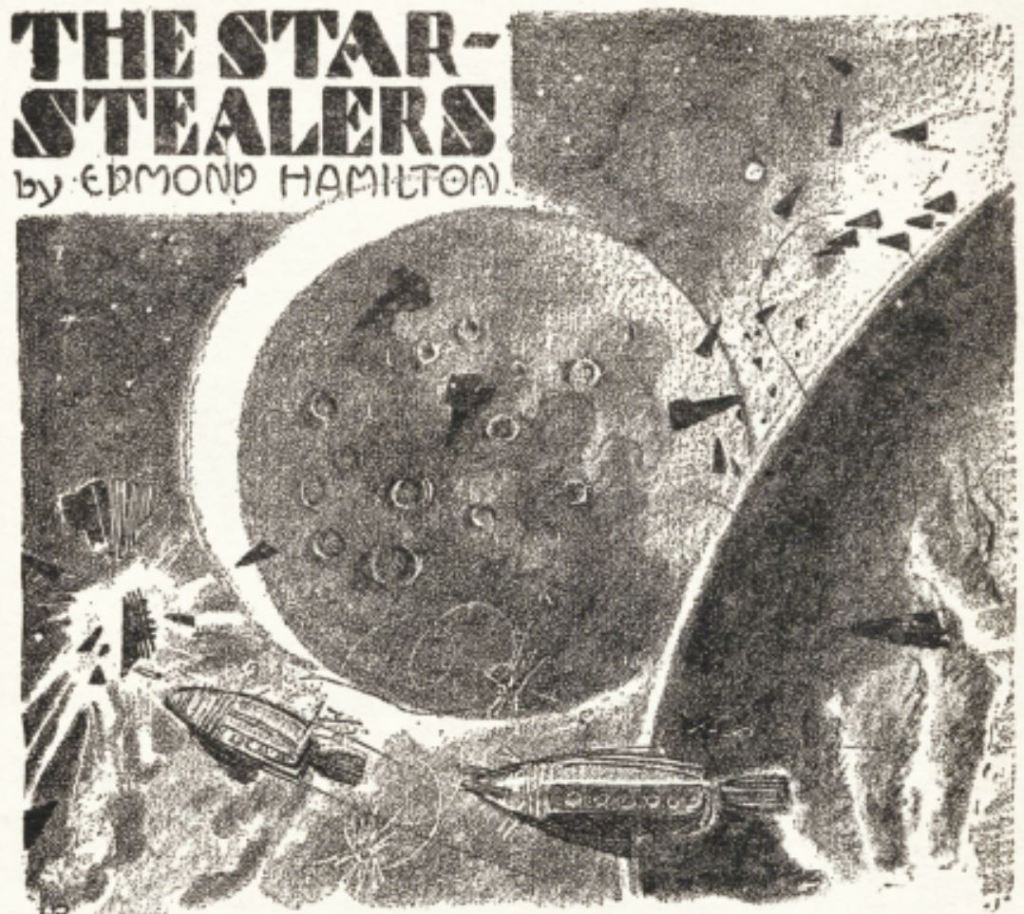
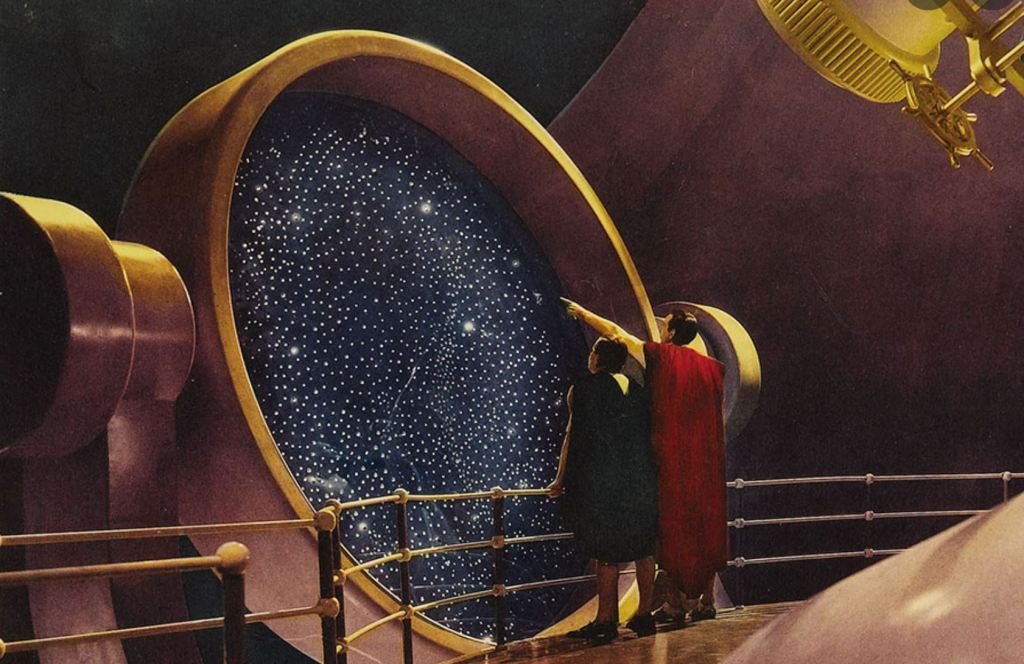
This has happened some, but not to the degree I assumed. For example, “The Star Stealers” is not Edmond Hamilton’s best. Hamilton was never a good writer, and it shows in “The Star Stealers,” which is little better than a comic book without pictures. Hamilton wrote two stories, “The Man Who Evolved” and “What’s It Like Out There?” I believe belong in retrospective SF anthologies. The original use of the term space opera was as a put down for the kind of writing “The Star Stealers” epitomizes. I even wonder if Hugo Gernsback, who had no ear for prose, had turned down “The Star Stealers.” Weird Tales is a legendary magazine today, but it’s content was often amateurish. But Hamilton was practically a house writer for them, so he probably didn’t submit it to Amazing. This story was no more sophisticated than the illustration that went with “The Star Stealers” at the top of the page.
Still, there’s plenty to like about “The Star Stealers,” and it makes an interesting entry for the anthology. The plot parallels the story by Wells, “The Star,” which was about a rogue astronomical body flying through the solar system, swinging too close to Earth. In “The Star Stealers” a giant sun is detected coming from outside the galaxy that will swing too close to Earth. For this story, the object is traveling many multiple speeds of light and will reach the solar system in four months. This is ridiculous, but Hamilton’s Federation space cruisers can travel a thousand times the speed of light, so its no problem. (By the way, how do astronomers detect objects approaching Earth traveling faster than light in their telescopes?)
“The Star Stealers” was published the year before Clyde Tombaugh discovered Pluto, and just five years after Edwin Hubble proved the existence of galaxies outside of the Milky Way, and less than two decades since Einstein explained that nothing could travel faster than light. Hamilton has his space cruiser traveling from Alpha Centauri to our system in twelve hours. This is almost as fast as they travel in Star Wars, but a good deal slower than what they can do in Star Trek. We might forgive Hamilton for breaking Einstein’s speed law in 1929, but even modern writers can’t let go of FTL.
In recent decades we’ve been seeing more stories following Einstein’s laws for interstellar travel, but for the most part writers keep coming up with theoretical gimmicks to go faster. Readers want science fiction where humans roam the galaxy at will, and we see this in “The Star Stealers.” However, the super-science of that story and other early space operas has been deemed excessive by modern fans. “The Star Stealers” feels as archaic today as a silent movie. At one time, “Doc” Smith had his characters hurling galaxies at each other, but nowadays, science fiction readers are happy with space opera that span just a few hundred light years. Vernor Vinge’s Zones of Thought series is the last science fiction I’ve read that covers the entire galaxy. The only other SF story I know that has characters traveling between galaxies is “The Star Pit” by Samuel R. Delany. I should forgive Hamilton because “The Star Pit” is not ridiculous to me at all, in fact, it’s my all-time favorite SF novella.
But as I said, “The Star Stealers” is a fascinating choice for this anthology. It anticipates the ultimate setting of science fiction fans who want to dwell in a galactic civilization, with countless exotic worlds to visit, and plenty of exotic races of intelligent aliens to be friends and foes. Edmond Hamilton grasped the final frontier early, and the idea of a federation of star systems. “Doc” Smith’s first space opera, The Skylark of Space has a lone Elon Musk like inventor competing with a mad scientist, Blackie DuQuesne to explore the galaxy. Hamilton jumps ahead of Smith by imagining a civilized galaxy. Unfortunately, Hamilton’s prose was painful, and he never achieved the popularity of Smith. “Doc” Smith’s second space opera series, The Lensman series actually popularized the galactic civilization which eventually led to Star Trek. It was Asimov, with the Foundation series, that popularized the galactic empire, which led to Star Wars. I keep mentioning those two franchises because they represent the most loved examples of science fiction today, and these earlier stories represented how thousands of fans eventually turned into hundreds of millions of fans.
So, in that sense, the VanderMeers have made an exceptional pick. Unfortunately, “The Star Stealers” is also a perfect example of bad writing, even for old timey science fiction. First, the bad characterization.
The hero of this tale is Ran Rarak. We expect him to be dashing, but there is no supporting description, even though he’s the admiral of a mighty space fleet. We expect Ran to be heroic, but in the big fight he gets knocked out and is unconscious for ten weeks. We eventually see Ran duking it out with one alien, but it’s an ordinary non-superhero punch out. And the one problem he solves is by ramming the enemy’s pivotal machine with his space cruiser.
Hamilton should get credit for introducing a female character in early SF. Dal Nara, pilot, second officer, is a woman who gets to be part of the story action but her only insight is to yell, “Hey, look!” warnings on a few occasions. Her only action is to use her long legs to grab a means of escape. And finally, her chosen reward for help saving the solar system is to visit a beauty parlor. But she’s not the love interest. Hamilton, we give you a gold star, but it doesn’t stick and falls off.
And like in Star Trek, characters are comically tossed around the bridge to show conflict in space. Only one named character in the story is killed, Nal Jak, but he does nothing, and we don’t even know the color of his shirt. Hurus Hol we’re told is the brilliant scientist, but we’re never shown him being brilliant. However, he does commit one of the cardinal sins of bad science fiction, he infodumps on Ran Rarak in a completely condescending way:
He was silent again for a moment, his eyes on mine, and then went on. “You know, Ran Rarak, that the universe itself is composed of infinite depths of space in which float great clusters of suns, star-clusters which are separated from each other by billions of light-years of space. You know, too, that our own cluster of suns, which we call the galaxy, is roughly disklike in shape, and that our own particular sun is situated at the very edge of this disk. Beyond lie only those inconceivable leagues of space which separate us from the neighboring star clusters, or island universes, depths of space never yet crossed by our own cruisers or by anything else of which we have record.

“But now, at last, something has crossed those abysses, is crossing them; since over three weeks ago our astronomers discovered that a gigantic dark star is approaching our galaxy from the depths of infinite space—a titanic, dead sun which their instruments showed to be of a size incredible, since, dark and dead as it is, it is larger than the mightiest blazing suns in our own galaxy, larger than Canopus or Antares or Betelgeuse—a dark, dead star millions of times larger than our own fiery sun—a gigantic wanderer out of some far realm of infinite space, racing toward our galaxy at a velocity inconceivable!

“The calculations of our scientists showed that this speeding dark star would not race into our galaxy but would speed past its edge, and out into infinite space again, passing no closer to our own sun, at the edge, than some fifteen billion miles. There was no possibility of collision or danger from it, therefore; and so though the approach of the dark star is known to all in the solar system, there is no idea of any peril connected with it. But there is something else which has been kept quite secret from the peoples of the solar system, something known only to a few astronomers and officials. And that is that during the last few weeks the path of this speeding dark star has changed from a straight path to a curving one, that it is curving inward toward the edge of our galaxy and will now pass our own sun, in less than twelve weeks, at a distance of less than three billion miles, instead of fifteen! And when this titanic dead sun passes that close to our own sun there can be but one result. Inevitably our own sun will be caught by the powerful gravitational grip of the giant dark star and carried out with all its planets into the depths of infinite space, never to return!”

Hurus Hol paused, his face white and set, gazing past me with wide, unseeing eyes. My brain whirling beneath the stunning revelation, I sat rigid, silent, and in a moment he went on.
The plotting of the story is about at the level of old Buck Rogers serials, which were more primitive than the Flash Gordans. Humans detect a giant sun heading towards the Milky Way and calculate it will swing near enough to the Sun to capture Sol and pull it into intergalactic space. They quickly assemble a fleet of fifty Federation space cruisers and take off. When they reach the giant sun which turns out to be populated death star, their fleet is almost completely destroyed, and our heroes get immediately captured. Like so many episodes of Star Trek where Captain Kirk is confined by ropes, chains, jails, cells, dungeons, and sexy space-babes, the plot pivots on merely escaping confinement and performing one little act, thus saving the Earth, solar system, galaxy, or universe. It turns out not all the fleet was destroyed, and good old Federation cruiser Number Sixteen escaped to fetch back a fleet of 5,000 Federation ships in the nick of time. Hamilton couldn’t even be bothered to name his ships, even the one that saves the day.
Edmond Hamilton seems to know little about astronomy or physics. He keeps mentioning three billion miles like it’s a tremendous distance, yet that’s just a tiny fraction light travels in one year: 5,878,625,370,000 miles. His ships accelerate but never decelerate. And a Federation spaceship can suddenly stop or hover in relation to each other even though they’ve been traveling a thousand times the speed of light. Another foreshadowing of Star Trek and Star Wars.
Like I said, this story was written just a few years after Hubble made the measurements to calculate that other galaxies were outside the Milky Way. It appears that Hamilton thinks our galaxy and the universe is terribly tiny. Was that true for all people back in the 1920s? Maybe it was for teenage readers of SF.
Even though E. E. “Doc” Smith was far more famous than Edmond Hamilton, he wasn’t much better as a writer. “The Star Stealers” is typical for both storytelling and science back in the 1920s and 1930s. There’s a reason why John W. Campbell, Jr. is so famous, because he attracted both stories and writers that were a quantum leap in quality and talent. And it explains why it’s hard so hard to find good science fiction stories between H. G. Wells and Robert A. Heinlein. This brings us back to the anthology.
Should we remember the all the bad stories that helped evolve the genre? There is a kind of fun academic appeal to reading old clunkers like “The Star Stealers” but is that what most buyers of retrospective anthologies want? And I still wonder if there were truly good stories from back then that could be rescued.
Look at it this way. There was thousands and thousands of short stories published in the 19th century, but how many are still embraced by readers today? Is the number even greater than 25? Or 10? I’m talking by bookworms, not scholars.
When a century separates readers from the 20th century, how many of these SF stories will still be read? At what point should we let go? Just how big would The Big Book of Science Fiction be if it only reprinted four and five star stories? My definition of a four-star story is any story on reading the first time leaves you knowing you’ll want to reread it. My definition of a five-star story are stories which bookworms cherish and read many times over their lifetime.
“The Star Stealers” fits neither definition for me. My definition for three-star stories are solid well-written stories that deserve to be published in a professional periodical, and might even deserve to be reprinted in an annual best-of-the-year anthology. It’s hard to judge the quality of “The Star Stealers” today by whether it deserved a magazine editor’s acceptance. But I’m guessing Farnsworth Wright was excited about the ideas in “The Star Stealer” and knew Hamilton wasn’t much of a writer. Wright and Gernsback knew their readers weren’t mature or educated, just enthusiastic. Even in 1929 I probably would have considered it a 2-star story, but I probably would have bought it if I was a magazine editor. It was different.
I enjoyed reading and writing about “The Star Stealers” because I’m an autodidactic scholar of science fiction, but I have to wonder what the average science fiction fan today will think of it.
With the ninth story of The Big Book of Science Fiction edited by Ann and Jeff VanderMeer, we’ve finally reached the land of science fiction. In our group discussions many have questioned whether the earlier stories were truly science fiction. With “The Fate of the Poseidonia” by Clare Winger Harris from the June 1927 issue of Amazing Stories we’ve finally reached the era of pulp science fiction magazines. If anything defined the concept, it was the science fiction magazines.
Clare Winger Harris images a much different winter of 1994-95. George Gregory discovers his girlfriend Margaret has taken up with another guy, a Mr. Martell. Martell looks odd, and acts suspicious. George tells Margaret of his worries, but she defends Martell and dumps Gregory. Mr. Gregory starts spying on Mr. Martell out of jealousy, and learns that Martell is a Martian spy. Unfortunately, no one will believe him, and he’s committed to a mental hospital.
Is “The Fate of the Poseidonia” the earliest example of Martians living amongst us stories? My two favorites of that theme are A Mirror for Observers (1954) by Edgar Pangborn and The Man Who Fell to Earth (1963) by Walter Tevis. Both of these novels have a quiet beauty you don’t often find in science fiction. This theme was also used on The Twilight Zone and The Outer Limits. The idea of Martians passing for humans is very entertaining to me which caused me to like “The Fate of the Poseidonia” more than it probably deserves. It’s a decent story, mainly suffering from an unskilled writer, but Harris did win third prize for it at Amazing Stories.
What makes this story so distinctive among those we’ve read so far is how the reader in thrown into the future. This isn’t a dream, or an experiment in storytelling, a political allegory, or philosophical musing. This story contains the real essence of science fiction. The setting is science fictional, and the intent of the story is science fictional. Clare Winger Harris asks us to believe that there are intelligent beings on Mars who come to Earth to steal our water. Their planet has dried up and they have the technology to lower ocean levels by many feet. Harris has created an entertaining example of “What if …?”
In 1927 it was widely assumed there could be life elsewhere in the solar system, especially Mars and Venus. Until Mariner 4 flew by Mars in July of 1965, hope was held out for life on Mars, even intelligent life. I’m not sure people growing today can understand how it was almost a common assumption that Mars and Venus could actually be inhabited. Sure, most scientists held little hope, but the public did, and it was reflected in Pre-NASA science fiction. From H. G. Wells to Roger Zelazny there were endless science fictional speculations about Martians. I loved the idea of Martians as a kid, and even wrote an essay, “I Miss Martians.”
I also grew up with NASA, so I quickly gave up all hope for finding any kind of life within our solar system. The more I read popular science, the more skeptical I became about science fiction. Eventually, I doubted most of what science fiction hoped. But in my old age I realized I still love the old unscientific science fiction. (I’m really digging listening to The Best of Walter M. Miller, Jr.)
I’ve mentioned this before, but I grew up reading Oz books before I discovered science fiction. At the beginning of the 20th century L. Frank Baum produced a series of children’s books about a fictional location that existed somewhere on Earth, but in a geography that had eluded all explorers. Over the series, the Land of Oz became richly complex. As a gullible nine-year-old in 1962 I wanted Oz to actually exist. I knew it didn’t, but I wanted it to be a real place. Hell, it was crushing to lose Santa Claus at 6, then Oz at 9, and Christianity at 12. So I turned to science fiction. My 69-year-old self realizes that for most of my lifetime, science fiction was my replacement for Oz and religion. I always rationalized that reading science fiction prepared me for the future, and inspired me to learn about science, but in reality, it was my way to escape the mundane.
This is very different from my middle-age self who wanted science fiction to be scientific. Now I see very little difference between science fiction and fantasy. Both are fairytales for readers who have left childhood. Both are about world building fictional universes. There seems to be some differences because some readers show preferences for one over the other. Maybe science fiction are those tales that seem more realistic. However, in 2021 how realistic is “The Fate of the Poseidonia” then? It’s far from scientific. In 1927 it was thought to be more realistic, but not if you were properly educated.
I’m using these essays reviewing the stories in The Big Book of Science Fiction to understand the evolution of the genre, but also to psychoanalyze myself. Why do I love science fiction so much? I want to define the term science fiction because it seems to point to exactly something that pushes my buttons. A good deal of pop culture is now science fiction, so I’m not alone in my attraction. Maybe we should all analyze this fixation?
We could say science fiction is fiction set is the future. That might be the one telling trait that defines science fiction for me, but maybe not everyone. Fantasies are set in the past, present, or never-never land. When they are set in the future, like Jack Vance’s The Dying Earth, I want to call them science fiction. This lets us file steampunk and alternate history in the fantasy bin. I like that, because neither of those types of stories feel like science fiction to me. We could split the difference on time travel stories. If characters head to the past, it’s fantasy, but if they go forward, it’s science fiction. But there’s a problem. All those stories about visiting dinosaurs are definitely science fiction to me.
What if someone today wrote a story set in the future where we discover an ancient dying civilization on Mars, something that’s been proven to be impossible? I can amend my definition by saying even fantasies set in the future belong in the science fiction bin too. In fact, older unscientific SF has become my favorite kind of science fiction in recent years. And I’ve notice a trend for writers to produce alternate history science fiction, like the novel The Calculating Stars by Mary Robinette Kowal, or the Apple TV+ series For All Mankind. I might not be the only person nostalgic for what science fiction used to be.
As I read and review the stories in The Big Book of Science Fiction, and our Facebook group discusses them, I’m trying to find a reason to keep the term science fiction. I swing back and forth from wanting to throw out all genre labels, to finding a practical meaning for the term science fiction that most people can agree on.
Right now my working definition is “Science fiction is fiction set in the future.” That leaves a lot of holes, but then we have almost a hundred stories yet to consider.
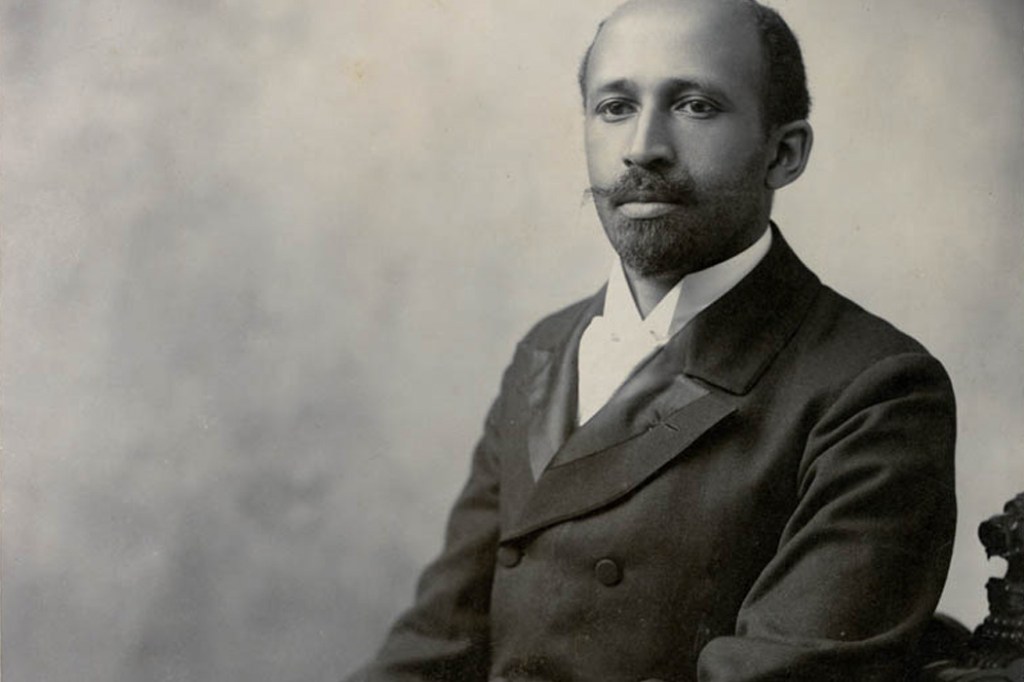
“The Comet” by W. E. B. Du Bois is the first story we’ve read in The Big Book of Science Fiction that reads like a modern short story, and feels like modern science fiction. Is there a name for the form of fiction we now consider the standard model? All the stories we’ve read so far felt quaint, experimental, philosophical, pretentious, or unnatural. “The Star” by H. G. Wells was the closest to normal, but it did feel old fashioned, like other stories from the 19th century. Du Bois story is from 1920, yet felt more polished and modern than most science fiction from the 1920s, 1930s, and into the 1940s.
I know I’m not being very precise here when trying to talk about writing styles or forms. I just don’t have the terminology. I’m trying to describe something I’ve observed from personal experience that might have precise labels among academics. The prose of Charles Dickens, Henry James, or Edith Wharton has a quality that makes them feel old to me, but they are still very readable. Then in the 1920s, Hemingway and Fitzgerald and other writers made their prose more streamlined, and thus created what I think of as the modern form of fiction. Modern fiction has a greater percentage of dialog, and that dialog rings more natural. In the 19th century, the narrative part of fiction was quite wordy, especially with writers like Henry James. H. G. Wells was long on narrative and short on dialog, and his characters sounded Victorian.
The prose in 1920s Amazing Stories and early 1930s Astounding feels oldy too, and has a clunky quality of bad writing. Science fiction has always had the extra burden of explaining the science fictional aspects. This is called info-dumping, and is comparable to 19th descriptive narration that would spend paragraphs describing a mantelpiece.
“The Comet” feels more like Fitzgerald in its storytelling techniques, which are more advanced than the first decades of science fiction of the 1920s and 1930s. A large part of Heinlein’s success when he made a splash in the early 1940s was his use of modern streamline writing. The focus was on dramatic dialog, while minimizing the infodumping and narrative descriptions. Heinlein’s prose sounds snappy, even breezy compared to his predecessors. Heinlein’s style immerses the reader into the fantastic with the minimum of fuss and notice.
In other words, I’m quite impressed with W. E. B. Du Bois writing in “The Comet.” It’s a shame he didn’t become a genre writer during the pulp era. “The Comet” is pre-apocalyptic, apocalyptic, and post-apocalyptic, as was “The Star” by Wells. The difference was Wells was narrating a ponderous worldwide overview, while Du Bois used the POV of one person.
Both are good stories, but “The Comet” points the way to the future. As we progress through the stories in The Big Book of Science Fiction, we’re seeing both science fiction themes evolve, as well as the techniques of fiction writing.
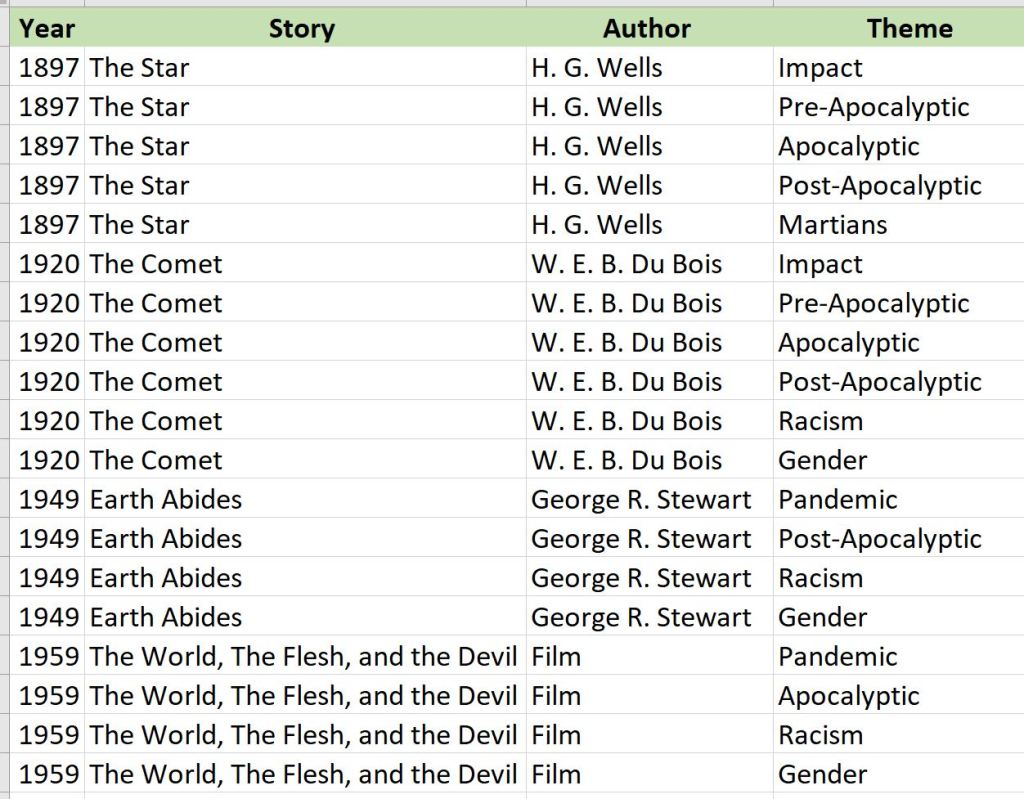
I would love if I could quantify these two progressions. I have no idea how to track changes in fiction writing. For science fiction themes I picture myself building a database of theme examples. Designing the structure of such a database will take considerable thought. Most science fiction stories have multiple themes. For example:
Notice that Earth Abides and The World, The Flesh, and The Devil do away with Pre-Apocalyptic and Apocalyptic phases of the story, jumping immediately into the Post-Apocalyptic phase. The direction of storytelling is towards getting into a tale quicker, and when there, conveying the action in prose that is speedier to read. Modern bestsellers are very easy to read, dominated by near realistic dialog. Older fiction have archaic dialog, sometimes sounding like lectures, that slow the story.
Written fiction, novels and short stories, can convey the inner world of thoughts and opinions, that media fiction, movies and television shows, seldom attempt to express. But written fiction seems to be moving away from this unique attribute in favor of speed. But it would be a shame to abandon it entirely. (As an aside, some modern written fiction comes across like the young writers were inspired by movies rather than books.)
All stories have a setup and something to say. In “The Comet” Du Bois wants to say things about race, using the setup of a science fiction theme to express himself. The collapse of civilization allows Jim Davis, a black man from 1910s New York City to connect with Julia, a white woman. This connection was impossible before the apocalypse. Like Rod Sterling talking about a character entering the twilight zone, science fiction allowed Du Bois to put Jim Davis in a setting to show how race is an artificial construct of society.
Because Du Bois’ goal was to change readers’ minds about race, can “The Comet” still be science fiction? In an earlier essay, I said science fiction are those stories set within specific themes, like the future, traveling in space, or after the collapse of civilization. Racism is a universal theme that SF can’t claim. Science fiction is the setup of “The Comet,” but the story was written to say things about racism.
This brings us to an interesting question: Do both the setup and the intent of the story have to be science fictional to make the story science fiction? Eventually, in The Big Book of Science Fiction, we’ll reach such stories. I expect that will be soon, maybe with “The Star Stealers” by Edmond Hamilton. Both Earth Abides by George R. Stewart and The World, the Flesh, and The Devil use both science fiction as a setup, and to say things about living in a post-apocalyptic world. Sure, they also say things about us and our society, but the purpose of these stories is to speculate about life after the apocalypse, in that territory of the future belonging to science fiction.
Because W. E. B. Du Bois brings back civilization at the end of “The Comet,” we’re not really in the future. “The Comet” feels like science fiction, even great science fiction, until the end, that is. We’re jerked back to the present like in the earlier story “Sultana’s Dream.” Du Bois ventured into the shadows of the twilight zone, but didn’t stay.
On one hand, does the label science fiction really matter? “The Comet” is an excellent short story. The literary world has had several major writers rejecting the science fiction label on their work. They have good reason to reject the label. On the other hand, if a literary writer strays into science fiction’s territory, using science fictional techniques for their story’s setup, and especially when what they have to say is science fictional, shouldn’t the work be called science fiction? On our third hand, if the term science fiction isn’t precise, isn’t it unfair to use the label on those who don’t want it? And if science fiction is just a marketing term, shouldn’t it be restricted to genre fiction? “The Comet” is literary fiction. The Handmaid’s Tale and Nineteen Eighty-Four are literary fiction and science fiction by my definition. But I can understand why literary writers wouldn’t want the science fiction label if its also equated with genre writing.
I believe we’re still on the road to science fiction, but we haven’t gotten there yet. But I’m starting to wonder whether or not I’m painting myself into a corner. I do not know our ultimate destination, but my intuition tells me I’m going to define science fiction in way that only I use. Most people will gladly accept “The Comet” as a perfectly good example of science fiction. I’m sure old Hugo Gernsback would have reprinted this story in Amazing Stories if he had known about it.
What would W. E. B. Du Bois think? 1920 was well before the term science fiction existed, but Du Bois lived until 1963. Did anyone ever ask him, “Were you writing science fiction when you wrote ‘The Comet?'” I believe he had a very clever idea for a story setup to express significant insights about racism. I’m not familiar with his work, but did he ever write a story about the future where racism didn’t exist? “The Comet” almost goes there. Such a story would be fully within my definition of science fiction.
Didn’t Du Bois pull back at the last moment because he knew most of his readers couldn’t go all the way? My point is science fiction is about going places we haven’t thought about going before. Du Bois got so very close. I’d like to even imagine he wanted to write that story.
Reading The Big Book of Science Fiction is causing me to reevaluate my relationship with science fiction. For most of my life I wanted science fiction to be serious speculation about the future. I considered ideas the pinnacle of science fiction’s virtues. But after reading a couple thousand science fiction short stories over the last decade, I realize storytelling is the primary consideration. Insights and ideas are secondary. Anyone can have a cool idea, it’s how they’re presented that determines the success of a story.
“The Doom of Principal City” by Yefim Zozulya reeks of Western Union. It might be an interesting example of an early dystopia, but that’s all it has, academic appeal. The reason why Nineteen Eighty-Four is still read and why its still so damn readable, is because we care about Winston Smith. The next reason we read Nineteen Eighty-Four is the marvelously crafted world building. We don’t have a character to care about in “The Doom of Principal City” and the setting only feels didactic. I’ve come to really dislike satire. Too often satire is buckshot broadsides, whereas beautiful storytelling uses precisely placed bullets. Of course, when I was young, satire was easy to love because it made us feel grown up and superior, but now that I’m old satire feels childish and snooty. “The Doom of Principal City” came across as vague cleverness, but then the writer might have feared political reprisals.
I should give Zozulya credit for the context in which was written, but I can’t. There was a certain level of cleverness in having the city conquered by peaceful means that turn oppressive, but the solution is the same old violence and destruction. I should give Zozulya credit because the story is still topical. Principal City could be Kabul. Think about it. Reread the story. But like I said, real art is about specifics. Its easy to be vaguely clever, but much harder to be vividly detailed.
Which gets me back to my new realization of what I love about science fiction. Storytelling is becoming everything. Science fiction only grabs me now with how the story is told. It can be simplistic or sophisticated, but its got to suck me in. Philosophical fiction, satire, social protest, experimental fiction just doesn’t dance anymore. I can admire writers for what they’re trying to do intellectually, but not as science fiction that moves me emotionally.
And I think this is due to aging. When I was young, I was easily amused, and easily impressed. “The Doom of Principal City” might have struct me as clever, or meaningful. Now, not so much. And partly that’s due to its narrative style. It feels like a parable, or allegory, rather than modern fiction. It’s setup reminds me of “The Illustrated Biography of Lord Grimm” by Daryl Gregory about a small country under attack by a powerful country with a superhero military force. I’m not fond of superhero stories, but Gregory’s storytelling was vivid and rich. That’s what’s missing from “The Doom of Principal City.” I have to wonder if writers back in 1910s didn’t have such abilities, or we’re just getting the weak examples of what they could do. I don’t think its the translation. “The Dead” by James Joyce was from that decade, so we do know what’s possible, although it might be fairer to use Arthur Conan Doyle or Edgar Rice Burroughs to compare, since they were genre writers.
I worry that the poor storytelling examples we’ve had at the beginning of The Big Book of Science Fiction is because the genre lacked for better ones. Or, are the VanderMeers more impressed with ideas?
“Two Truths and a Lie” by Sarah Pinsker is a recent example of what I consider captivating storytelling. It does have plenty of sparkly ideas, but what really sparkles is how they’re presented.

 Classics of Science Fiction