I struggle to review and rate books. There are so many issues to consider. One important issue is reviewing against expectations. Sales blurbs, and even author’s opening chapters that you read at Amazon or at a bookstore can convince you to buy a book thinking it’s exactly what you want to read. But when you read the book, often the author takes it in another direction you didn’t anticipate. Should you judge the book by your disappointment? Of course not. But that’s hard not to do.
Here’s my review at Goodreads for A Gift of Time by Jerry Merritt:
I'm giving this book five stars because A Gift of Time is actually very readable and engaging. However, the book greatly disappointed me. I'd only give it three stars if I rated it by my expectations, but is it fair to rate a book poorly because the author didn't write the one you wanted?

When I read the blurb that said it was about an 80-year-old-man who got to live his life over again starting when he was a 10-year-old-boy I bought the book immediately. I loved that idea. And for a while, the story pursued that angle. But then it quit being about the lessons of living life over and became an action-oriented adventure with a time machine. That might please the average SF fan but I found it just a series of plot cliffhangers with no emotional depth. Luckily, it does have an emotionally satisfying ending. I just wanted it to be a different book. It could have been another Replay or The Midnight Library, and for a short while, it was.
First, the positives. I listened to this book and Christopher Lane’s narration was pitch-perfect. He’s the kind of audiobook narrator that does voices for the different characters and all the characters in this book sound like Merritt’s characterization. An author could not hope for more. Merritt is also an excellent storyteller. Micajah “Cager” Fenton is an old man driven by regrets. Aren’t we all. He is given a unique opportunity to live his life over starting at age ten. And for a while Merritt gives me exactly what I wanted. Can you imagine knowing what you know now and being back in your ten-year-old body? Cager’s first realization is how self-centered he was as a kid, and immediately changes his life by caring about other people.
Can you imagine a whole novel about someone reconsidering every point of their life with mature insight? That’s the story I wanted. And Merritt followed that plotline for a while. Then it switched to other directions, mainly ones driven by modern action-oriented plotting. I don’t want to go into specifics because that would spoil Merritt’s story. And many readers will like these new directions. I just didn’t care for them as much as the original story.
Part of my problem is time travel. It’s extremely hard to write a good time travel story. If you haven’t read many, then A Gift of Time might thrill you. But time travel can make plotting pointless. As a reader you realize the author can get away with anything. For me, that feels like cheap manipulation. I also feel the same about thrillers, which this novel also becomes. Some people love Disneyland, but I don’t. It’s all childish pretending to me. Thrillers are just fantasies about gunplay. A Gift of Time works through several genres. I suppose I should warn people one of them is like Law and Order: SVU. There’s also a bit of Southern Gothic which I loved quite a bit, but what I came for was the Ray Bradbury literary Sci-Fi. I wished the whole novel had been just those two.
Like I said, is it fair to wish that the writer wrote something else? This is Merritt’s book, and most readers at Goodreads loved this book. So take my laments with a grain of salt, especially if you’re young and not old and jaded. I did race through this novel because it’s an audiobook version of a page turner, and I’m seldom hooked by novels nowadays.
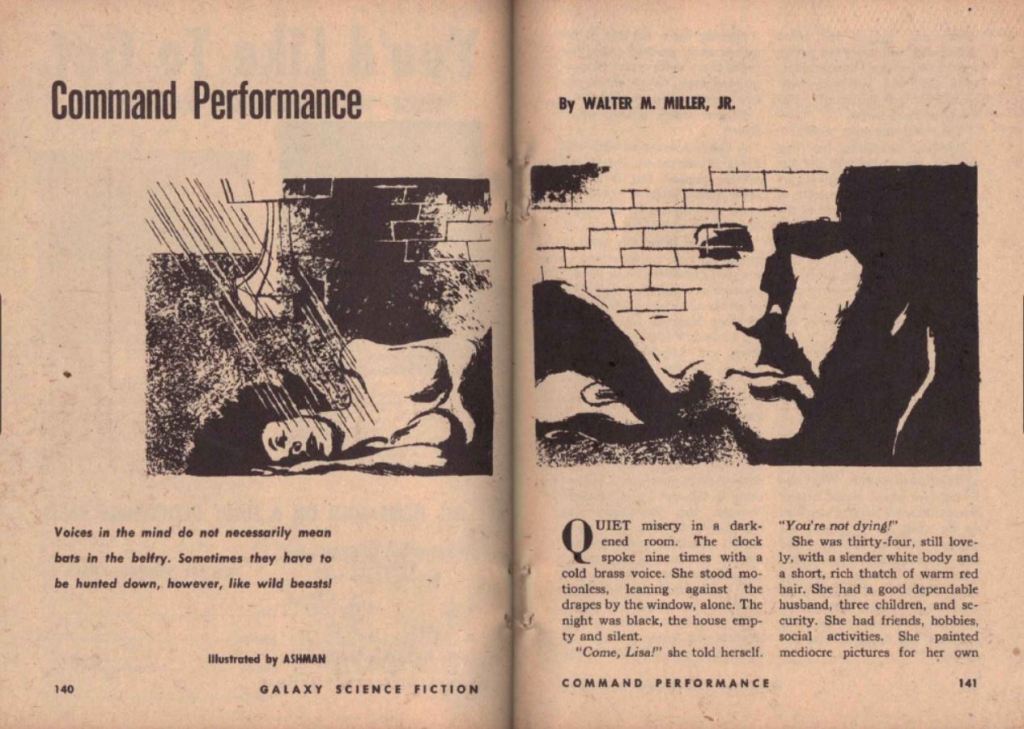
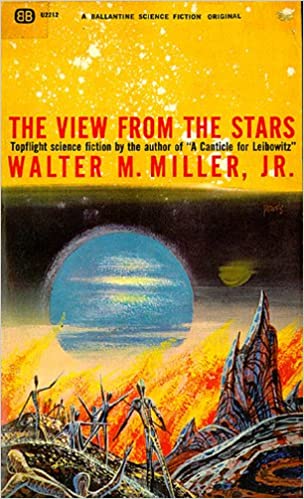
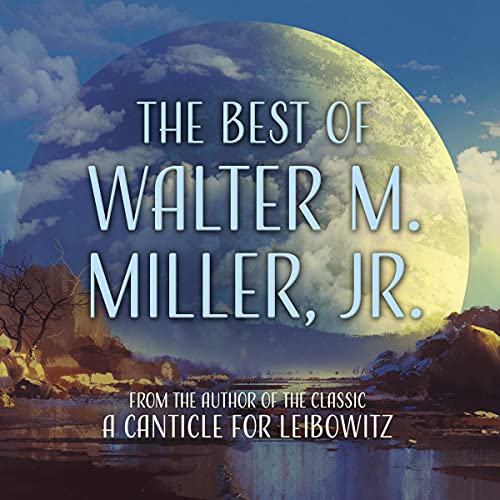
“Command Performance” by Walter M. Miller, Jr., was first published in Galaxy Science Fiction (November 1952) and was retitled in 1965 to “Anybody Else Like Me?” for Miller’s second collection The View from The Stars. This was my third reading of the story. Previously read in The Best Science-Fiction Stories: 1953 edited by Everett F. Bleiler and T. E. Dikty, and The Great Sf Stories 14 (1952) edited by Isaac Asimov and Martin H. Greenberg. I just listened to the story in The Best of Walter M. Miller, Jr. that was released on audio two weeks ago (June 2021).
Imagine you’re a science fiction writer and want to tell a story about a person who feels they are different from other people and one day they discover they’re a telepath when they finally meet someone like themselves. How would you plot such a story? I wouldn’t have done it like Walter M. Miller, Jr. did in “Command Performance,” and neither would you, but I was quite impressed with how he envisioned such an encounter playing out. Miller had an interesting take on how telepathy might work, and like many science fiction stories from the 1950s, it’s very psychological.
Most writers picture telepathy as people talking to each other without speaking aloud. Miller takes the concept much further. He has his characters, Lisa Waverly and Kenneth Grearly sharing thoughts, emotions, bodily sensations, fantasies, and inputs from all five senses. Much like that old saying about walking in someone else’s shoes.
I wish “Command Performance”/”Anybody Else Like Me?” was a novel instead of a short story, and Miller had worked out Lisa’s and Kenneth’s relationship at length. However, it appears Miller never finished a fully completed published novel. Miller’s most famous book, A Canticle for Leibowitz was a fix-up novel based on three previously published stories. ISFDB only lists one story in the novel section, “The Reluctant Traitor,” probably a novella, that appeared in the January 1952 issue of Amazing Stories. Saint Leibowitz and the Wild Horse Woman was a novel he almost completed before committing suicide, was finished by Terry Bisson, and published after his death.
According to ISFDB, Walter M. Miller, Jr. published 41 works of short fiction in the 1950s, and one in 1997, so evidently writing novels wasn’t his thing. I found this essay by Terry Bisson, “A CANTICLE FOR MILLER; or, How I Met Saint Leibowitz and the Wild Horse Woman but not Walter M. Miller, Jr.” to be quite interesting, revealing a few more tidbits about Miller. And now that I’m listening to The Best of Walter M. Miller, Jr. that just came out in audio, I’m finding each story makes me want to know more about Miller as a person. As Bisson points out, Miller did not want to meet people, and never even met his agent. That makes me even more curious about him.
I believe stories reveal details about their writers, even when writers desperately try to stay hidden. I’m only on the fourth story in this audiobook, and I’m guessing there will only be fourteen total if it’s based on the 1980 edition of the book of the same name. (Why haven’t his other stories been collected?)
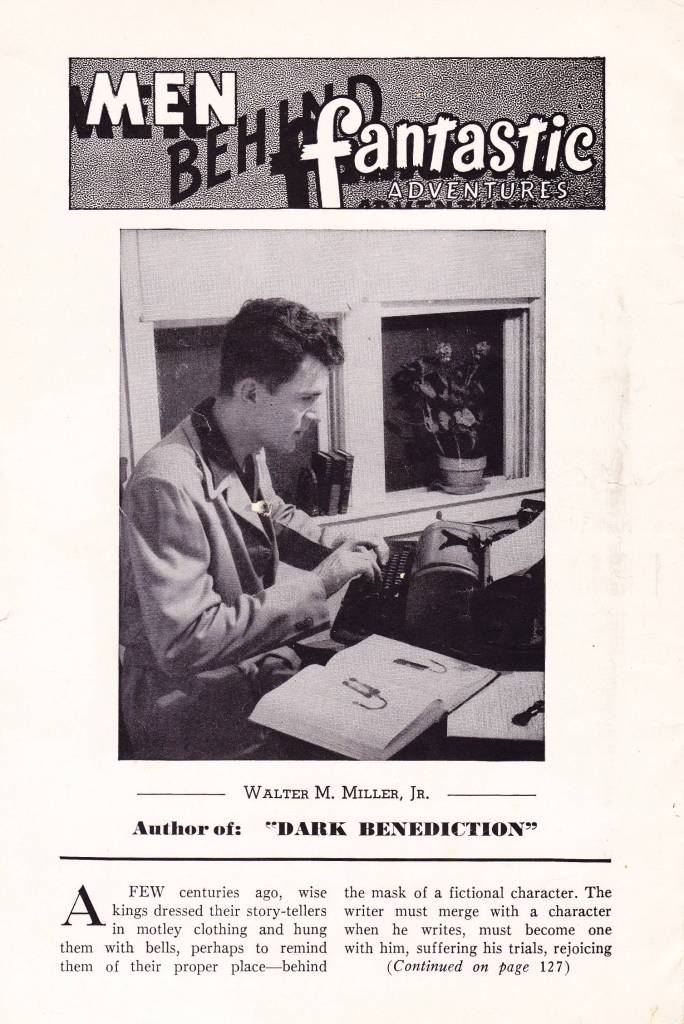
I can’t find much on Miller except his entries in Wikipedia and SF Encyclopedia. But at the beginning of his career, he wrote this profile about himself for the September 1951 issue of Fantastic Adventures:
I believe this provides us with a few additional clues. Miller became a recluse making himself enigmatic. I don’t think Miller was telepathic, but he might have felt himself different from other people. But as I listen to his stories I can’t help but wonder about the man who wrote them. They are a strange take on science fiction, focusing on humans, and less about aliens and spaceships. Miller seemed more interested in psychology, philosophy, religion and aspects about mundane life. One reason why I’m so fond of science fiction of the 1950s is because the characters were often ordinary, just ones who encountered the fantastic in strange little ways.
I’m really enjoying this collection and looking forward to hearing all 22 hours. I then hope to reread A Canticle for Leibowitz before trying Saint Leibowitz and the Wild Horse Woman.
James Wallace Harris, 7/8/21
Update:
A friend sent me a chapter from Better to Have Loved: The Life of Judith Merril by Judith Merril and Emily Pohl Weary where Merril recounts her affair with Walter M. Miller, Jr. while married to Frederik Pohl. It added many more puzzle pieces to my growing mental picture of Miller. I went to buy the book on Amazon and Amazon informed me I already had a copy. Now I need to read it.
Unfortunately, I don’t have a table of contents for the audiobook version of The Best of Walter M. Miller, Jr. but I’m hoping it’s the same as the 1980 hardback edition. That book seemed to combine the two previous paperback collections, Conditionally Human (1962) (3 novellas) and The View from the Future (1965) (9 stories and novelettes) and added two other stories for a total of 14. That leaves 27 stories uncollected. There were other collections of Miller’s stories, but they all seem to be reprinted from that same list of 14. Maybe they were all dogs, and not worth reprinting, but sometime I hope to read them too.
I know the short story is an obscure art form on the wane, and the minority of readers who still enjoy reading short stories mostly read new ones as they come out in online periodicals, but I’m concerned with remembering the best science fiction short stories from the past. Old novels, movies, and television shows have massive support systems for being remembered and introduced to new potential fans. Have you ever seen a book 1,001 Short Stories to Read Before You Die? YouTube is overrun with YouTubers devoted to their favorite books, movies, albums, and television shows, but has YouTube every offered to show you one devoted to short stories? And how often do you see a Top 100 list of all-time best short stories on the web where they live and die by Top 100 lists? Or even the equivalent of the Billboard Hot 100 for current short fiction releases?
About the best a short story can hope for is getting anthologized, and even then, damn few anthologies stay in print. Anthologies that reprinted science fiction short stories were common on twirling book racks in the drugstores of the 1950s through the 1970s, but they’ve about disappeared today. Of course, the science fiction magazines that published the stories originally, have faded into obscurity only loved by the last 10,000 subscribers. The internet has brought about a renaissance of online publication of short stories, and that’s reflected in the annual awards which pretty much ignore the printed magazines nowadays.
Science fiction short stories published in periodicals go back at least two hundred years, and there are fans who still read them too, just not that many. And those fans are dying off. There’s barely enough storyworms to keep the memory of classic short SF alive. (Which probably explains why so few anthologies are for sale.)
Last night I read “The Country of the Kind” by Damon Knight for the fourth time this century. And it wasn’t because the mood struck me to read it again. I’m reading The Great SF Stories 18 (1956) (1988) edited by Isaac Asimov and Martin H. Greenberg and it’s included in that anthology. It was also included in The Science Fiction Hall of Fame Volume One (1970) edited by Robert Silverberg which I listened to when it came out on audio in 2017, and then listened to again when the book club I’m in read it last year. I first read The Science Fiction Hall of Fame anthology back in the 1970s when it came out. I also read “The Country of the Kind” recently in Science Fiction of the Fifties (1979) edited by Martin H. Greenberg and Joseph Orlander.
I have this self-imposed rule that I don’t skip short stories I’ve read before when reading anthologies. I’ve discovered it takes multiple readings to fully appreciate a short story. “The Country of the Kind” has gotten better on every rereading.
This got me to thinking. How do average science fiction fans stumbleupon old science fiction short stories to read? I figure it’s the same way I discover older SF short stories, by reading anthologies. But like I said, anthologies aren’t as common as they once were. How often do young science fiction fans buy a SF anthology? Or a collection? Do they even know the difference between an anthology and collection? Many people selling them on eBay don’t. The collection is a book of short stories by a single author, and I believe this is the most common way that bookworms still read short stories today. It’s when they decide to consume everything by their favorite author that they finally turn to the short story.
An anthology is a book of short stories by multiple authors. Most readers today see them as annual best-of-the-year volumes that collect the top short stories from the previous year. About every five years a large retrospective anthology comes out that presents the best of the genre’s past. I hardly ever see them anymore, but some theme anthologies reprint short stories with similar subjects are still being published. Baen used to do this, but I haven’t seen any in a while. One exciting new anthology that just came out is The Best of World SF: Volume 1edited by Lavie Tidhar.
Yesterday I went looking for 21st-century anthologies that look back on science fiction of the 19th and 20th centuries. Here’s what I found currently in print. A few of these titles are aimed at the textbook market, reminding me that school reading is another way young readers encounter old SF stories.
Hyperlinks in the titles below are to the CSF database were you can see their table of contents by story in order by year published. That page also has additional links for more information about all the stories. If you don’t want to lose your place here, do a right-click and select Open in New Window, and then close that window after you’ve poked around.
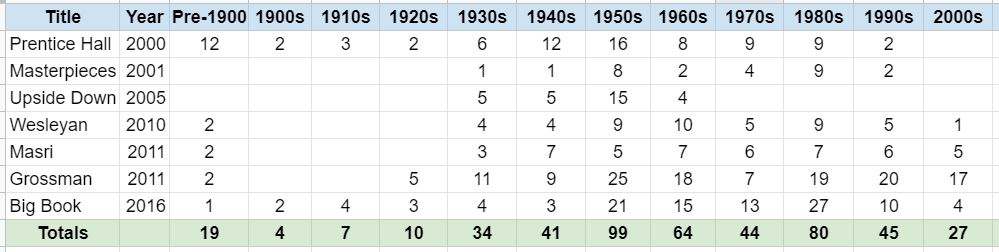
Here’s how these anthologies remember short stories by decades. Like I said, science fiction short stories have been around a very long time. But looking at the numbers below makes it look like something happened in the 1930s. Amazing Stories began in 1926, which some claim was the start of the genre, but others think it really began when John W. Campbell, Jr. became editor of Astounding Science-Fiction in the late 1930s. (See my essay “19th Century Science Fiction Short Stories” for an overview of a baker’s dozen of anthologies that remember that century.)
It’s interesting to see the distribution of stories by decades. Both The Prentice Hall Anthology of Science Fiction and The Big Book of Science Fiction have something from every decade. In terms of totals, the 1950s win, with the 1980s coming in second. The so-called Golden Age of the 1940s seems to be fading.
If you want to read some of the classics of SF anthologies, check out Mark R. Kelly’s Anthology page.
The Classics of Science Fiction Short Stories list, which is set to a minimum of 8 citations produces a list of 97 stories. It remembers stories from 1934-2010, which is a kind of a moving memory bubble. The entire database contains 4,554 stories from 1809-2010 with at least 1 citation. We currently believe that 7-8 citations represent a certain level of popularity or remembrance.
“The Country of the Kind” is reprinted in the Sense of Wonder (2011) anthology, so it’s still being remembered. Here’s the history of where it’s been anthologized since its original publication in 1956. The last major anthology it was in was The Very Best of Fantasy & Science Fiction, Volume 2 (2014) edited by Gordon Van Gelder.
If you’ve been paying attention, you’ll note “The Country of the Kind” gets reprinted every few years in an anthology. That’s how Damon Knight’s little classic stays alive. I doubt many young readers today read anthologies, so it’s probably just barely hanging on in our collective memory.
When I researched this story on Google, I did notice that several sites devoted to writing school papers offered an analysis of the story for a fee. Being taught in school is another way for a short story to survive. There are other ways. Getting made into a movie or TV show sometimes happens, but that mostly seems to happen to stories by Philip K. Dick. Several episodes of Love, Death & Robots were based on recently published SF stories. I’m also in a Facebook group that helps.
Speaking of reading science fiction short stories in school, I can tell from my stat pages that some are probably popular with teachers. I doubt that many Googlers would be searching on these stories unless they were forced to by a school assignment. Another indicator they are assigned reading is they get hits only during the school year.
It’s rather telling that “The Country of the Kind,” “The Veldt” by Ray Bradbury, and “The Ones Who Walk Away From Omelas” by Ursula K. Le Guin seem to be very popular in the classroom. And each of those stories deal with a particular incidence of violence. It’s almost as if controversial nastiness makes for teachability.
Finally, I’ve thought of one other new way that short stories are presented to help them be remembered: audiobooks. Both audiobook publishers and podcasters present audio productions short stories. For example, here’s one for “The Country of the Kind.” I noticed yesterday that Audible came out with The Best of Walter M. Miller, Jr. in June with over 20 hours of readings of Miller’s short stories. That made me very happy. Audible has some SF anthologies, but not many. The best way to find audio productions of short stories is to look for collections by your favorite author. For example, they have The Complete Short Stories by J. G. Ballard that runs over 63 hours, or five volumes of The Collected Short Stories of Philip K. Dick.





 Classics of Science Fiction