Good Science Fiction Bad Science

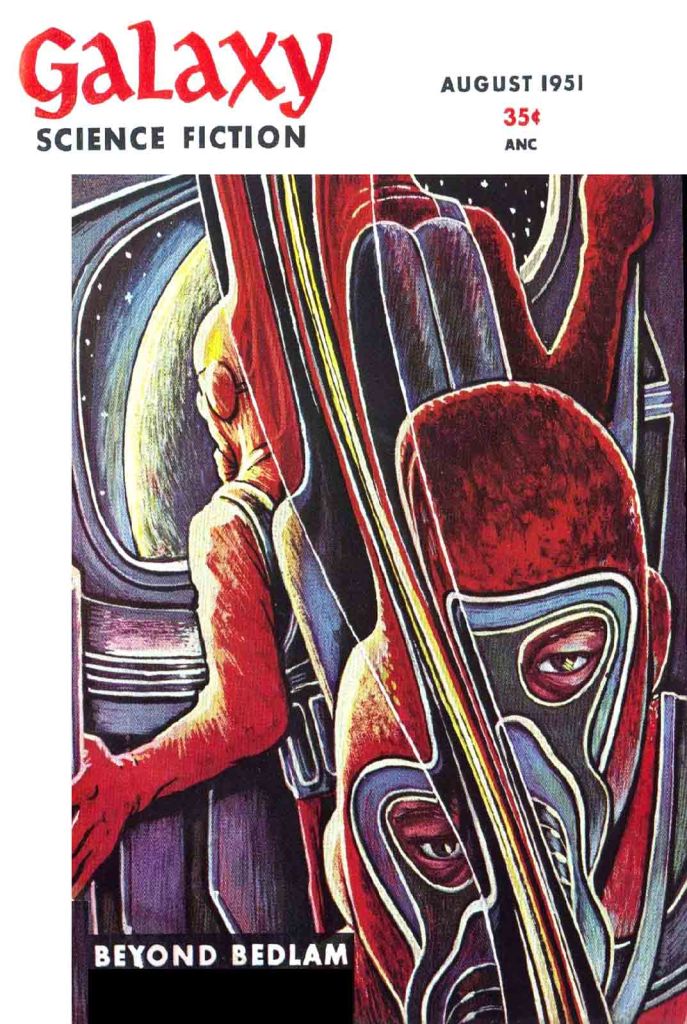
Do you stop reading science fiction when you encounter bad science, dated beliefs, or foolish concepts? I do if I’m warned ahead of time – but not if I’ve already gotten sucked into a the story. “Beyond Bedlam” by Wyman Guin is one such story that I kept reading once I realized it’s basic premise was ridiculous. It was first published in the August 1951 issue of Galaxy Science Fiction. I read it because of a friend recommending it and I read Robert Silverberg’s Reflections column about “Beyond Bedlam” being a one-hit wonder for Wyman Guin.

Maybe I shouldn’t tell you the premise for “Beyond Bedlam” because it might keep you from reading it. It’s available to read for free by following the link to the Galaxy magazine above, or by following this link to Project Gutenberg. The story is a short novella, about 20,000 words, so it will take you a bit of time to consume. Silverberg liked it well enough to anthologize it twice. Check to see if you have the classic 1980 SF anthology The Arbor House Treasury of Great Science Fiction Short Novels.

“Beyond Bedlam” is about a future utopian America that we would rebel against, but Wyman Guin presents as making sense to the citizens of that era. Guin didn’t write much science fiction because he worked in the pharmacological industry. His story presents the 29th-century America running smoothly because everyone is required by law to take psychiatric drugs. The characters in the story refer to our times as a dangerous failure because we let our emotions get the best of us. This by the way, isn’t the crazy premise of the story. Other science fiction stories have predicted people in the future controlled by drugs, and people do take a lot of drugs today for the mental health.

Guin takes one extra step that pushes the story into unbelievability territory – but I won’t give that away. Hopefully, you’ll start reading and get sucked in. Or maybe you will even think it a cool idea. Some science fiction fans love wild ideas no matter how silly they might be. I completely reject Guin’s speculation but enjoyed the story.

I understood why Guin wrote this story. I read lots of old books and watch lots of old movies, and the 1940s and 1950s was a time when people were fascinated with psychiatry and psychological mysteries. What’s particularly fascinating, and I’m giving a hint here that older readers might understand, is the 1951 “Beyond Bedlam” was written well before the 1957 bestseller, The Three Faces of Eve.

The reason why I found “Beyond Bedlam” compelling is Guin’s storytelling. Silverberg said Guin wrote 80,000 words of rough draft before distilling his story down to 20,000 words. It’s tightly plotted, with vivid characterization and great worldbuilding. It’s also filled with emotions derived from five characters’ unique movitations. Plus, “Beyond Bedlam” is quite adult, which wasn’t typical of science fiction in 1951.

Wyman Guin’s low output and his crazy premise will probably doom this nifty tale to obscurity. That’s a shame. “Beyond Bedlam” is not a literary classic. It’s a nostalgic tidbit from the dregs of decomposing pop culture that old fans fondly recall as they wait to die.

James Wallace Harris, 10/29/20

Philosophy & Science Fiction

Eric Schwitzgebel, Rich Horton, and Helen De Cruz are assembling an anthology of best philosophical science fiction in the history of the Earth. I’m looking forward to seeing what stories they select and reading them. Science fiction is often inherently philosophical, even though some stories like “The Ones Who Walk Away from Omelas” by Ursula K. Le Guin are iconic for being intentionally philosophical.

I say science fiction is often inherently philosophical because it speculates about the future of our species. Humanity’s potential covers the spectrum from snuffing ourselves out to replicating our species across the universe like a virus.

For example, I just read “Founding Fathers” by Isaac Asimov from the October 1965 issue of Galaxy Magazine. It’s a sentimental story about five scientific explorers who are marooned on a planet that they thought would have an Earth like atmosphere, but tragically has enough ammonia in it to keep Earth plants from growing. All five scientists try to alter conditions to get edible plants to thrive but the explorers die before succeeding. The story is sentimental because Asimov lets us know their decomposing bodies will alter the course of this planet’s evolution and one day when humans rediscover the planet it will be ready for colonization.

Asimov is putting over the philosophical idea that humanity’s purpose is to spread across the galaxy. When I was twelve I traded religion for science fiction because I was gung ho for this kind of final frontier ideology. I felt we lived in a meaningless reality. Religion only offered a make-believe purpose. The idea that humans should conquer the galaxy offered a kind of existential meaning, or at least purpose, and that felt real and worthy. Thus science fiction became my Socrates.

Science fiction often seeks an existential or transcendental purpose for our existence. Science measures and statistically analyzes reality, philosophy uses logic and rhetoric to examine what science can’t. Science fiction when its good, tries to speculate about new grist for both mills: science and philosophy.

Science fiction, unfortunately, is amateur metaphysics because most science fiction writers are neither scientists or philosophers, and even when they are, science fiction is neither scientific nor disciplined philosophy.

In other words, science fiction likes to bullshit about the aspects of reality that science and philosophy haven’t nailed down as their own. This is delightfully entertaining, and even a satisfying substitute for science and philosophy, although, science fictional efforts often veer into fantasy and even flakiness. Still, for the philosophically and scientifically minded, who lack the will or ability to follow those more disciplined disciplines, science fiction can provoke endless concepts to ponder.

Socrates, Plato, and Aristotle were amateurs themselves, because they lived before philosophy developed into a rigorous academic discipline. Their work sometimes veers into fantasy and flakiness too. Of course, many scientists as well as average folks, sneer at philosophers as being no better than those theists who count angels on pinheads. In terms of explaining reality, science is the only cognitive tool that consistently works. Theology was our original effort to explain reality, theorizing there were higher beings that created, controlled, and explained everything. Philosophers were humans with hubris that said, “Wait a minute, maybe that isn’t so. Maybe we can figure out reality on our own.” However, after a lot of endless conjecture science came into being which suggested “Why don’t we just observe and statistically decide by looking for consistency.”

Science can’t measure everything, leaving room to theological, philosophical, and science fictional speculation. To theorize that one day humans will create robots that are sentient has philosophical and even theological implications. Take that Asimov story, “Founding Fathers.” Shouldn’t we ask if it’s ethical to interfere in a planet’s evolution if it’s already evolved life? Asimov felt sentimentally proud for his fictional heros, but on the other hand, couldn’t they have theoretically killed off trillions of lifeforms, including intelligent beings, and beings with abilities we can’t imagine?

Most of the time science fiction speculates about the future. It imagines positive futures we could build for ourselves or extrapolates on negative trends that will create futures we should avoid. Science fiction speculates about technologies we could invent if they are scientifically possible. It also considers the aesthetics and ethics of such creations.

Science fiction is naturally ontological. The overwhelming intent of science fiction so far has been to suggest humans should explore space, even colonize the universe. That is a powerful philosophical purpose. But is it valid? We seldom question it. That’s why I was so impressed with Aurora by Kim Stanley Robinson. What if human can’t find purpose in the final frontier because we’re not adaptable to living anywhere but Earth?

In my old age I often question science fiction’s preoccupation with space exploration. What if the real philosophical question that science fiction should explore is: “What should humanity do with itself if it has to dwell only on the Earth for a few million years before becoming extinct?” That offers a greater challenge than the easier apparent purpose of the final frontier.

Didn’t Plato invent the utopia? Hasn’t science fiction claimed the utopia for its intellectual territory? How close can we get to a perfect society that won’t smother us if we continue to exist as a species for millions of year? This is why my favorite short work of science fiction is “The Star Pit” by Samuel R. Delany. It’s about living with limitations, especially limitations that crush our spirit.

Science fiction has unlimited potential for exploring philosophical concepts. I’m looking forward to that new anthology.

James Wallace Harris, 10/19/20

Poking Fun at Science Fiction

I’ve been thinking about humor in science fiction. Generally, when we think of funny science fiction we think of Hitchhiker’s Guide to the Galaxy or stories by Robert Sheckley, R. A. Lafferty, or sometimes John Scalzi. But that’s science fiction having fun, what about when the genre is the butt of the humor? For example, westerns were skewered hilariously in Blazing Saddles. Galaxy Quest comes to mind, but then that film was roasting the genre out of fondness. I don’t think Blazing Saddles was an actual tribute to westerns in the same way Galaxy Quest was to science fiction. And what about self-deprecating humor in science fiction. I love recursive science fiction, but most of it celebrates the love of science fiction. I’m curious, do many recursive science fiction stories satirize the genre? I’m not going to answer that extensively in this essay, so don’t get your hopes up. But keep reading for an example of where I’m going.

My problem is sarcasm, satire, and subtle jabs go right over my head (my lady friends take advantage of this). I’ve always seen science fiction as mostly straight stories, well, at least I did. I’ve been reading hundreds of short stories lately, and I’m starting to get suspicious. Every once in a while I wonder if the author has both a pen and pin in hand. As a reader, I felt it was my job to suspend disbelief and let the writer put the story over. Now that I’m writing more about what I read, I’m wondering if I should always look below the surface for different motives the writer might have had for writing their story.

Take this story by Judith Merril, “The Deep Down Dragon.” I read it in Galaxy: Thirty Years of Innovative Science Fiction edited by Frederik Pohl, Martin H. Greenberg, and Joseph D. Olander. What’s unique about this anthology is each story is prefaced with the author’s memory of writing it.

Study that Emsh (Ed Emshwiller) painting above. At first I thought it a clever way to suggest action – a woman had been abducted from a space colony. But then I thought of something, and it became funny, But how could it possibly comic? Obviously a woman has been kidnapped by an alien on a colony world – that’s tragic. But if you know the history of science fiction magazines, and the cliches about covers with BEMs carrying off a scantily clad women, then you might think Emsh is playing around. In case you don’t know the lingo, BEM stands for bug eyed monster. Sex sells, even for science fiction magazines. Why did Emsh leave off the sexy woman and lower the sales of that issue? Because we expected a naked woman he thought might be funny to disappoint us. Sure, the painting is of a serious action scene, a man is running to rescue a woman. Maybe even the editor told him, “No babes.” But I like to think Emsh is also poking fun at science fiction (See the section below, Sex, Nudity, and Prudity in Science Fiction.)

But the ribbing of SF doesn’t end there. Judith Merril tells a serious story about a man rescuing a woman, but it’s a story within a story. In the tale psychologists are showing potential space colonists a scene they’re supposed to react to like an inkblot test. Essentially, the characters are reacting to an animated version of Emsh painting. First, we hear from the woman as she tried to explain why she wasn’t clothed, and why she was wearing high heels in a space habitat. Then we hear a man’s version of the story about how he carefully tracks down the woman and fleeing alien – but he’s obviously an intellectual who over prepares, over thinks, and is not a brawny action-oriented kind of guy. You get the feeling Judith is making fun of SF by having the woman be the stereotype of the woman on SF covers, and the man be the stereotype of SF readers – the ninety-pound weakling/egghead.

Now it’s completely possible to read this story straight, but I found it more fun to think Emshwiller and Merril were poking fun at science fiction. And I found the story I reviewed last time, “Wall of Crystal, Eye of Night” by Algis Budrys more admirable when I assume Budrys wasn’t completely serious either. That he was creating something over the top he knew fans would love. But I have to wonder, was Merril and Budrys also looking down on their readers? Or the genre? I imagine some writers do. And is knowing that important to the story? Sometimes the story is better when we’re in on the laugh.

Most humor is in good fun. For example, take these two covers I found when looking for the BEM covers. They play against type.

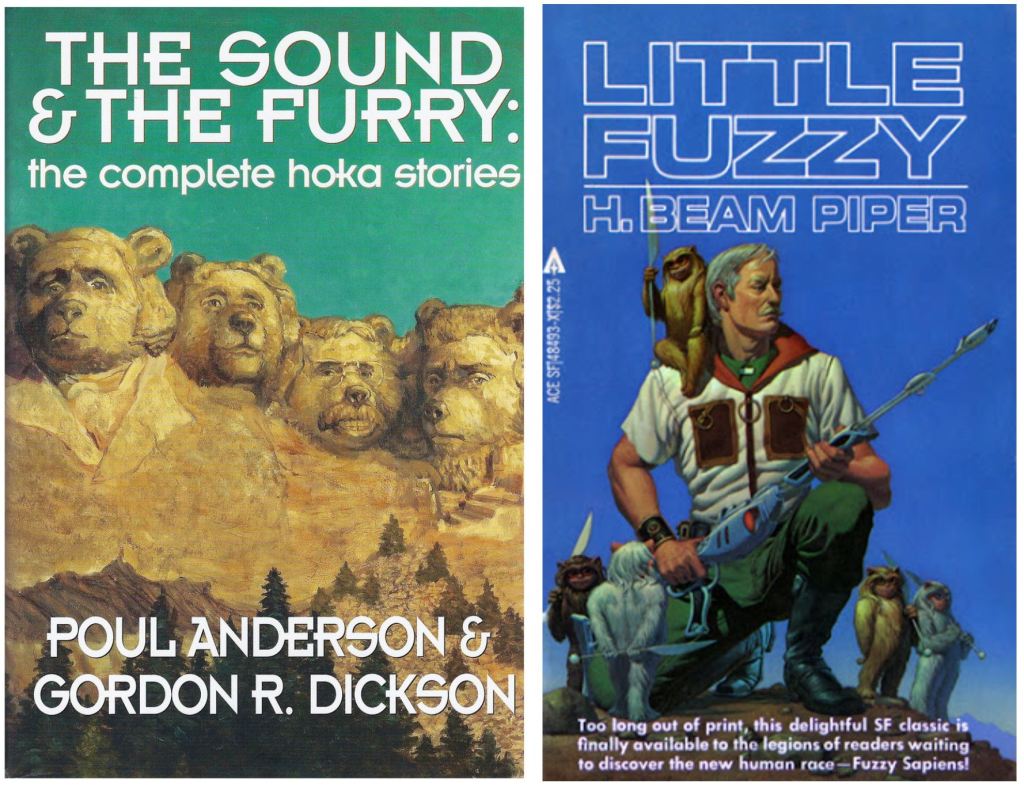
But when you start looking at covers on science fiction magazines, most of them are deadly serious sense of wonder scenes, or at least heroic action scenes. Generally, when we have humor in our genre, we’re still suppose to take the story seriously, or mostly serious. And by serious, I mean close to realistic. For example, the Little Fuzzy stories by H. Beam Piper have a realistic side, but Poul Anderson’s Hoka stories are just for fun.

As I breezed past hundreds of covers I was disappointed I didn’t find more clever satire. One of my favorites was for “The Pirates of Erastz” by Murray Leinster.

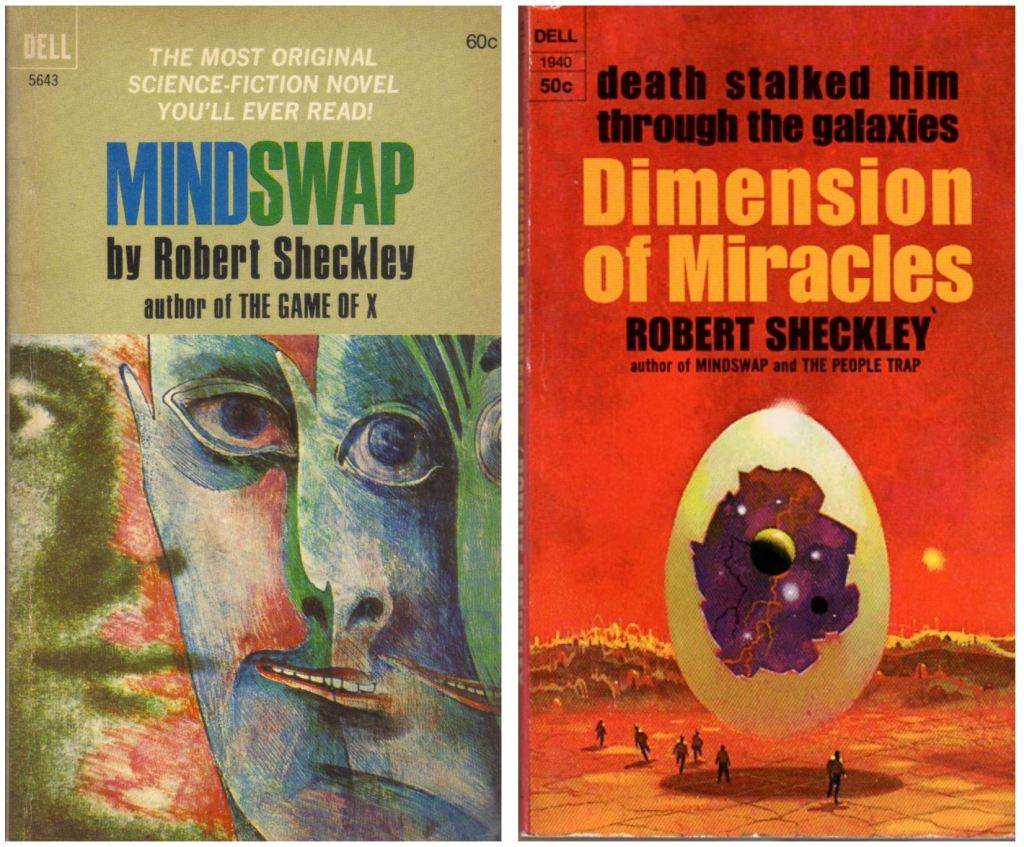
My all-time favorite SF novel is Have Space Suit-Will Travel by Robert A. Heinlein. I’ve always taken it completely straight, but the title is proof enough it’s a spoof and Heinlein was having fun. We science fiction true believers want our fantasies to be possible. No matter how absurd the situation gets in novels like Mindswap and Dimension of Miracles. On one level I still take Sheckley’s story as something that’s possible in our infinite universe. But that requires some major suspension of disbelief.

When a book is obviously funny, we know we shouldn’t take it seriously. But do we always know when we’re reading is something serious? What if it’s sometimes supposed to be funny in places? Or just slyly satirical? I confess here I have been sorely lacking in the ability to spot humor in SF. But now that I’m thinking about it, I’m on the lookout.

Sex, Nudity and Prudity in Science Fiction

While researching this post I also encountered protests against the skimpily dressed women on covers. Over the years I’ve read memoirs by SF writers and readers about how the covers were so embarrassing that they had to hide their SF magazines. Some even tore the covers off them afraid their parents would see them.

Most fans loved sexy (sexist) covers (hey they were adolescent boys), but some didn’t. Here’s a few quotes given to me by a Mr. Lock regarding Weird Tales.

Oct 1933:
Here is a word about our covers, from Lionel Dilbeck, of Wichita, Kansas: “But whatever you do, do not continue to disgrace the magazine with naked women as you did in the June and July issues. If you think that the readers want them, have them vote on it. Personally I prefer any kind of monster that it is possible to think of rather than the sexy covers you have been having. And I really hate to tear the covers off the magazine, as that also spoils the looks of them.”

March 1934:
Clara L. Heyne, of St. Paul, writes to the Eyrie: “But when I take the magazine to work for reading at noon, I take the cover off because I know how the pictures of nude women affect those who don’t know WT.”

May 1934:
Joseph H. Heil, of New York, writes: “Why the nudes? I have noticed that the majority of your readers have resented your cheap-looking covers, and I wish to add my emphatic vote against the continuance of these trashy covers. Looking back on the old issues of WT, I find that they contained none of the nudism of your present-day frontispieces, but, notwithstanding, they were much more interesting, and illustrated the stories much more vividly than today. I was first attracted to your publication (several years ago) by an exciting cover depicting some weird plants over-running the earth. Many people are, I am sure, attracted likewise; but how can you expect to attract the attention of a lover of the weird by the portrayal of a wide-eyed nude, gracefully reclining on stones or silks, as the case may be? Why make your readers tear off your covers in order to take the magazine anywhere, outside the privacy of one’s own home, and even there one has to be careful not to let it lie around where it might be noticed.”

Here’s a quote sent to me by Paul Fraser from Marian Cox in Startling Stories, September 1951.

By the 1950s most SF magazines moved away from the damsel in distress in space. It’s rather amusing though, because those covers are now favorites on Facebook groups devoted to science fiction art.

James Wallace Harris. 10/16/20

Realism in Science Fiction

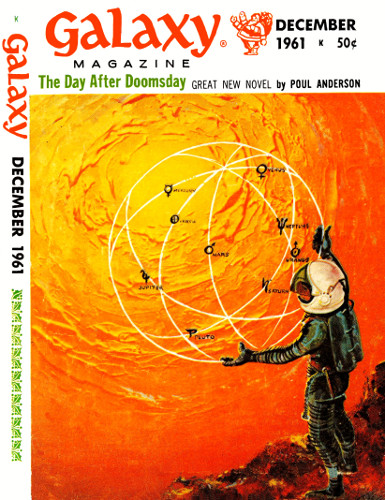
Our Facebook group, Best Science Fiction and Fantasy Short Fiction recently read “Wall of Crystal, Eye of Night” by Algis Budrys, originally published in the December 1961 issue of Galaxy Magazine. We’re group reading Galaxy: Thirty Years of Innovative Science Fiction edited by Frederik Pohl, Martin H. Greenberg, and Joseph D. Olander. Because of this I’ve been thinking about the legacy of Galaxy Magazine, science fiction from the 1950s and how realistically did science fiction fans see the future.

So far “Wall of Crystal, Eye of Night” hasn’t found many admirers in our group, although the anthologist Rich Horton considers it one of his all-time favorite stories. My taste in SF often overlaps with Rich. I found the story to be compelling, thought provoking, not quite a classic, but unbelievably unrealistic.

I’ve read many books about science fiction of the 1940s, which older fans call The Golden Age of Science Fiction. John W. Campbell, Jr. was given most of the credit for this golden age because as editor he discovered and nurtured Heinlein, Asimov, Van Vogt, Hubbard, and many other SF writers that became famous in the genre when Baby Boomers were growing up. Many young SF writers and readers today are rebelling against that era of science fiction, but I think even by the end of the 1940s the writers and readers of the day were also ready to change, and that’s why F&SF (1949) and Galaxy (1950) quickly became popular magazines. And I’ve been told by many readers of my Baby Boom generation that they considered the 1950s to be the real Golden Age of Science Fiction. Did science fiction become more realistic in that decade?

Even though “Wall of Crystal, Eye of Night” came out at the end of 1961, I’m considering it a reflection of 1950s science fiction. Like the two classic stories from 1950, “Scanners Live in Vain” by Cordwainer Smith and “Coming Attraction” by Fritz Leiber, they mark a new beginning by reacting to the previous decade.

I have written elsewhere that I felt 1940s science fiction could be characterized by a yearning for transcendence. Campbell, Heinlein, and others expected mankind to evolve in the future, gaining mental and psychic powers that would help them conquer the galaxy. Reading “Wall of Crystal, Eye of Night” provided a kind of epiphany for me. It was wild, full of vitality, but ultimately discomforting because its lack of realism. Handling the fantastic in the same way superhero comic books handle reality. Is that the real legacy of 1950s SF?

Fiction has always had a strange relationship with reality and realism. I suppose we could say fiction has different levels of realism. By the way, I don’t mean to imply any artistic criticism to these various levels – at least for now.

  • Level 1 – Greek myths, superhero comic books, Bible stories, talking animal stories
  • Level 2 – Young adult or adult fantasy, science fiction
  • Level 3 – Science fiction that tries to be scientific
  • Level 4 – Most mundane genre fiction
  • Level 5 – Serious literature that’s mimetic

Unfortunately, much of science fiction swings the needle towards Level 1 rather than towards Level 5, even though science is in its label. “Wall of Crystal, Eye of Night” slams the needle over to 1 on the gauge. Is this good or bad? The story is fun. It’s a thrill ride. Should we even worry about it’s over-the-top fantastic elements?

I should warn you, I read “Wall of Crystal, Eye of Night” just after reading “The Boys Is the End of the Superhero As We Know It. And it’s about time.” That essay begins with “After two seasons of The Boys, I can say with roughly 85 percent confidence that Dr. Fredric Wertham was right.” I’ve got to admit that my confidence level is even higher, but then I’m prejudice against superhero comics. If you don’t know who Fredric Wertham is, read this. For most of my life I’ve had to accept the studies that say fiction, especially violent fiction, has no impact on the development of children, even though I find such results hard to believe. However, the years 2016-2020 makes me strongly wonder if Fredric Wertham wasn’t right all along. But I go further than Wertham, and wonder if science fiction and fantasy is dangerous too.

“Wall of Crystal, Eye of Night” opens in the skyscraper office of Rufus Sollenar, a entertainment business titan. He’s looking out a floor to ceiling window contemplating his success in life. He believes his new product, EmpaVid, will dominate the market and guarantee success and riches for the rest of his life. EmpaVid is a television system that manipulates the emotions of the viewers. Sollenar expects EmpaVid patents to allow him to dominate the entertainment industry.

Sollenar wears utilijem rings that allows him to operate everything in his office with a wave of his hand. Budrys describes the scene quite dramatically, with Sollenar conducting the machines of his office with simple hand gestures, like a magical superpower. Still, it’s technology, making the story science fiction. Sollenar is smug and feels like he dominates the world when looking out his window down on the city.

Eventually, a Mr. Ermine forces is way into Sollenar’s office. An ermine is a weasel, and even Mr. Ermine dresses in rust colored garments, the color of a weasel. This is rather obvious, too much like a comic book villain. Galaxy Magazine was aimed at adults, and from what Budrys says in his memoir of working there, Horace Gold wanted it to be read by a wider audience than just the average young science fiction fan. I feel this aspect of the story counters that goal. But maybe I’m being too harsh.

Mr. Ermine is from the IAB, the International Association of Broadcasters. At first you think of him as a toady but eventually we learn he’s far more powerful, like an enforcer for the mob. Over the course of the story the IAB becomes more sinister, and suggesting Budrys wants us to believe it’s a secret cabal that manipulates the entertainment business, and will go to any length to get what they want. Again, this is painting reality with comic book strokes. People who love conspiracies will love this aspect of the tale.

After some heavy-handed info-dumping we get down to the conflict of the story. Mr. Ermine tells Sollenar that Cortwright Burr, a competitor, has gone to Mars and had the Martian engineers make him a device. The implication being that the Sollenar corporation and IAB are threatened.

We next see Sollenar acting like Spiderman climbing on Cortwright Burr’s corporate skyscraper. We are given some razzle-dazzle about the machinery that allows Sollenar to do this, but once again the story falls into comic book mode. There were many SF stories in the 1950s and 1960s about titans of industry at war with one another. Alfred Bester aided his characters in The Demolished Man with psychic powers, and Philip K. Dick wrote many stories of business power figures battling with reality-bending drugs and technology. The most famous novel of this sub-type was The Space Merchants by Pohl and Kornbluth, first serialized in Galaxy.

In the early 1950s there were dozens of science fiction magazines on the market, and hordes of prolific writers to fill their pages. Business in America was booming, and like the ambitious said to one another, “The sky’s is the limit,” meaning nothing is impossible. Often it feels like these science fiction writers also felt there were no limits, and SF readers will believe anything. This is why critics of the genre claimed science fiction was for gullible young males. But on the other hand, the stories had an excitement and energy that fans loved.

Reading “Wall of Crystal, Eye of Night” both annoyed and excited me. I’m torn by admiring Budrys flamboyant imagination and insulted that he thinks so little of my intelligence.

Sollenar enters Burr’s office like Neo in a scene from The Matrix, diving through a window with his pistol aimed, hitting the ground, and popping up. Sollenar fires and hits Burr with a blast of energy from his gun, throwing Burr’s body against the wall. Burr had been holding a golden ball when shot and had yelled a command at it just before he was hit. Burr, now a sack of broken bloody bones holds the sphere up and Sollenar blasts him again. Burr drops the ball and Sollenar goes after it but sees that Burr is still animated even though his face is blown away. Sollenar shoots him again. He then gathers up the ball, but seeing Burr still moving fires all his remaining charges into the body. Sollenar is so freaked out he leaves the ball. He then climbs out the window and gets into his spiderman suit, but sees Burr still trying to come after him.

Why didn’t Burr die. How could his body be so destroyed yet still move? Later Sollenar is back at his building with his girlfriend on the balcony, and the body of Burr shows up climbing the outside of the building. WTF? Sollenar crushes the gripping hand on the rim of the outside wall, and the body falls down to crash below.

This is like some supernatural horror film, or an EC Comic. It reminds me of the Marvel films of today, and why I don’t like them. I hate films that show extreme violence with the reality of The Three Stooges or Wile E. Coyote. But I keep reading. How can Budrys explain this to me?

The next scene has Sollenar going to the TTV Executives’ Costume Ball. Guess what, Curt Burr is there, dressed as a gallows bird. Not only does Budrys go for obvious symbolism, but he just flat out tells us. And guess how Sollenar is costumed? As a Medici. Is this story supposed to be a comedy? Is this story supposed to be a mad parody of the genre like the first version of Casino Royale made fun of James Bond movies? Have I been taking it too seriously, when it was meant to be a gag all along?

One reason I can’t stand superhero comics and movies is I can’t buy into their reality, I can’t suspend my disbelief to accept their obviously unreal premises. Is Budrys trying to get his readers to believe his story or is he satirizing the genre? Galaxy Magazine was known for its satire and human. Am I taking things to literal? Sarcasm often flies over my head, and satire often just seems stupid. Is Budrys secretly sneering at his reader?

If “Wall of Crystal, Eye of Night” was filmed it would look a Marvel film. Do fans of such film see them as satire? What are they poking fun of?

Sollenar now accuses Burr of buying immortality from the Martians. But what a horrifying kind of immortality, becoming a walking bag of broken bones and torn up flesh that can’t die.

Ermine now returns, also in costume, one which no one would take him for a man. Ermine even proves how inhuman he is, by showing Sollenar he has no feelings from his nerves. He feels no pain.

Sollenar learns that he must succeed or IAB will kill him. He takes a rocket to Mars. The trip must have lasted no more than what jet plane takes to get to a nearby city. More unreality. More comic book realism. And I should say, the realism level of Star Wars.

Sollenar violently ditches Ermine on Mars and heads out to find the Martian engineers. I did like the whole description of Mars, both the human and Martian cities and the Martians. Maybe that’s because I’ve always been a sucker for stories about Mars.

Sollener bargains to buy immortality like Burr, but it turns out Martians don’t have immortality to sell. What the Martians are selling is an illusion machine. It can make the irrational rational.

Now this would be hilarious if Budrys intended all along to make this a recursive science fiction story, poking fun at the genre. Judith Merril did that “The Deep Down Dragon” another story in the Galaxy anthology. But am I seeing SF humor too often? I get the feeling Budrys does want us to believe this wild adventure story just like Philip K. Dick often used techniques in his serious stories by having his characters confused by reality. I think, but not sure, that Budrys is pulling a PKD here. In a way, Cort Burr prefigures Palmer Eldritch. So maybe PKD 1960’s work was inspired by Budrys?

If I read this story right, Cort Burr was never shot. Sollenar just believed he was. And to escape Ermine who is waiting to shoot him, he buys a Martian machine to give Ermine the illusion that his nerves function again, and that he killed and buried Sollenar.

Ultimately, this is a fun story, even though it mainly works at Level 1 reality. And as long as we accept it as creative fun there is no harm in playing make believe. But we still have to consider the article about the danger of superhero stories. Has generations absorbing anti-reality fiction from comics, science fiction, television, movies, video games affected them? Would society be saner and wiser if its citizens only consumed Level 4 and Level 5 fiction?

Contemplate all the news stories you’ve encountered in 2020. Too much of it feels like people are trying to live Level 1 reality as being real. Think about those men who planned to kidnap a governor believing they were freedom fighters. Think about Qanon believers. Think about all the crap stories people believe today. Did science fiction contribute to the current climate of anti-science? We aren’t living in a satire although it sure feels like one. And that’s painful!

Does consuming Level 1 fiction create a Level 1 society? We can claim Bible stories and Greek mythology proves we’ve been consuming such fiction for thousands of years. Would going cold turkey on such fiction help? Or do we consume Level 1 fiction because the average human can only comprehend reality with Level 1 thinking?

This is a lot of philosophical navel gazing to get from one minor SF story from 1961. But, I’ve got nothing better to do. It is 2020, you know.

Additional Reading

James Wallace Harris, 10/12/20
My Changing Attitudes Towards Science Fiction Over a Lifetime

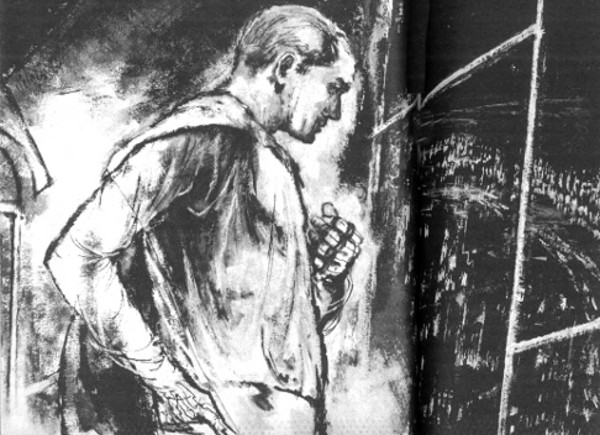
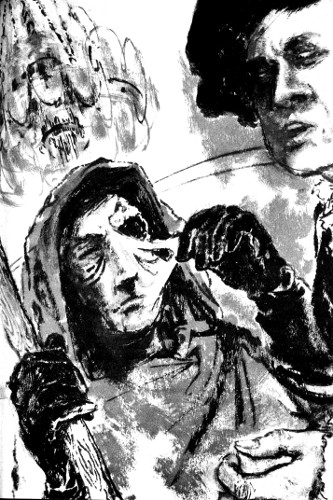
“The Gift” by Ray Bradbury – illustration Esquire Magazine, Dec. 1952

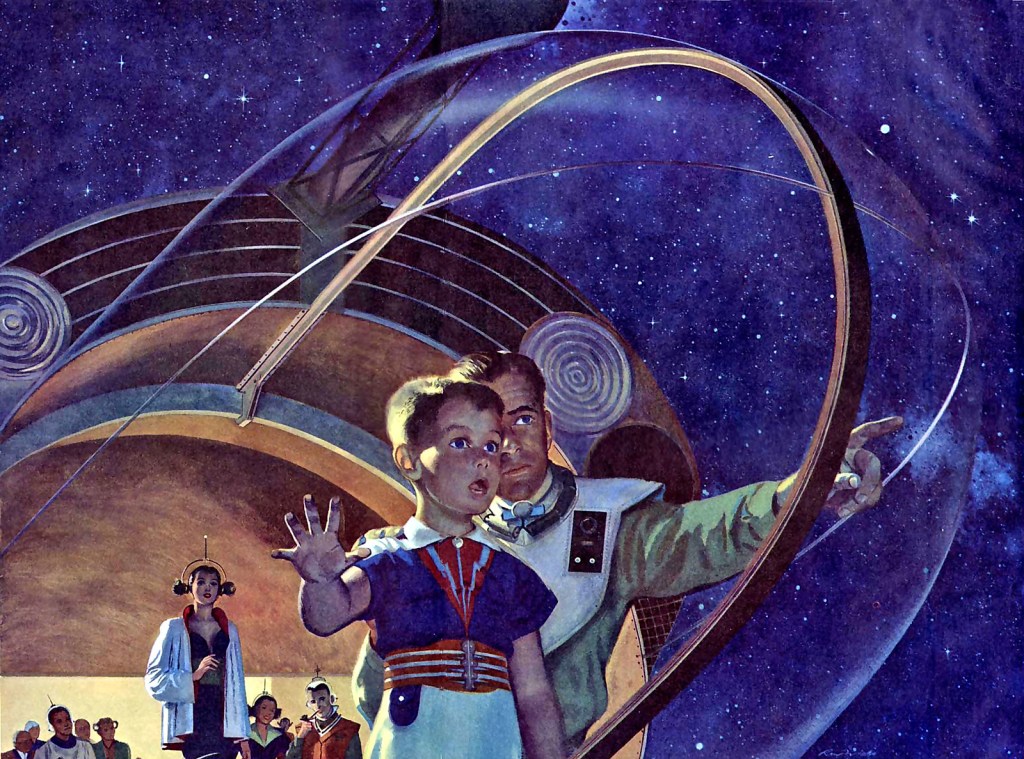
When I was young, science fiction was all about sense of wonder. This was back in the late 1950s and early 1960s. I didn’t even know the phrase science fiction – I was just mesmerized by the images of rockets and space travel. Science fiction was rare shows I’d stumbleupon on television. We think we can remember what it’s like to be a child, but we can’t because we have a lifetime of words and concepts that children don’t have. Remember when you thought you could fly?

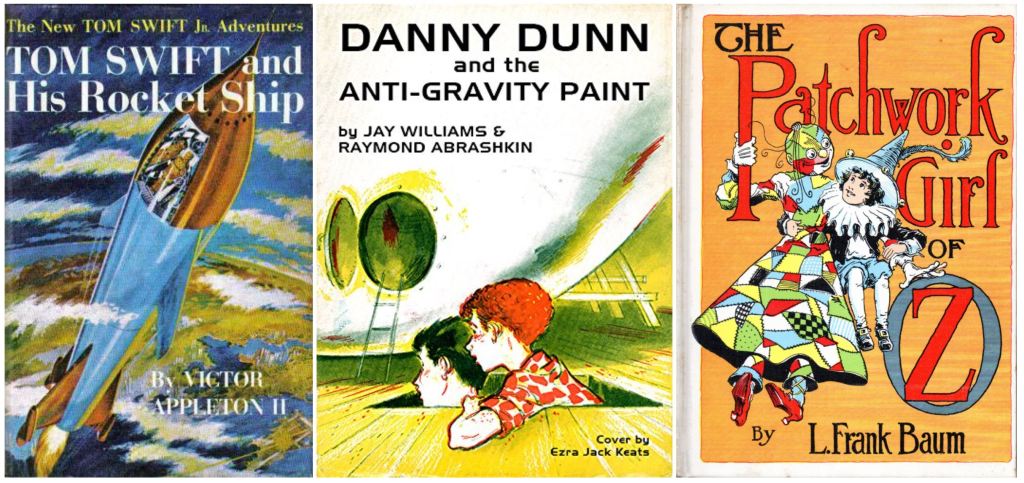
Then in 1961, when I was in the fifth grade I discovered Tom Swift Jr., Danny Dunn, and Oz books. This was just after the first Project Mercury mission. I also found nonfiction books about planes, rockets, and space, all at the Homestead Air Force Base Library. I knew more then, but didn’t really understand the concept of science. I recently read “People Soup” by Alan Arkin (yes, that Alan Arkin) in which he perfectly captured the attitude of ten-year-olds have towards science. Science and technology was magic that was real, and at ten I had unlimited faith in what science could do. So did Bob and Bonnie in Arkin’s story.

I’m not sure how aware of the world I was at age ten. I assume my vocabulary had grown since the late 1950s but was still quite small, and without the words to anchor ideas I’m not sure how much I could have understood conceptually about the science fiction I was consuming. Like I said, I didn’t even know that the fictional books, TV shows, and movies were even categorized by genre labels. Probably my awe and wonder was akin to ancient Greek children listening to the adventures of gods and goddesses. Isn’t it tragic that we believe the strongest in the fantasies we first encountered as children?

Then in the fall of 1964 I had an English teacher who gave me a recommended reading list. I was also taking science and math classes, and I loved reading popular science books. Still, I’m not sure how well I understood the concepts of science. That reading list included the writer Robert A. Heinlein, and I found his book Red Planet. I loved that novel and it inspired me to read astronomy books, especially books about Mars. It was then I knew I wanted to go to Mars in the same way Kip Russell wanted to go to the Moon in Have Space Suit-Will Travel.

By now I was in the eighth grade and my school was preparing us to think about the future of jobs, careers, and colleges. I knew immediately I wanted to become an astronaut. Within a year I had read most of what Heinlein had written, and his books were often inspirational about ambition, studying science, and space exploration. Then I read a career guide which gave the requirements for different kinds of jobs. I learned that astronauts needed 20-20 vision. I was devastated because I was a four-eyed nerd. After that I gave up considering careers and became a hedonist. I wished I had discovered computers back then, which is what I eventually got into. For the rest of junior and senior high I had to attend school, but I only applied myself at having fun – mostly reading science fiction and listening to rock and roll music. I did dabble in girls and drugs, but lacked talent to really pursue them properly.

For many years I just coasted. My parents were alcoholics and my family went through a long period of painful times. I used science fiction to ignore real life. Science fiction actually made me happy in a time when I should have been miserable. I’m quite thankful for that. Science fiction was a kind of virtual reality, one in which I escaped.

Then in the twelfth grade (1968/69) I took a creative writing course. I thought maybe I could become a professional science fiction writer. I wanted to be a prophet of space exploration, evening knowing I’d be like Moses and never reach the promised land. At the time I really thought the purpose of science fiction was to promote manned space travel. By then Star Trek mania had arrived and it seem to legitimize the idea that the final frontier was humanity’s destiny. Well, I believed it. I was quite naive and didn’t realize that the majority of population didn’t. Most SF fans and non-fans knew science fiction was merely entertainment.

I graduated high school just a couple months before the first Moon landing. If asked in the summer of 1969, I would have strongly predicted Americans would be on Mars by the 1980s, and humans would have explored most of the solar system by the year 2000. I hoped some kind of interstellar drive would be discovered and we’d be on to the stars before I died in the middle of the 21st-century. As we know I was as cracked as my crystal ball.

By the end of the 1970s I was married and working at a university that I’d stay at until I retired in 2013. For forty years I waited for us to go to Mars and we never did. Plenty of people wanted to go, but not enough to influence the politics involved. The will of the people never pushed for expanding into space. The high point of this period was Red Mars by Kim Stanley Robinson, and several other science fiction novels that tried to seriously imagine colonizing Mars. Then came Robert Zubrin’s nonfiction books, A Case for Mars. Our society had everything we needed to go to the red planet, we just didn’t want to go. I was a true believer in a religion that most people were atheists.

During the past 55 years I probably read close to two thousand science fiction books. I also read hundreds of popular science books. I slowly grew up and realized that space travel isn’t what I dreamed about as a kid. When I was young I would have sold my soul to become a space explorer. Now, you couldn’t pay me to go. Over the decades I slowly learned I didn’t have the right stuff, and never had. I hate being sick, and most people get space sick. I hate discomfort, and space travel is very uncomfortable. I won’t or can’t push myself to my limits. Even if they had allowed astronauts needing glasses back in the 1960s, I never could have gotten into the program. I’m a dreamer, not a doer.

Even though I came to realize I wasn’t suited for space travel, I still hoped that a branch of humanity would colonize the Moon and Mars, and eventually we’d find a way to the stars. Science fiction was still my religion. I put my faith in science fiction. I loved science fiction books that worked to imagine the full potential of the human race. By then I had given up on fun science fiction. I didn’t like Star Wars because it wasn’t realistic.

In the last ten years I’ve read many essays and books that suggest that human space exploration is probably not practical. To me, the most important science fiction novel of this era was Aurora by Kim Stanley Robinson. Robinson was one of a few science fiction writers who were considering the possibility we would never go to the stars. Oh, we’ll probably go to Mars someday. And we’ll develop bases on the Moon, but interstellar travel is about as likely as time travel. I’ve read many science books since 2000 that have added to the evidence against manned space travel.

If I tell young science fiction fans I don’t think it’s possible to go to the stars they get upset. The dream doesn’t die. Why? There’s something deep in that belief we don’t understand.

It’s not physically impossible to travel between the stars, but it’s just not probable or practical for humans. It might not even be practical for machines. My current science fiction faith is in artificial intelligence. Machines are perfect for space travel, but I’ve even begun to wonder if a superintelligent AI might find the distances too far to cross.

As my beliefs about science fiction grow more skeptical it’s became harder to enjoy science fiction. At least, enjoy it with the same attitude I had growing up. But I have a heavy science fiction habit. I know I need to either give up science fiction or find a new purpose for it.

After I discovered Audible.com in 2002, that purpose was nostalgia. I bought audiobook editions of all the science fiction books I loved reading during the previous forty years. I saw these stories in a new light. I was able to psychologically analyze my younger selves and realize a lifetime of delusional thinking.

I discovered science fiction had never been particularly serious to begin with. Sure, the final frontier true believers read science fiction, but most of them went on to become scientists and engineers. There was never much science to be learned in science fiction. If you really want humanity to explore space you need to become a rocket scientist or politician, not a science fiction fan or writer.

This brought about a new understanding of science fiction. It’s an art form. Sure, a rather minor art form. But I had invested a lifetime of studying this art and it was too late to take up another. My new attitude towards science fiction is studying its history. That makes me sometimes feels like an English major (which I was), and sometimes a scholar of religion or mythology. Other times, it feels like I’m an art historian. Science fiction writers craft stories, and a lot art and creativity goes into that craft.

My new attitude towards science fiction is admiring the craft of inventing science fictional ideas while embedding them into fiction. My reading has shifted away from novels. It just takes too much time to study novels, and there’s are too many SF novels to make a comprehensive study this late in life. I’ve found science fiction short stories to be just the right size to collect and analyze. I can read 300+ short stories a year. I have two bookcases of SF anthologies, mostly the annual best-of-the-year anthologies, but also lots of genre retrospective and theme anthologies. It’s a manageable amount of territory to explore, but I should probably specialize even more.

To get some idea of the scope of this microscopic patch of literary history read Mark R. Kelly’s site on SF anthologies. Now when I read a science fiction story I wonder how and why the author wrote it, and what readers could get out of it. I consider fiction a message in a bottle, from one lonely conscious mind to another. What are we really coding and decoding when we write and read science fiction?

I could live another ten, twenty, or even thirty years, although I tend to believe I’ll have a statistical average length of life. In any event, I might have enough time to change my mind one or more times about science fiction. I don’t think I can give it up. Years ago I saw a television news story about priests and preachers who have lost their faith. Many of them continued on in their jobs because it was too late to retrain. I’ve lost my faith in science fiction, but not my love. To keep that love going requires constantly repurposing my approach to the genre.

JWH