Ever Wonder Why You Read Science Fiction?

Angel's Egg by Edgar Pangborn

Ever psychoanalyze your own reading choices? Ever wonder about the unique appeal of science fiction? Ever wonder if your personal daydreams overlap with the authors’ own fantasies? Are stories just stories or do they the trigger synapses storing your hidden desires?

Every science fiction story has at least one weird idea in it. Some stories are subtle with one slight bit of strangeness. Others are overflowing with the fantastic. Each bit of added weirdness is like an ingredient in a recipe. Most of the ingredients are common off the science fiction spice rack. I’m developing a new theory. I’m realizing each writer brings their own special flavor of weirdness to the genre. Think about all your favorite science fiction writers, don’t their collective work leave a unique aftertaste in your mind? Just recall Philip K. Dick or Ursula K. Le Guin as examples.

To be completely holistic, we should consider our own weird interests and how we resonate with the pet themes of the writers. Most sense-of-wonder aspects of science fiction are not part of our everyday reality. What science fiction fans love are far-out concepts presented as mundane. We want reality to include our pet fantastic, weird, strange, and unbelievable concepts. If asked, we might say we’re only pretending, but I can’t help but believe that deep down we all want science fiction to come alive. And all of us are psychically drawn to our own hidden daydreams reflected in the fiction we read.

Maybe all readers are Walter Mittys, leaving writers to the hard work of generating fantasies. Books are VR machines powered by our own CPU-brains. If you start thinking about fiction this way, you become a connoisseur of hidden emotions.

I used to assume it was the science fictional tropes that shaped science fiction stories, the spaceship, the robot, the alien, but I’m now wondering if authors’ own inner obsessions and philosophies sculpt SF stories more, and the stories we love most are the ones that resonate with our own emotions. I’m even wondering if writers don’t go into science fiction because it offers the tools to promote their own weird hopes, desires, and fears better than any other literary form.

The story I’m going to discuss as my example is “Angel’s Egg” by Edgar Pangborn. Not because it’s special, but simply because it’s the last story I read and it’s stuck in my mind. “Angel’s Egg” was Pangborn’s first published science fiction story, appearing in the June 1951 issue of Galaxy Science Fiction. Since Galaxy began publishing in October 1950, Pangborn was essentially a new SF writer for a new SF magazine, and “Angel’s Egg” is different from the SF norm Astounding Science-Fiction had established. Times were changing. Although, I do wonder if Pangborn had submitted “Angel’s Egg” to John W. Campbell first? Was it a reject, or had Pangborn been inspired by the new magazine H. L. Gold was publishing? It actually feels more like an F&SF story, a magazine that launched in 1949.

Another part of the flavor of science fiction is where and when it’s published. “Angel’s Egg” presents a kind of weirdness for America in 1951. People were still freaking out over atomic bombs, plus the flying saucer craze was stirring up the crazies in the late 1940s. The early 1950s were a boom time for science fiction with dozens of magazines, new hardback publishers, TV shows and movies. America and the world feared total annihilation. Earthlings dreaded invasion by superior beings. We thought the human race was being judged and we all knew we weren’t going to pass the test.

Edgar Pangborn (1909-1976) got his first novel published in 1930, a mystery. His father and sister were also authors, and they all often wrote about the supernatural. All that went into the weird flavor of “Angel’s Egg.” If you follow the link you can read the story at Project Gutenberg. You can also read the story at the Internet Archive, in digital editions of the original June 1951 Galaxy Science Fiction magazine.

I wonder if H. L. Gold’s lead-in is how Gold really saw Pangborn’s story:

When adopting a pet, choose the species that
is most intelligent, obedient, loyal, fun to
play with, yet a shrewd, fearless protector.
For the best in pets—choose a human being!

If I had been Pangborn, I would have been pissed and insulted. Actually, I think it’s also insulting to the science fiction reader. Maybe “Angel’s Egg” was too weird for H. L. Gold, or maybe Gold just had a non-serious attitude towards science fiction. His mag was often filled with satire and humor. Yet, in some ways, it is hard to take Pangborn’s story seriously. “Angel’s Egg” is really about a savior from another world who asks one human to sacrifice life to save our species. That’s heavy. Pangborn is actually telling a spiritual story using the language of science fiction.

How serious should we take Pangborn? Is he inventing a weird story just to make a few bucks? How Freudian or Jungian is this story? Is “Angel’s Egg” a message from Pangborn’s unconscious mind about the state of humanity in 1951? If you haven’t read the story you have no idea what I’m talking about. I’ll try to include enough quotes to make sense, but you might want to read it first.

The story starts with a frame. A letter from an FBI agent to a local police captain who had asked the agency to investigate the death of a person named Dr. David Bannerman who died in 1951. Attached to the letter is a note from a librarian who found the letter in 1994. Included with the letter is Dr. Bannerman’s journal dated from June 1, 1951, to July 31, 1951.

The story is Bannerman’s journal extract. Writers use this kind of framework to give their tale a greater feel of authenticity. It’s also a trick to allow a first-person narrator to die in the story. Pangborn also wanted to use the first-person narrative to make the story feel as real as possible. But such techniques were also common in older, especially 19th-century science fiction. We know Pangborn came to science fiction rather late, so he might not have known the conventions of the genre.

How “Angel’s Egg” is told has a kind of archaic flavor that I enjoy. Pangborn leans toward the sentimental, more like Bradbury and Simak, his contemporaries. Here’s how the story begins and where the egg comes from in the title.

It must have been at least three weeks ago when we had that flying saucer flurry. Observers the other side of Katahdin saw it come down this side; observers this side saw it come down the other. Size anywhere from six inches to sixty feet in diameter (or was it cigar-shaped?) and speed whatever you please. Seem to recall that witnesses agreed on a rosy-pink light. There was the inevitable gobbledegookery of official explanation designed to leave everyone impressed, soothed and disappointed.

I paid scant attention to the excitement and less to the explanations—naturally, I thought it was just a flying saucer. But now Camilla has hatched out an angel.

I have eight hens, all yearlings except Camilla; this is her third spring. I boarded her two winters at my neighbor Steele's farm when I closed this shack and shuffled my chilly bones off to Florida, because even as a pullet she had a manner which overbore me. I could never have eaten Camilla. If she had looked at the ax with that same expression of rancid disapproval (and she would) I should have felt I was beheading a favorite aunt. Her only concession to sentiment is the annual rush of maternity to the brain—normal, for a case-hardened White Plymouth Rock.

This year she stole a nest successfully, in a tangle of blackberry. By the time I located it, I estimated I was about two weeks too late. I had to outwit her by watching from a window; she is far too acute to be openly trailed from feeding ground to nest. When I had bled and pruned my way to her hideout, she was sitting on nine eggs and hating my guts. They could not be fertile, since I keep no rooster, and I was about to rob her when I saw the ninth egg was not hers, nor any other chicken's.

Doesn’t this seem like a very strange way to begin a science fiction story? A mysterious ninth egg? Then Pangborn tells us:

That was ten days ago. I know I ought to have kept a record; I examined the blue egg every day, watching how some nameless life grew within it, until finally the angel chipped the shell deftly in two parts. This was evidently done with the aid of small horny out-growths on her elbows; these growths were sloughed off on the second day.

I wish I had seen her break the shell, but when I visited the blackberry tangle three days ago she was already out. She poked her exquisite head through Camilla's neck feather, smiled sleepily, and snuggled back into darkness to finish drying off. So what could I do, more than save the broken shell and wriggle my clumsy self out of there?

I had removed Camilla's own eggs the day before—Camilla was only moderately annoyed. I was nervous about disposing of them even though they were obviously Camilla's, but no harm was done. I cracked each one to be sure. Very frankly rotten eggs and nothing more.

In the evening of that day I thought of rats and weasels, as I should have earlier. I hastily prepared a box in the kitchen and brought the two in, the angel quiet in my closed hand. They are there now. I think they are comfortable.

Three days after hatching, the angel is the length of my fore-finger, say three inches tall, with about the relative proportions of a six-year-old girl. Except for head, hands, and probably the soles of her feet, she is clothed in feathery down the color of ivory. What can be seen of her skin is a glowing pink—I do mean glowing, like the inside of certain seashells. Just above the small of her back are two stubs which I take to be infantile wings. They do not suggest an extra pair of specialized forelimbs. I think they are wholly differentiated organs; perhaps they will be like the wings of an insect. Somehow I never thought of angels buzzing. Maybe she won't. I know very little about angels.

Angels? Really, in a science fiction story? Are we reading a tall tale, or is this science fiction? Where are the rockets and robots? Why does Pangborn couch his alien in religious garb?

I made no entry last night. The angel was talking to me, and when that was finished I drowsed off immediately on a cot which I have moved into the kitchen to be near them.

I had never been strongly impressed by the evidence for extrasensory perception. It is fortunate that my mind was able to accept the novelty, since to the angel it is clearly a matter of course. Her tiny mouth is most expressive, but moves only for that reason and for eating—not for speech. Probably she could speak to her own kind if she wished, but I dare say the sound would be above the range of my hearing as well as my understanding.

Last night after I brought the cot in and was about to finish my puttering bachelor supper, she climbed to the edge of the box and pointed, first at herself and then at the top of the kitchen table. Afraid to let my vast hand take hold of her, I held it out flat and she sat in my palm. Camilla was inclined to fuss, but the angel looked over her shoulder and Camilla subsided, watchful but no longer alarmed.

Now we have an angel that’s telepathic. What we quickly learn is the angel is really an alien from a very advanced civilization. But its physical form is more like Disney’s Tinkerbell than modern angels. In Biblical times angels were a non-human species that came from another realm to visit Earth. In modern times, angels are people who have died and gone to heaven. Why is Pangborn recasting a Biblical image?

Angel's Egg 2 by Edgar Pangborn

There is also a slight undercurrent of sexuality to Bannerman’s angel even though there is no possibility of sex. Bannerman is a lonely man, who is crippled from the war, living away from other people out in the country. The angel saves him.

I don’t know why Pangborn made his tiny alien into an angel. Maybe he considered an ordinary alien cruising around in a flying saucer too common and ugly. I’m also wondering if Pangborn has the same theory as I do, that science fiction is a modern replacement for religion? Instead of dying and going to heaven we build a rocket and fly up into the heavens to other planets and stars. Instead of God(s), we imagine super-intelligent aliens. Instead of being saved and given everlasting life, we develop scientific ways to achieve immortality. Instead of the power of prayer, we evolve telepathy.

Pangborn’s little alien with wings is really a wise being from an ancient civilization that wants to save humans from self-destruction. Her father and nine siblings came to Earth to uplift us. And she asks Bannerman to sacrifice himself to save all of us. This is a very Christian story. Pangborn’s second SF novel, A Mirror for Observers (1954) has pretty much the same theme. It won the International Fantasy Award in 1955. Pangborn isn’t well-remembered today, but he had a certain level of success in the 1950s and 1960s.

Reading “Angel’s Egg” and A Mirror for Observers are my only experiences with Edgar Pangborn’s work. I own three more of his novels, but they are unread. Yet, from this small sample, I detect a rather unique mind using science fiction for its philosophical purposes. I feel Pangborn yearning for humanity to be saved from itself, and that was a very common hope in science fiction of the 1940s and 1950s.

If you think about it, there are two ways to be saved. One is to be rescued, the other is to overcome. Christianity is all about being saved by a higher power. And it’s rather strange that so many science fiction stories in the 1940s and 1950s had humanity being rescued by a higher power, not God(s) but aliens. The most famous example is 2001: A Space Odyssey (1968) by Arthur C. Clarke. But that story is really a retelling and refinement of his 1953 novel Childhood’s End.

Personally, I don’t like the idea of humanity being rescued by outsiders. I’m a pull-yourself-up-by-your-bootstraps kind of guy. But after Hiroshima, many people felt humans were children with a dangerous toy they couldn’t handle. Remember the old film The Day the Earth Stood Still (1951)? It was saying we needed guardian robots. I admire the Prime Directive from Star Trek.

Pangborn imagines his aliens as gentle guiders of the uncivilized. But isn’t that still being uplifted? If we’re reshaped by an outside force are we really ourselves? I never understood the basic tenet of Christianity, that we should be forgiven of our sins. I believe we should overcome our sinful ways, not be saved.

You’d think I’d dislike this story because it conflicts with my personal philosophy. But I still loved “Angel’s Egg” even though it’s rather clunky with religious imaginary and I’m an atheist. Although I kept thinking of the little angel as a more sophisticated Tinkerbell. What I loved were Pangborn’s emotions. What I loved was Bannerman’s sacrifice and how it was made. But then memory is a pet theme of mine.

The angel offered him two choices.

I made plain that I would never willingly part company with her, which I am sure she already knew, and she gave me to understand that there are two alternatives for the remainder of my life. The choice, she says, is altogether mine, and I must take time to be sure of my decision.

I can live out my natural span, whatever it proves to be, and she will not leave me for long at any time. She will be there to advise, teach, help me in anything good I care to undertake. She says she would enjoy this; for some reason she is, as we'd say in our language, fond of me.

Lord, the books I could write! I fumble for words now, in the usual human way. Whatever I put on paper is a miserable fraction, of the potential; the words themselves are rarely the right ones. But under her guidance—

I could take a fair part in shaking the world. With words alone. I could preach to my own people. Before long, I would be heard.

I could study and explore. What small nibblings we have made at the sum of available knowledge! Suppose I brought in one leaf from outdoors, or one common little bug—in a few hours of studying it with her, I'd know more of my own specialty than a flood of the best textbooks could tell me.

She has also let me know that when she and those who came with her have learned a little more about humanity, it should be possible to improve my health greatly, and probably my life expectancy. I don't imagine my back could ever straighten, but she thinks the pain might be cleared away, entirely without drugs. I could have a clearer mind, in a body that would neither fail nor torment me.

I think this is the choice we’d all jump at. But Pangborn wants to give us a science-fictional Christ. I might need to remind you that Camilla was the hen who sat on the angel egg.

Then there is the other alternative.

It seems they have developed a technique by means of which any unresisting living subject, whose brain is capable of memory at all, can experience total recall. It is a by-product, I understand, of their silent speech, and a very recent one. They have practiced it for only a few thousand years, and since their own understanding of the phenomenon is very incomplete, they classify it among their experimental techniques.

In a general way, it may somewhat resemble that reliving of the past which psychoanalysis can sometimes bring about in a limited way for therapeutic purposes. But you must imagine that sort of thing tremendously magnified and clarified, capable of including every detail which has ever registered on the subject's brain.

The purpose is not therapeutic, as we would understand it; quite the opposite. The end result is—death.

Whatever is recalled, by this process is transmitted to the receiving mind, which can retain it, and record any or all of it, if such a record is desired; but to the subject who recalls, it is a flowing away, without return. Thus it is not a true "remembering," but a giving. The mind is swept clear, naked of all its past, and, along with memory, life withdraws also. Very quietly.

At the end, I suppose it must be like standing without resistance in the engulfment of a flood tide, until finally the waters close over.

That, it seems, is how Camilla's life was "saved." When I finally grasped that, I laughed, and the angel of course caught the reason. I was thinking about my neighbor Steele, who boarded Camilla for me in his henhouse for a couple of winters.

Somewhere safe in the angelic records there must be a hen's-eye image of the patch in the seat of Steele's pants. And naturally Camilla's view of me too; not too unkind, I hope. She couldn't help the expression on her rigid little face, and I don't believe it ever meant anything.

At the other end of the scale is the saved life of my angel's father. Recall can be a long process, she says, depending on the intricacy and richness of the mind recalling; and in all but the last stages it can be halted at will. Her father's recall was begun when they were still far out in space and he knew that he could not long survive the journey.

When that journey ended, the recall had progressed so far that very little actual memory remained to him of his life on that other planet. He had what must be called a deductive memory—from the material of the years not yet given away, he could reconstruct what must have been, and I assume the other adult who survived the passage must have been able to shelter him from errors that loss of memory might involve. This, I infer, is why he could not show me a two-moon night.

I forgot to ask her whether the images he did send me were from actual or deductive memory. Deductive, I think, for there was a certain dimness about them not present when my angel gives me a picture of something seen with her own eyes.

Jade-green eyes, by the way. Were you wondering?

In the same fashion, my own life could be saved. Every aspect of existence that I ever touched, that ever touched me, could be transmitted to some perfect record—the nature of the written record is beyond me, but I have no doubt of its relative perfection. Nothing important, good or bad, would be lost. And they need a knowledge of humanity, if they are to carry out whatever it is they have in mind.

It would be difficult, she tells me, and sometimes painful. Most of the effort would be hers, but some of it would have to be mine. In her period of infantile education, she elected what we should call zoology as her life work; for that reason she was given intensive theoretical training in this technique. Right now I guess she knows more than anyone else on this planet not only about what makes a hen tick, but how it feels to be a hen.

Though a beginner, she is in all essentials already an expert. She can help me, she thinks, if I choose this alternative. At any rate, she could ease me over the toughest spots, keep my courage from flagging.

For it seems that this process of recall is painful to an advanced intellect—without condescension, she calls us very advanced—because, while all pretense and self-delusion are stripped away, there remains conscience, still functioning by whatever standards of good and bad the individual has developed in his lifetime. Our present knowledge of our own motives is such a pathetically small beginning! Hardly stronger than an infant's first effort to focus his eyes.

Of course, we know which one Bannerman chooses.  The rest of his journal is about forgetting as his memories are peeled away. In some ways, this part of the story reminds me of Charlie Gorden from Flowers for Algernon when Charlie was on his decline.

I have read science fiction my whole life. Often just for escapism and entertainment, but I must admit I wished reality was different and sometimes science fiction reflected an alternate reality I preferred. Pangborn’s dream isn’t mine, but I feel great sympathy for him. His story draws me back to how some people felt during the year I was born.
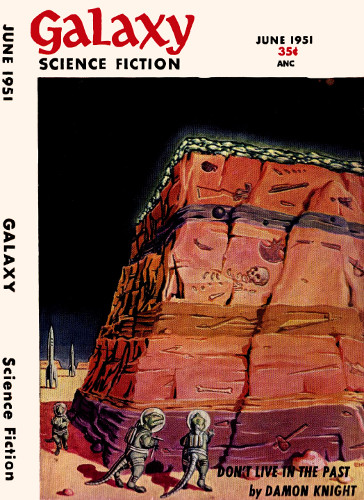
Galaxy June 1951

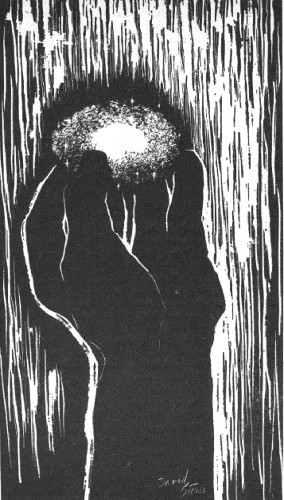
[The above illustrations are the ones that first appeared with the story in Galaxy Science Fiction.]

James Wallace Harris, 11/26/19
Chronology of Books About Science Fiction

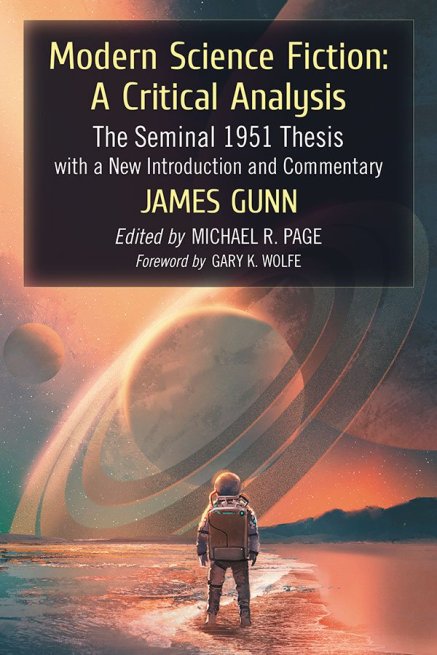
Modern Science Fiction by James Gunn

After reading Astounding: John W. Campbell, Isaac Asimov, Robert A. Heinlein, L. Ron Hubbard, and the Golden Age of Science Fiction (2018) by Alec Nevala-Lee I reread The World Beyond the Hill: Science Fiction and the Quest for Transcendence (1989) by Alexei and Cory Panshin. These two books form an interesting synergy. They are about science fiction’s Golden Age of the 1940s, written over a generation apart, that leaves two distinct impressions. After finishing the Panshins’ book I remembered that the blog MarzAat reviewed a master’s thesis on science fiction that James Gunn wrote back in 1951. I figured Modern Science Fiction: A Critical Analysis would be a third view of SF’s Golden Age of the 1940s, and it was. It’s also one of the earliest scholarly examinations of science fiction.

Gunn divides his book into two parts, one that focuses on the philosophy of science fiction, and the other on categorizing plots. I can only recommend this work to people like me who enjoy reading about the history of science fiction. I doubt Modern Science Fiction will appeal to average SF readers because of its academic nature. However, it is a unique early perspective on the genre. The Panshins’ book is a more compelling read because they tie everything together with a single theory. The Nevala-Lee book is more readable because biographies have a great common appeal.  Gunn writes an aerial overview and is a quick introduction to the genre at a time when few people knew it existed. I enjoyed it mostly for the stories Gunn picked to discuss. Often they were the same classics we remember today, but sometimes not.

I’ve now read five books that covered Astounding Science-Fiction in the 1940s – including A Requiem for Astounding by Alva Rogers and Astounding Days by Arthur C. Clarke that I read the year before last. I also read The Great SF Stories 1-12 (1939-1950) edited by Isaac Asimov and Martin H. Greenberg, so I’m familiar with many of the stories themselves. I’m slowly getting a feel for how science fiction developed chronologically. I’m currently reading short SF from 1951.

The one book I recommend for understanding the science fiction stories of the 1940s is The World Beyond the Hill by Alexei and Cory Panshin. It was quite insightful. I realized how we think of science fiction now, or even when I started reading it in the 1960s, is quite different from how writers and readers thought of it in the 1940s. The subtitle of his book is Science Fiction and the Quest for Transcendence and back then I believe science fiction was seeking transcendence that echoes the Transcendentalists of the 1850s. Science fiction from 1939-1949 had a kind of excitement like the counter-culture did in the 1960s.

There’s a reason why Campbell, van Vogt, and others went ga-ga for Dianetics, and Astounding couldn’t run enough ESP/psionics stories in the 1950s. James Gunn saw some of that too in his book, but he called it philosophical. We now pity Campbell and van Vogt being caught up in L. Ron Hubbard’s scam, but Dianetics and Scientology in the 1950s promised to give SF fans the transcendental uplift they dreamed of from reading science fiction in the 1940s. If this seems like a digression from the history of science fiction, it’s not. I believe studying science fiction as it evolved over time is rewarding. I wish the Panshins had written a comprehensive book about science fiction in the 1950s for me to read next. So far I can’t find anything like The World Beyond the Hill for that decade. I’m guessing science fiction changes every decade or with each new generation of readers. I believe my best bet for the 1950s is Transformations: The Story of the Science Fiction Magazines From 1950 to 1970 by Mike Ashley.

The long introduction by Modern Science Fiction’s editor Michael R. Page is a gem of an overview of books about science fiction. Page says Gunn’s 1951 book-length thesis is probably just the fourth book about science fiction after Pilgrims Through Space and Time (1947) by J. O. Bailey, The Imaginary Voyage in Prose Fiction (1941) by Philip Gove’s, and Voyages to the Moon (1948) by Marjorie Nicolson. The latter two were really about proto-SF, and Bailey’s book barely mentions the Golden Age. So Gunn’s book could be the first about Campbell’s Golden Age Astounding. It was written at a time when the non-SF-reading public was just learning the term science fiction, and Gunn spends part of his time introducing the genre. (See my essay “When Mainstream American Discovered Science Fiction.”  I reprint a Life Magazine article from 1951 telling its readers all about the world of science fiction and fandom.)

Because Page mentions so many books he considers carrying on Gunn’s work exploring science fiction I thought I’d list them as a checklist to acquire. I’ve owned and read many of them over the years, but I thought it would be nice to make this a chronological list to remember and share. I’m anxious to get into the 1950s and 1960s, after gorging on books about the 1940s.

Here are the books Page mentions. I’ve put a plus by the ones I’ve already read/own. Most cover more than one decade of SF history. Someone needs to write a history of the first decade of F&SF, Galaxy, and the big boom in science fiction. (Maybe Ashley’s has done just that.)

  • 1941 – The Imaginary Voyage in Prose Fiction by Philip Gove
  • 1947 + Pilgrims Through Space and Time by J. O. Bailey
  • 1947 – Of Worlds Beyond (symposium) edited by Lloyd Arthur Eschbach
  • 1948 – Voyages to the Moon by Marjorie Nicholson
  • 1951 + Modern Science Fiction by James Gunn (master’s thesis)
  • 1951 – Modern Science Fiction (essays) edited by Reginald Bretnor
  • 1955 – Inquiry into Science Fiction by Basil Davenport
  • 1956 + In Search of Wonder by Damon Knight
  • 1959 + The Science Fiction Novel (symposium)
  • 1960 + New Maps of Hell by Kingsley Amis
  • 1963 + Explorers of the Infinite by Sam Moskowitz
  • 1964 + The Issue at Hand by James Blish
  • 1966 + Future Perfect by H. Bruce Franklin
  • 1966 + In Search of Wonder by Damon Knight (expanded edition)
  • 1966 + Seekers of Tomorrow by Sam Moskowitz
  • 1966 – Voices Prophesying War by I. F. Clarke
  • 1967 – The Future as Nightmare by Hillegas
  • 1968 – Yesterday’s Tomorrows by Armytage
  • 1970 – Into the Unknown by Robert M. Philmus
  • 1970 + More Issues at Hand by James Blish
  • 1970 + The Universe Makers by Donald A. Wollheim
  • 1971 + SF: The Other Side of Realism (essays) edited by Thomas Clareson
  • 1971 + Science Fiction: What It’s All About by Sam Lundwall
  • 1973 + Billion Year Spree by Brian Aldiss and David Wingrove
  • 1974 – Science Fiction Reader’s Guide by L. David Allen
  • 1974 – New Worlds for Old by David Ketterer
  • 1975 + Alternate Worlds by James Gunn
  • 1976 + Anatomy of Wonder by Neil Barron
  • 1976 + A Pictorial History of Science Fiction by David Kyle
  • 1977 + The Creation of Tomorrow by Paul A. Carter
  • 1977 – Science Fiction: History, Science Fiction by Eric S. Rabkin
  • 1977 + The Jewel-Hinged Jaw by Samuel R. Delany
  • 1979 – The Pattern of Expectation 1644-2001 by I. F. Clarke
  • 1979 – Metamorphoses of Science Fiction by Darko Suvin
  • 1979 – The Known and the Unknown by Gary K. Wolfe
  • 1979 + The Science Fiction Encyclopedia by Peter Nichols and John Clute
  • 1979 + The World of Science Fiction by Lester del Rey
  • 1980 – Aliens and Linguists by Walter E. Meyer
  • 1980 – The Cybernetic Imagination in Science Fiction by Patricia Warrick
  • 1981 – Alien Encounters by Mark Rose
  • 1982 – Terminal Visions by W. Warren Wagar
  • 1985 – Scientific Romance in Britain 1890-1950 by Brian Stableford
  • 1986 + Trillion Year Spree by Brian Aldiss and David Wingrove
  • 1987 – Foundations of Science Fiction by J. J. Pierce
  • 1987 – Great Themes in Science Fiction by J. J. Pierce
  • 1989 – Rationalizing Genius by John Huntington
  • 1989 – When World Views Collide by J. J. Pierce
  • 1989 + The World Beyond the Hill by Alexei and Cory Panshin
  • 1990 – Understanding American Science Fiction 1926-1970 by Thomas Clareson
  • 1993 – The Magic that Works: John W. Campbell and the American Response to Technology by Albert I. Berger
  • 1994 – Odd Genre by J. J. Pierce
  • 1998 + The Mechanics of Wonder by Gary Westfahl
  • 2008 – The Seven Beauties of Science Fiction by Istvan Csciery-Ronay
  • 2012 – Astounding Wonder by John Cheng
  • 2017 – Science Fiction and the Mass Cultural Genre System by John Rieder

Books Page Didn’t Mention Which I Own:

  • 1964 + A Requiem for Astounding by Alva Rogers
  • 1975 + Hell’s Cartographers (essays) edited by Brian W. Aldiss, Harry Harrison
  • 1980 + SF in Dimension by Alexei and Cory Panshin (expanded edition)
  • 1982 + The Engines of the Night by Barry N. Malzberg
  • 1984 + Age of Wonders by David G. Hartwell
  • 1986 + Dimensions of Science Fiction by William Sims Bainbridge
  • 1986 + Galaxy Magazine by David L. Rosheim
  • 1999 + Back in the Spaceship Again by Karen Sands, Marietta Frank
  • 1999 + Pioneers of Wonder by Eric Leif Davin
  • 2000 + Critical Theory and Science Fiction by Carl Freedman
  • 2000 + The Time Machines by Mike Ashley
  • 2003 + The Cambridge Companion to Science Fiction (essays) edited by Edward James, Farah Mendlesohn
  • 2004 + The Gernsback Days by Mike Ashley, Robert A. W. Lowndes
  • 2005 + Different Engines by Mark L. Brake, Reverend Neil Hook
  • 2005 + On SF by Thomas M. Disch
  • 2005 + Transformations by Mike Ashley
  • 2007 + Gateways to Forever by Mike Ashley
  • 2007 + The Gospel According to Science Fiction by Gabriel McKee
  • 2009 + Science Fiction and Philosophy edited by Susan Schneider (essays)
  • 2014 + New Atlantis: v. 3: The Resurgence of Scientific Romance by Brian Stableford
  • 2014 + New Atlantis: v. 4: The Decadence of Scientific Romance by Brian Stableford
  • 2016 + The History of Science Fiction by Adam Roberts
  • 2016 + New Atlantis: v. 1: The Origins of Scientific Romance by Brian Stableford
  • 2016 + New Atlantis: v. 2: The Emergence of Scientific Romance by Brian Stableford

You’d think with so much written about science fiction it would be well defined with a precise well-interpreted history.

James Wallace Harris, 11/17/19

Why Swallow Even One Porcupine?


2019-Sep-Oct F&SF

In the Sept/Oct 2019 issue of The Magazine of Fantasy & Science Fiction science columnist Jerry Oltion wrote a piece called “Net Up or Net Down?” where he asks readers how scientifically accurate should science fiction stories be? For his first example, he uses The Martian by Andy Weir, which many readers consider good hard SF. The trouble is, the opening premise is not scientific at all. The story begins with a Martian lander taking off to avoid being blown over by a dust storm. But Oltion calculations predict the fastest recorded wind on Mars would feel like a 12mph breeze on Earth.

Now here’s the thing, I don’t know enough science in this situation to evaluate Oltion’s science. I wondered if gravity is 1/6th of that on Earth, does it mean things are easier to blow over? But then I remembered a 12mph breeze on Earth can make a kite fly, but not something metal like a garbage can. How many readers just accepted what Weir wrote as fact because it came from a science fiction story? Before science fiction became common, when it was considered trashy, kids would justify reading SF to their parents by claiming they learned science from reading science fiction. Does anyone really learn any kind of science from science fiction?

Oltion then mentions some other famous science fiction stories and their scientific problems. He goes on to say:

How scientifically accurate does a story have to be? Ever since Jules Verne, and probably before that, people have been arguing about that very question. Some people feel that the writer has to get every scientific detail correct or the story is flawed, while others feel that a writer can fudge a little for the sake of the story. A common rule of thumb is that the author gets one porcupine—i.e. the reader will swallow a porcupine for the sake of a good story, but they won’t swallow two.

But why should we have to swallow any porcupines? Why shouldn’t new science fiction stories be scientifically accurate as current scientific knowledge? I’m sure Weir could have found another reason to make Mark Watney a castaway on Mars.

It’s one thing to speculate beyond what science knows, but it’s another thing to ignore what it does.

Oltion also asks how we can love Star Wars which requires fans to swallow a pack of porcupines when we often reject other stories that are less fantastic as being unbelievable. His answer is we accept stories that have internal consistency. But I ask, why call that science fiction? Why not just call it fantasy? If we’re going to put science in the label, shouldn’t it mean something?

There is a story in this same issue, “Erase, Erase, Erase” by Elizabeth Bear that I find wonderful, compelling, and a great example of good writing. But it has neither fantasy or science fiction elements. It could have been published in a mundane literary magazine. I have no complaints that Bear’s story was published in F&SF, but that might not be true for everyone.

It feels like we’re reaching a stage where anything goes. In the SF/F genres, science fiction doesn’t have to be scientific, and fantasy doesn’t require fantasy. Of course, science fiction has never been scientific, even in the old days. Readers have been happily chowing down on porcupines forever and with great relish. Maybe I should just stop worrying about genre labels or literary standards. Stories are whatever we’re willing to read.

However, I think we all have our personal standards, they’re just not shared standards. Writers can write whatever they want and find an audience because readers are so different.

Personally, I want science fiction to be scientifically accurate to current science. That’s why I don’t enjoy space opera anymore, not with FTL ships. And the more I think about it, the more I doubt humans will ever colonize another world with an existing biosphere. As I become more skeptical about the science fiction I’ve consumed in the last 55 years, I’m thrilled when discovering science fiction that does feel realistic. I love it when a writer imagines something I think might be possible.

I guess I’m old and tired and I’ve had my fill of porcupines.

James Wallace Harris, 11/14/19


Does Science Fiction Have A Purpose?


1940-03 Astounding p122 bw

Norman Spinrad’s latest “On Books” column has caused some minor controversy, although I’m not sure why since everything in the column seems reasonable to me. Although I tend to like modern short science fiction more than he does. I do agree that the science fiction genre has been diluted with too much fantasy. I wish there were two completely separate genres. I’m also bothered by the fact that many younger readers don’t seem to distinguish between real science fiction and fantasy science fiction.

I found this statement by Spinrad the most interesting:

It tells us that fantasy has long since come to dominate SF. It tells us that many or perhaps even a majority of these SF writers do not have the education or indeed the inclination to learn the difference between science fiction and fantasy and to dish the result out to a populace that has more than enough confusion about the difference between reality and magic already.

It got me to thinking about the meaning of science fiction. To be able to distinguish science fiction from fantasy requires a precise definition of each. Too many have tried that for me to consider jumping into the fray. But I have thought of another angle of attack. What is the purpose of each?

Right now science fiction and fantasy seem to be fairy tales for older readers. And for these readers fantasy has a flavor of the past and science fiction has a flavor of the future. And if this is their sole purpose then it hardly matters if writers distinguish between the two. Especially if editors and readers are only looking for entertaining stories.

Since Spinrad is criticizing writers for not knowing the difference between science fiction and fantasy I must assume he believes there is a difference. I know I do, but are we deluding ourselves if no one else does?

There is an interesting aspect of this problem. The SF/F genre is the only genre where short fiction is thriving, still being bought by editors and read by readers. Would-be writers are attracted to its paying markets. What could be happening is hordes of writers looking to get published see this and have decided to its easier to get acceptance letters in our genre, and even get paid. They feel this market requires fantasy and science fiction elements in their stories so they add them. I’m guessing Spinrad feels these new writers don’t know the genre or its history and thus are just making stuff up that they believe is science fiction. Spinrad also feels they don’t know traditional storytelling techniques.

I’m an MFA dropout. Twenty years ago I took many creative writing courses and workshops but didn’t finish my degree. At the time my professors tried to steer us away from writing genre stories. The emphasis was on getting published in literary magazines. The MFA was a terminal degree for teaching in higher education, so the focus was on getting a job at a university. Being published in literary magazines counted towards an academic job. My courses promoted literary writing techniques, and these are different from genre story writing. I believe many SF/F writers in recent generations have taken MFA courses and that has influenced their writing style, and changed the genre.

There are practically no jobs for creative writing majors, even though the degree is promoted as a pathway into teaching. I’m guessing that’s why we’re seeing an influx of these writers into our genres. And for the most part, they didn’t grow up reading science fiction and fantasy magazines. However, that’s not their fault. Nor do I have any problem with them using our genre as an outlet for their creative hopes.

However, should science fiction be anything people want to write and call science fiction, or should it have a purpose? In 2004 DARPA created the Grand Challenge offering a million-dollar prize for the first autonomous vehicle to travel its predefined course. That was a very definite purpose. Science fiction doesn’t have such a highly focused purpose like DARPA’s, but does it at least have a vague purpose? One that goes beyond fairy tales for grown-ups.

I believe H. G. Wells, Hugo Gernsback, John W. Campbell, and Robert A. Heinlein felt it did. Yet, describing that purpose is as difficult as defining science fiction. Science has the job of describing reality. But the term “science fiction” isn’t storytelling about describing reality. Ironically, that job belongs to literary fiction. Science fiction has taken on the job of trying to describe what science cannot yet describe but should eventually. To confuse the issue science fiction often speculates about possibilities that turn out to be impossible. Science fiction’s apparent purpose to explore territory science hasn’t but hopefully will. Fantasy doesn’t even go near this territory, nor does it try.

Good science fiction should be a cognitive tool for philosophically guessing what we might find in reality. Science fiction is fictionalized thought experiments. Whether science fiction is told using old-fashioned storytelling structures, or in newer MFA literary styles doesn’t matter. The real purpose of science fiction is to present philosophical insights into the event horizon between what is known and what is not.

The trouble is most “science fiction” writers, past or present, have taken these speculations and created fun fantasies. Star Wars is the perfect example. Star Wars has no extrapolation or speculation. Basically, Star Wars borrowed most of its themes and icons from Isaac Asimov, ones Asimov first created for speculative SF. Star Wars turned real science fiction into Disneyland fun science fiction. And there’s nothing wrong with that. It has a different purpose.

Part of the problem Spinrad complains about regarding not distinguishing science fiction from fantasy is most science fiction readers who read only fiction marketed as science fiction can’t distinguish serious science fiction from fun science fiction. There’s nothing wrong with fantasy. Anything that calls itself fantasy isn’t even part of this discussion. I am not worried that fantasy sells more than science fiction. It does bother me a little that fantasy is shelved with science fiction, but that’s only an inconvenience. It is more annoying that some magazines and anthologies want to package them together, so half the content I purchase isn’t wanted. But my real problem, and I think Spinrads’s too, is serious science fiction is being rejected by society totally embracing fun science fiction.

For most of its history, science fiction has had the reputation of being that silly Buck Rogers stuff. There were a few writers and editors that wanted science fiction to have more validity. Even today there are writers that use both science fiction and fantasy to express serious philosophical insights and worries. What’s even more ironic, is real serious science fiction often gets stripped of its label science fiction and reclassified at literature, such as Brave New World, Nineteen Eighty-Four, Slaughterhouse-Five, The Handmaid’s Tale, and so on. Writers like Kurt Vonnegut and Harlan Ellison escaped the whole problem of defining science fiction by rejecting the label completely.

Like I said earlier, Spinrad and I might be suffering from a delusion, and so were Wells, Gernsback, Campbell, and Heinlein. That’s one reason why I’m reading and researching old science fiction. Were these guys on to something, or were they crazy, or boosting their egos with fantasies of self-importance? Alec Nevala-Lee’s book Astounding suggests they were egomaniacs using science fiction to make their lives significant. But I don’t know. In all those old pulp stories there’s a glint of gold. Was it fools gold or the real gold?

James Wallace Harris, 11/6/19


Heinlein’s Magazine Fiction

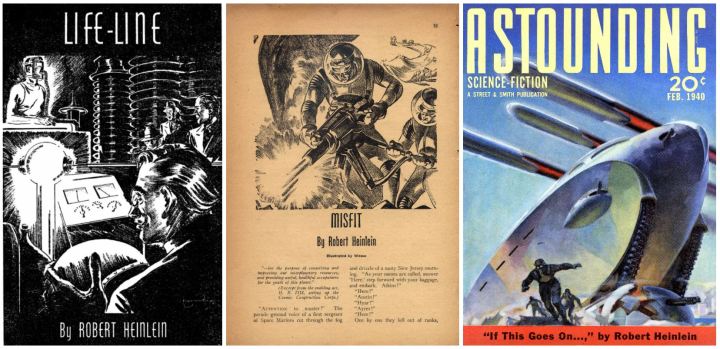
Heinlein first stories

I’m rereading The World Beyond the Hill (1989) by Alexei and Cory Panshin. It’s a brilliant, Hugo award-winning work (1990), that chronicles the Golden Age of Astounding Science-Fiction by focusing on John W. Campbell, Robert A. Heinlein, Isaac Asimov, and A. E. Van Vogt. If that sounds similar to Alec Nevala-Lee’s recent Hugo award-nominated book Astounding you’d be right. But each book tells a very different story covering the same history. Nevala-Lee felt L. Ron Hubbard was the big fourth rather than Van Vogt. The Panshins work to explain science fiction’s literary evolution in a historical context leaving you feeling their book is primary about science fiction. Whereas Nevala-Lee works to describe the psychology of the men who wrote this science fiction, leaving you feeling its a biography of these men. You need to read both books to get the big picture.

I’ve been a Heinlein fan since I was 12, but mostly for the work he wrote in the 1950s. Rereading The World Beyond the Hill inspires me to study Heinlein’s stories from the 1940s. The Panshins often point out there were contextual differences between the magazine publications and book publications, sometimes reflecting changes in Heinlein’s personal philosophy. The Panshins make a great case that Heinlein was doing truly groundbreaking SF writing in the 1940s that reshaped the genre. And they explain how John W. Campbell worked with Heinlein, Asimov, and Van Vogt to push science fiction in new directions.

I worry that the current attacks on Campbell’s many faults forget to consider his virtues. I believe anyone who vilifies Campbell because of the Nevala-Lee’s book should also give Campbell a fair shake by reading The World Beyond the Hill. I’m less concerned with the biographies of these men than how science fiction developed. After I finish rereading The World Beyond the Hill I plan to read The Pleasant Profession of Robert A. Heinlein by Farah Mendlesohn.

The Panshins made a great case for how exciting science fiction was during the early years of Campbell’s editorship, especially regarding Heinlein. Their descriptions of Heinlein’s early stories reveal far more than I got when I read them. I’ve decided they deserve a close rereading.

The Panshins quote from Heinlein’s July 1941 Guest of Honor speech at the third Worldcon in Denver:

There won’t always be an England—nor a Germany, nor a United States, nor a Baptist Church, nor monogamy, nor the Democratic Party, nor the modesty tabu, nor the superiority of the white race, nor aeroplanes—they will go—nor automobiles—they’ll be gone, we’ll see them go. Any custom, technique, institution, belief, or social structure that we see around us today will change, will pass, and most of them we will see change and pass.

Heinlein worked to illustrate that in his early stories, especially the ones he called Future History stories. Later on Heinlein would admit his particular extrapolations were wrong, but I believe the essence of science fiction is the attempt to imagine such change.

As I read these books about Heinlein I want to study his development by rereading the stories as they were published. I looked around for a convenient list of them in chronological order but didn’t find any that I liked. So I made one.

Just looking at this list shows how productive Heinlein was in the 1940s, especially 1941.

Story Issue Magazine
“Life-Line” 1939-08 Astounding
“Misfit” 1939-11 Astounding
“Requiem” 1940-01 Astounding
“If This Goes On –” p1 1940-02 Astounding
“If This Goes On –” p2 1940-03 Astounding
“Successful Operation” 1940-Spring Futuria Fantasia as “Heil!”
“Let There Be Light” 1940-05 Super Science Stories
“The Roads Must Roll” 1940-06 Astounding
“Coventry” 1940-07 Astounding
“Blow-Ups Happen” 1940-09 Astounding
“Magic, Inc.” 1940-09 Unknown
“Sixth Column” p1 1941-01 Astounding
“Sixth Column” p2 1941-02 Astounding
“Sixth Column” p3 1941-03 Astounding
“–And He Built a Crooked House” 1941-02 Astounding
“Logic of Empire” 1941-03 Astounding
“Beyond Doubt” 1941-04 Astonishing Stories
“They” 1941-04 Unknown
“Solution Unsatisfactory” 1941-05 Astounding
“Universe” 1941-05 Astounding
“–We Also Walk Dogs” 1941-07 Astounding
“Methuselah’s Children” p1 1941-07 Astounding
“Methuselah’s Children” p2 1941-08 Astounding
“Methuselah’s Children” p3 1941-09 Astounding
“Lost Legacy” (excerpt) 1941-08 Super Science Novels Magazine
“Elsewhen” 1941-09 Astounding
“By His Bootstraps” 1941-10 Astounding
“Common Sense” 1941-10 Astounding
“Lost Legacy” 1941-11 Super Science Stories
“My Object All Sublime” 1942-02 Future combined with Science Fiction
“Goldfish Bowl” 1942-03 Astounding
“Pied Piper” 1942-03 Astonishing Stories
“Beyond This Horizon” p1 1942-04 Astounding
“Beyond This Horizon” p2 1942-05 Astounding
“Waldo” 1942-08 Astounding
“The Unpleasant Profession of Jonathan Hoag 1942-10 Unknown Worlds
“The Green Hills of Earth” 1947-02-08 Saturday Evening Post
“Space Jockey” 1947-04-26 Saturday Evening Post
“Columbus Was a Dope” 1947-05 Startling Stories
“It’s Great to Be Back” 1947-07-26 Saturday Evening Post
“Jerry Was a Man” 1947-10 Thrilling Wonder Stories
“Water is for Washing” 1947-11 Argosy
“The Black Pits of Luna” 1948-01-10 Saturday Evening Post
“Gentlemen, Be Seated” 1948-05 Argosy Magazine
“Ordeal in Space” 1948-05 Town & Country
“Our Fair City” 1949-01 Weird Tales
“Nothing Ever Happens on the Moon” p1 1949-04 Boy’s Life
“Nothing Ever Happens on the Moon” p2 1949-05 Boy’s Life
“Gulf” p1 1949-11 Astounding
“Gulf” p2 1949-12 Astounding
“Delilah and the Space-Rigger” 1949-12 The Blue Book
“The Long Watch” 1949-12 The American Legion Magazine
“Farmer in the Sky” p1 1950-08 Boy’s Life
“Farmer in the Sky” p2 1950-09 Boy’s Life
“Farmer in the Sky” p3 1950-10 Boy’s Life
“Farmer in the Sky” p4 1950-11 Boy’s Life
“Between Planets” p1 1951-09 The Blue Book
“Between Planets” p2 1951-10 The Blue Book
“The Puppet Masters” p1 1951-09 Galaxy
“The Puppet Masters” p2 1951-10 Galaxy
“The Puppet Masters” p3 1951-11 Galaxy
“The Year of the Jackpot” 1952-03 Galaxy
“The Rolling Stones” p1 1952-09 Boy’s Life as “Tramp Space Ship”
“The Rolling Stones” p2 1952-10 Boy’s Life as “Tramp Space Ship”
“The Rolling Stones” p3 1952-11 Boy’s Life as “Tramp Space Ship”
“Project Nightmare” 1953-04/05 Amazing Stories
“Sky Lift” 1953-11 Imagination
“The Star Beast” p1 1954-05 F&SF
“The Star Beast” p2 1954-06 F&SF
“The Star Beast” p3 1954-07 F&SF
“Double Star” p1 1956-02 Astounding
“Double Star” p2 1956-03 Astounding
“Double Star” p3 1956-04 Astounding
“The Door Into Summer” p1 1956-10 F&SF
“The Door Into Summer” p2 1956-11 F&SF
“The Door Into Summer” p3 1956-12 F&SF
“The Menace from Earth” 1957-08 F&SF
“Citizen of the Galaxy” p1 1957-09 Astounding
“Citizen of the Galaxy” p2 1957-10 Astounding
“Citizen of the Galaxy” p3 1957-11 Astounding
“Citizen of the Galaxy” p4 1957-12 Astounding
“The Man Who Traveled in Elephants” 1957-10 Saturn
“Tenderfoot in Space” p1 1958-05 Boy’s Life
“Tenderfoot in Space” p2 1958-06 Boy’s Life
“Tenderfoot in Space” p3 1958-07 Boy’s Life
“Have Space Suit-Will Travel” p1 1958-08 F&SF
“Have Space Suit-Will Travel” p2 1958-09 F&SF
“Have Space Suit-Will Travel” p3 1958-10 F&SF
“All You Zombies …” 1959-03 F&SF
“Starship Troopers” p1 1959-10 F&SF
“Starship Troopers” p2 1959-11 F&SF
“Podkayne of Mars” p1 1962-11 If
“Podkayne of Mars” p2 1963-01 If
“Glory Road” p1 1963-07 F&SF
“Glory Road” p2 1963-08 F&SF
“Farnham’s Freehold” p1 1964-07 If
“Farnham’s Freehold” p2 1964-08 If
“Farmham’s Freehold” p3 1964-10 If
“The Moon is a Harsh Mistress” p1 1965-12 If
“The Moon is a Harsh Mistress” p2 1966-01 If
“The Moon is a Harsh Mistress” p3 1966-02 If
“The Moon is a Harsh Mistress” p4 1966-03 If
“The Moon is a Harsh Mistress” p5 1966-04 If
“I Will Fear No Evil” p1 1970-07 Galaxy
“I Will Fear No Evil” p2 1970-08/09 Galaxy
“I Will Fear No Evil” p3 1970-10/11 Galaxy
“I Will Fear No Evil” p4 1970-12 Galaxy

James Wallace Harris, 11/5/19